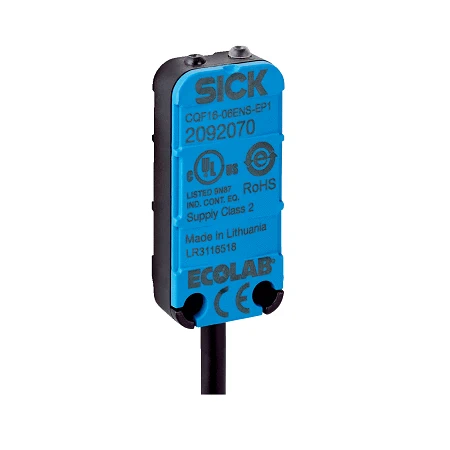
1. Requesting replenishment of a water-based adhesive reservoir
A carton-gluing station can mount the sensor outside a plastic adhesive reservoir at its replenishment point. The water-based adhesive must stay within the specified conductivity limit and wall thickness range. Full or empty teach-in adapts the threshold, and the PNP NO output gives the controller a discrete indication as the adhesive surface passes the monitored height.
Problem Solved
The low-level event gives the packaging controller a replenishment cue before the monitored adhesive reserve is exhausted, helping coordinate refilling without a probe inside the reservoir.
Adhesive reserve
External teach-in
PNP NO
2. Starting a condensate collection drain cycle
A condensate collection vessel can place the sensor at the level where a drain cycle should begin. Through-wall capacitive detection monitors water-based liquid without opening the nonmetal vessel. The controller reads the PNP NO output and applies its drain sequence, while full or empty teaching accounts for the actual wall and expected moisture or deposits.
Problem Solved
A high-level event gives the controller a defined trigger for condensate removal, reducing dependence on timed draining when the rate of liquid accumulation varies during machine operation.
Condensate collection
Drain trigger
Media compensation
3. Checking liquid arrival in a nonmetal transfer pipe
A transfer system can fasten the supplied bracket beside a suitable plastic or glass pipe and teach the sensor for the actual water-based liquid. The pipe diameter and wall thickness must meet the documented limits. The PNP NO switching event identifies local liquid presence during a priming sequence, with 10 Hz switching defining the event-rate limit.
Problem Solved
A local liquid-arrival event gives the controller a reference during line priming, helping distinguish a filled monitored pipe section from an empty section without a wetted contact probe.
Pipe priming
Local liquid arrival
10 Hz