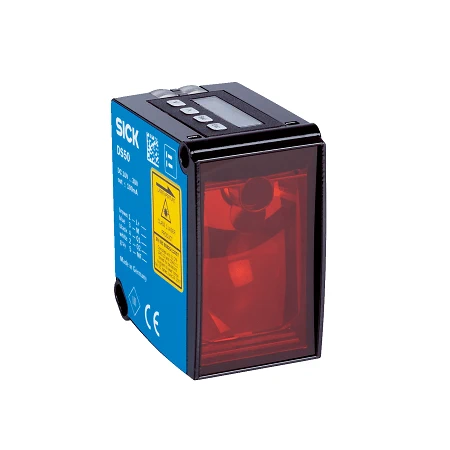
Technical Overview
The SICK DT50-N2113 measures distance to natural objects using a class 2 red time-of-flight laser. Range is 200–20,000 mm at 90% remission, 200–8,500 mm at 18% remission and 200–5,000 mm at 6% remission. One NPN switching output and one 4–20 mA analog output support external machine control. The analog signal has 16-bit output resolution,with teach-in,scaling and inversion. Fast,medium and slow averaging give specified15/30/80 ms lateral-entry response;output time is≥2 ms for continuous distance change. A multifunction input supports laser-off or external teach. The IP65 zinc-diecast sensor has an LC display,two LEDs and an M12 five-pin connector,with warm-up up to fifteen minutes.
Target-dependent200–20,000 mm distance sensor with one NPN output,one4–20 mA output,16-bit analog-output resolution and three averaging settings.
Key Features
- 200–20,000 mm at90% remission;200–8,500 mm at18%;200–5,000 mm at6%
- 658 nm class2 red laser;typical15 ×15 mm spot at10 m
- One NPN digital output;maximum current≤100 mA
- One 4–20 mA analog output;load≤300 Ω;16-bit output resolution
- Teach-in,scaling and inversion of analog/digital outputs
- Fast/medium/slow averaging;15/30/80 ms lateral-entry response
- Output time≥2 ms for continuous distance change
- Distance-to-object switching;10–1,000 mm hysteresis;laser-off/teach input
- LC display,two LEDs and M12 five-pin male connector
- IP65 zinc-diecast housing;−30 to+65 °C operation;warm-up≤15 min
Send a distance-related analog signal and a taught switching condition to external machine control,with target remission and electrical loads checked for the installation.
Technical Specification Matrix
| Parameter | Value |
|---|
| Functional principle | Time-of-flight laser distance evaluation |
| Target | Natural objects |
| Measuring range | 200–20,000 mm at90% remission;200–8,500 mm at18%;200–5,000 mm at6% |
| Repeatability | ≥1 mm;1σ;6–90% remission;depends on fast/medium/slow averaging |
| Averaging | Fast,medium or slow |
| Response time | 15/30/80 ms,depending on fast/medium/slow averaging;lateral object entry |
| Light source | Visible red laser;658 nm |
| Laser class | 2;IEC60825-1:2014 and EN60825-1:2014 |
| Laser pulse figures | Maximum output180 mW;pulse5 ns;duty cycle1/200 |
| Laser handling | Do not intentionally look into the beam or point it at eyes |
| Typical light spot | 15 ×15 mm at10 m |
| Average laser service life | 100,000 h at25 °C |
| Digital outputs | 1 ×NPN;maximum output current≤100 mA;short-circuit protected |
| Switching modes | Distance to object(DtO) |
| Output adjustment | Teach-in,scaling and inversion of digital and analog outputs |
| Hysteresis | 10–1,000 mm |
| Multifunction input | Laser off,external teach or deactivated;input response≤15 ms |
| Other functions | Switch-off display,reset,lock user interface |
| Power supply | 10–30 V DC;limit values;reverse-polarity protected |
| Supply network requirement | Short-circuit protected network,max8 A |
| Power consumption | ≤2.1 W without load |
| Supply ripple | ≤5 Vpp;must remain within supply limits |
| Initialization time | ≤250 ms |
| Warm-up time | ≤15 min |
| Indicators and display | LC display and2LEDs |
| Connection | M12 five-pin male connector |
| Pin assignment | 1BN=L+;3BU=M;4BK=Q digital;2WH=QA analog;5GY=MF |
| Housing material | Zinc diecast |
| Window material | PMMA plastic |
| IP rating | IP65 |
| Protection class | III |
| Operating temperature | −30 to+65 °C |
| Storage temperature | −40 to+75 °C |
| Relative humidity | ≤95%;non-condensing |
| Ambient light immunity | Typical40,000 lx |
| Vibration resistance | EN60068-2-6 and EN60068-2-64 |
| Shock resistance | EN60068-2-27 |
| MTTFD | 101 years |
| DCavg | 0% |
| Physical Weight (kg) | 0.2 |
| Dimensions L x W x H (cm) | 5.77 x 3.61 x 7.27 |
| Resolution | 1,000 µm |
| Measurement accuracy | ±7 mm at90% remission |
| Analog output | 1 ×4–20 mA;load≤300 Ω |
| Analog-output resolution | 16 bit |
| Output time | ≥2 ms;continuous change of distance |
Industrial Applications
1. Following a container surface level
A container can present a sufficiently reflecting material surface inside the remission-dependent range and use the 4–20 mA output as a distance reference for external level control. The controller derives level from the installed geometry and taught analog span. Actual surface return,averaging,warm-up and theload≤300 Ω receiving input are checked before selecting process thresholds.
Problem Solved
An analog surface-distance value lets external process control follow changing fill level across a taught span,supplying information for replenishment or filling decisions between fixed switching events.
Level trend
Analog distance
External geometry
2. Estimating roll size from its outer surface
A roll station can aim the sensor at the outer material surface and send the selected 4–20 mA signal to external evaluation. With the roll axis and sensor reference fixed,the controller derives a roll-size estimate from measured distance. The actual surface remission determines usable range,and averaging is selected after checking the rotating material return and required response.
Problem Solved
A distance-derived roll-size estimate gives external unwind or rewind control a changing material reference,helping it follow consumption or build-up beyond a single fixed end-of-roll threshold.
Roll surface
External calculation
Averaging
3. Combining position feedback with a switching condition
A moving machine assembly can present a natural target within the appropriate remission-dependent range. The analog output passes distance information to an external positioning controller,while the single NPN output reports a taught distance condition for sequence coordination. The controller implements correction;the actual target,receiving load,≥2 ms output-time bound and selected averaging are validated for the intended movement.
Problem Solved
Providing analog distance information alongside a taught switching event lets external control follow position continuously and coordinate a selected sequence condition from the same measured target reference.
Position feedback
Switching event
External control