1. Local Inert-Gas Regulator Adjustment
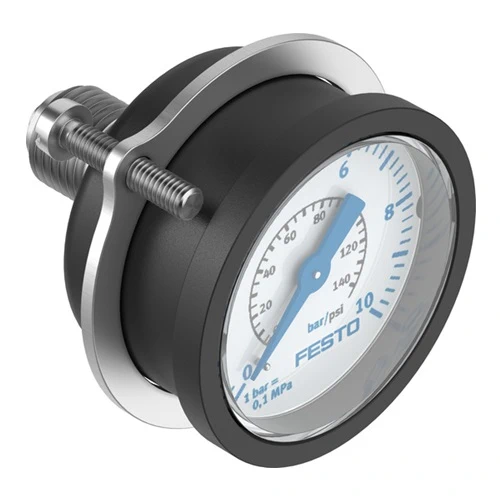
A production workstation sets an inert-gas regulator before a process run. Connected through the centred rear G1/4 interface, the gauge provides a local 0–10 bar reading while the operator adjusts the regulator. Its Bourdon-tube mechanism presents pressure directly at the installation, and accuracy class 2.5 defines the instrument's indication class for the task.
Problem Solved
Direct local indication gives the operator pressure feedback while adjusting an inert-gas regulator, avoiding reliance on an unobserved regulator position as the process setting.
0–10 bar
Inert gas
G1/4 rear connection
2. Panel Indication of Neutral-Fluid Line Pressure
A machine transferring a neutral fluid needs a pressure reading visible at its operator panel during startup and inspection. The gauge is specified for neutral fluids, with brass wetted components and a 0–10 bar operating range. Front-panel mounting positions the dual-scale dial for observation, while the centred rear G1/4 connection routes the pressure line behind the panel.
Problem Solved
Front-panel installation places the fluid-line pressure reading at the operator interface, while the rear connection keeps the process-pressure tubing behind the panel rather than across its face.
Neutral fluids
Brass wetted parts
−20 to +60 °C media
3. Commissioning with Bar and Psi Documentation
An equipment commissioning team works with a machine specification written in bar and a customer procedure written in psi. The gauge's outer bar scale and inner psi scale provide both readings on the same instrument. This supports comparing the observed pressure with either document at the measurement point without repeatedly converting a single-unit dial reading.
Problem Solved
Two pressure scales let technicians relate one local measurement to bar-based and psi-based procedures, reducing the need for a separate unit-conversion step during commissioning.
Outer bar scale
Inner psi scale
EN 837-1