1. Slowing a Cylinder near a Working Position
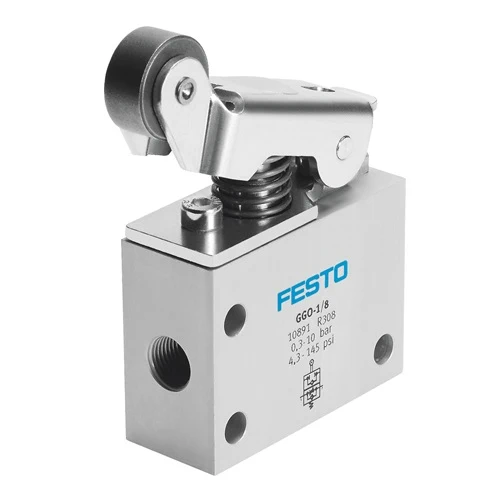
A pneumatic cylinder approaches a working position where the machine needs a lower movement speed than during the initial travel. A cam engages the roller lever as the mechanism advances, progressively restricting the controlled air passage. The initial-flow screw sets the starting condition, while the cam geometry determines how restriction changes over the remaining actuation travel.
Problem Solved
Mechanical position changes the flow restriction during the stroke, providing a direct way to moderate approach motion through the cam and roller relationship rather than a fixed restriction alone.
Roller-lever actuation
Progressive restriction
Initial flow adjustment
2. Free Return after a Restricted Working Stroke
A reciprocating mechanism needs restricted flow during its working movement but a less restricted reverse path during return. The GGO combines the mechanically controlled passage with a check-valve path that remains available independently of roller position. Its exact nominal ratings distinguish 950 l/min controlled-direction flow from 1150 l/min reverse-direction flow for assessing the two operating phases.
Problem Solved
The check-valve path separates reverse flow from the roller-controlled restriction, allowing the return circuit to use its documented reverse-flow characteristic even while the lever remains actuated.
One-way flow control
1150 l/min reverse
Lever-independent return
3. Cam-Defined Speed Change during a Feed Movement
A machine feed mechanism needs its pneumatic flow setting to change along a defined portion of travel. The manufacturer describes continuously variable restriction through a shaped cam or control rail acting on the roller lever. Through-hole mounting places the valve relative to that cam, while the 0.03–8 bar operating range and G1/4 connections define its pneumatic installation envelope.
Problem Solved
A shaped mechanical control profile links flow variation to mechanism position, providing a repeatable physical relationship for the feed sequence without requiring an electrical proportional command.
Cam-controlled flow
G1/4
0.03–8 bar