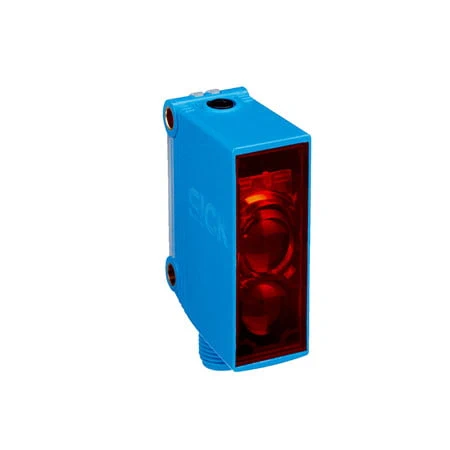
SICK 1065883 GL10-N4111 NPN Retro-Reflective Sensor

USD 57.20

GL10-N4111 provides up to 12 m sensing with PL80A, NPN output, 1,000 Hz switching and an M12 4-pin connector in an IP67 housing.

SKU SICK-1065883 Category
SICK G10

SICK GL10-N4111 NPN Retro-Reflective Sensor

BrandSICK
Model IdentifierGL10-N4111
Official Part Number1065883

Technical Overview

The SICK GL10-N4111 is a retro-reflective photoelectric sensor with an NPN output and a visible red PinPoint LED. A passive reflector returns the transmitted beam to the receiver, and an opaque target is detected when it interrupts that path. The specified sensing range is 0.15–12 m with a PL80A reflector or 0.15–10 m with a P250; maximum ranges are 15 m and 12 m respectively. The dual-lens optics require a minimum reflector distance and provide no sensitivity adjustment. Selectable light/dark switching, a response of no more than 500 µs, 1,000 Hz operation, an M12 4-pin connector and IP67 housing support conveyor integration.

NPN retro-reflective sensor with 12 m sensing range using PL80A, 1,000 Hz switching, M12 4-pin connector and IP67 housing.

Key Features

  • Retro-reflective detection with dual-lens optics
  • 0.15–12 m sensing range with PL80A reflector
  • 0.15–10 m sensing range with P250 reflector
  • 15 m maximum range with PL80A; 12 m maximum with P250
  • 625 nm visible red PinPoint LED; Ø 58 mm spot at 5 m
  • NPN output with selectable light/dark switching
  • Optical configuration without sensitivity adjustment
  • Response ≤ 500 µs; 1,000 Hz switching
  • 10–30 V DC and M12 4-pin connector
  • IP67 ABS/PMMA housing; −30 to +60 °C operation

Monitor a reflector-based optical path across a conveyor while keeping electrical connections on one side of the machine.

Technical Specification Matrix

ParameterValue
Functional principlePhotoelectric retro-reflective sensor, dual-lens optics with minimum reflector distance
Sensing range0.15–12 m with PL80A; 0.15–10 m with P250
Maximum sensing range0.08–15 m with PL80A; 0.08–12 m with P250
Light sourcePinPoint LED, visible red light
Wavelength625 nm
Light spot sizeØ 58 mm at 5 m
AdjustmentNone
Power supply10–30 V DC; short-circuit-protected network, max. 8 A
Residual ripple< 5 Vpp; remain within supply-voltage limits
Current consumption20 mA
Switching outputNPN
Switching modeLight/dark switching; selectable via selector
Output current≤ 100 mA
Response time≤ 500 µs with resistive load
Switching frequency1,000 Hz at light/dark ratio 1:1
ConnectionMale connector M12, 4-pin
Circuit protectionSupply/input/output reverse-polarity protection, interference suppression and output overcurrent/short-circuit protection
Protection classIII
Housing formRectangular
Housing materialABS/PMMA plastic
IP ratingIP67
EMC standardEN 60947-5-2
Operating temperature−30 to +60 °C
Storage temperature−40 to +70 °C
UL fileNRKH.E348498 & NRKH7.E348498
Conditional standardUL325 when used with a sturdy protective hood, for example BEF-G10WSG (2071960)
Dimensions L x W x H (cm)3.9 x 2 x 5
Physical Weight (kg)0.035

Industrial Applications

1. Counting separated opaque cartons

A carton conveyor can place the sensor on one side and a passive reflector on the other. Each opaque carton interrupts the returned red beam, producing a NPN switching event for the counter. Retro-reflective sensing provides the optical path, while the 1,000 Hz switching frequency supports repeated transitions within the specified timing limits.

Problem Solved

The reflector needs no electrical supply, reducing wiring across the conveyor while the machine receives a discrete event for each separated carton that interrupts the beam.

Retro-reflective NPN 1,000 Hz

2. Monitoring accumulation at a transfer point

At a conveyor transfer, a load that remains between the sensor and reflector holds the received-light signal in the blocked state. The machine controller can use this duration to identify sustained occupancy and regulate upstream release. Selectable light/dark switching adapts the signal polarity, while the M12 4-pin connector connects the sensor to local machine wiring.

Problem Solved

A sustained beam blockage identifies a transfer position that remains occupied, helping the controller coordinate upstream feeding before additional loads enter the same constrained space.

Light/dark switching M12 4-pin connector Beam interruption

3. Checking opaque sheet continuity

An opaque sheet feeder can direct the returned beam through the expected material path. The sensor detects whether the material continues to block that path, and an opening caused by runout or a break changes its switching state. IP67 protection suits exposed machine mounting, while the visible red beam assists positioning during initial setup.

Problem Solved

A change in the received-light state gives the controller an electrical indication of missing material at the monitoring position, supporting an orderly response to interrupted feed.

IP67 Visible red light Material continuity

Select your currency