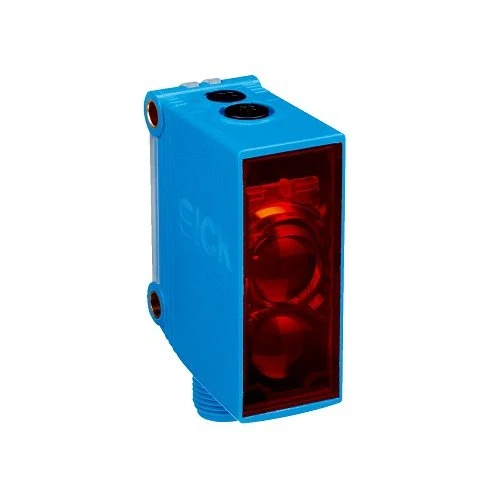
SICK 1065890 GL10 PNP Polarized Retro-reflective Sensor

USD 67.34

GL10-P4211 offers polarized retro-reflective sensing, 0.15–12 m range with PL80A, PNP switching, 625 nm PinPoint LED, M12 connection and IP67 protection.

SKU SICK-1065890 Category
SICK G10

SICK GL10-P4211 PNP Retro-reflective Photoelectric Sensor

BrandSICK
Model IdentifierGL10-P4211
Official Part Number1065890

Technical Overview

The SICK GL10-P4211 is a retro-reflective photoelectric sensor with a polarizing filter and visible red PinPoint LED. With a PL80A reflector it provides 0.15–12 m sensing and 0.08–15 m maximum range; a P250 reflector provides 0.15–10 m sensing and 0.08–12 m maximum range. The dual-lens arrangement requires the specified minimum reflector distance. A 270° potentiometer adjusts sensitivity and range, while a separate selector sets light/dark switching for the PNP output. Response is no more than 500 µs with resistive load, with 1,000 Hz switching at a 1:1 light/dark ratio. The four-pin M12 connector and IP67 ABS/PMMA housing support operation from −30 to +60 °C.

Polarized retro-reflective PNP sensor with 0.15–12 m PL80A sensing range, 270° potentiometer adjustment, 1,000 Hz switching and M12 connection.

Key Features

  • Retro-reflective photoelectric sensing with polarizing filter
  • PL80A: 0.15–12 m sensing; 0.08–15 m maximum range
  • P250: 0.15–10 m sensing; 0.08–12 m maximum range
  • Dual-lens optics; specified minimum reflector distance applies
  • 625 nm visible red PinPoint LED; Ø58 mm spot at 5 m
  • 270° sensitivity/range potentiometer and separate light/dark selector
  • PNP output ≤100 mA; ≤500 µs response with resistive load; 1,000 Hz at 1:1 ratio
  • M12 four-pin male connector; 10–30 V DC; 20 mA consumption
  • ABS/PMMA housing; IP67; −30 to +60 °C operation

Detect interruption of a returned reflector beam using adjustable sensitivity, selectable light/dark switching and a PNP signal for external machine control.

Technical Specification Matrix

ParameterValue
Functional principleRetro-reflective photoelectric sensing
Polarizing filterYes
Optical arrangementDual lens; specified minimum reflector distance applies
Sensing range0.15–12 m with PL80A reflector
Maximum sensing range0.08–15 m with PL80A reflector
P250 reflector range0.15–10 m sensing; 0.08–12 m maximum
Other reflector rangesREF-IRF-56 tape: 0.15–3 m sensing, 0.1–4 m maximum; PL20A: 0.15–6 m / 0.08–7.5 m; PL30A: 0.15–8.5 m / 0.08–11 m; PL40A: 0.15–11.5 m / 0.08–13.5 m, respectively sensing / maximum
Light sourceVisible red PinPoint LED
Wavelength625 nm
Light spot sizeØ58 mm at 5 m
LED service lifeAverage 100,000 h at +25 °C
Adjustment270° potentiometer for sensitivity/sensing range; separate light/dark selector
Digital outputPNP; maximum current ≤100 mA
Switching modeLight/dark switching, selectable
Response time≤500 µs signal transit time with resistive load
Switching frequency1,000 Hz at 1:1 light/dark ratio
ConnectionM12 four-pin male connector
Pin assignment1 BN=L+; 2 WH=not connected; 3 BU=M; 4 BK=Q (CD-066)
Power supply10–30 V DC, limit values; short-circuit-protected network maximum 8 A
Ripple<5 Vpp; remain within supply tolerances
Current consumption20 mA
Protection classIII
Circuit protectionA: supply reverse-polarity protection; B: inputs and outputs reverse-polarity protection; C: interference suppression; D: output overcurrent and short-circuit protection
Housing materialABS/PMMA
IP ratingIP67
Mounting holesØ4.2 mm
IndicatorsGreen: power; yellow: received light beam
Operating temperature−30 to +60 °C
Storage temperature−40 to +70 °C
MTTFD1,567 years
DCavg0%
Mission time20 years
Physical Weight (kg)0.035

Industrial Applications

1. Counting separated opaque cartons across a conveyor

A conveyor can pass separated opaque cartons between the sensor and a correctly aligned reflector. Each carton interrupts the returned beam, and external counting logic evaluates the PNP switching transitions. Installation uses the range limits of the actual reflector, including minimum distance, while commissioning checks carton opacity, separation and speed against the response and switching-frequency conditions.

Problem Solved

A beam-interruption reference helps external counting logic register separated cartons across a conveyor, using the actual reflector arrangement and verified pulse spacing for the selected switching mode.

Carton counting Reflector beam PNP switching

2. Confirming an opaque carrier at a transfer stop

A transfer station can position the reflector so an arriving opaque carrier blocks the returned beam when seated at the stop. The potentiometer adjusts the received-light condition and the selector matches light/dark behavior to external sequencing logic. Setup checks carrier geometry, final position and reflector alignment so the blocked condition corresponds to the monitored arrival point.

Problem Solved

A seated-carrier reference helps external transfer logic coordinate the next process step using an observed position condition, with beam placement checked against the actual carrier geometry.

Carrier arrival Transfer stop Light/dark selection

3. Monitoring an occupied point in an opaque-part chute

A chute can place a returned reflector beam across a defined point where accumulated opaque parts interrupt it. External monitoring logic samples the PNP state to identify occupation of that point. Installation checks reflector range, alignment, part geometry and contamination effects; the detected condition represents the monitored beam position and requires application-specific logic to interpret sustained blockage.

Problem Solved

An occupied-point reference helps external monitoring logic identify persistent blockage at a chute location, supporting a process response when accumulated parts interrupt the checked reflector beam.

Chute occupation Blocked beam Process monitoring

Select your currency