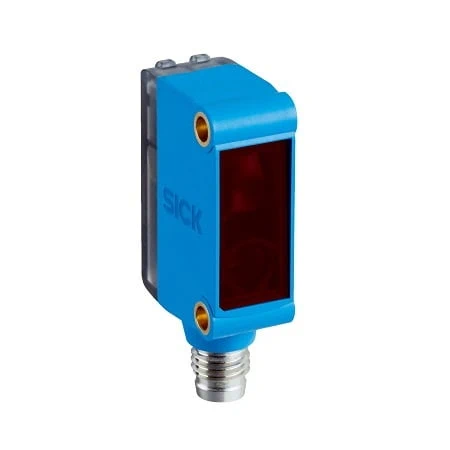
SICK 1050707 GL6-N4111 NPN Retro-reflective Photoelectric Sensor

USD 52.00

GL6-N4111 offers polarized red-light sensing, 0.07–5 m range with PL80A, an NPN output, no sensitivity adjustment and an M8 four-pin male connector.

SKU SICK-1050707 Category
SICK G6

SICK GL6-N4111 NPN Retro-reflective Photoelectric Sensor

BrandSICK
Model IdentifierGL6-N4111
Official Part Number1050707

Technical Overview

The SICK GL6-N4111 is a polarized dual-lens photoelectric retro-reflective sensor with an NPN output and no sensitivity adjustment. With PL80A, sensing spans 0.07–5 m and maximum range is 0.03–6 m. Its 650 nm red PinPoint LED produces an 8 mm spot at 350 mm. Opaque targets interrupt the returned optical path to provide a switching event for external control. Response is below 625 µs with resistive load, with 1,000 Hz switching at a 1:1 light/dark ratio. The 10–30 V DC device uses an M8 four-pin male connector. Its ABS/PC housing, PMMA optics and M3 mounting holes support IP67 installation, with operation from −25 to +55 °C.

Polarized NPN retro-reflective sensor with 0.07–5 m PL80A sensing, no sensitivity adjustment and an M8 four-pin male connector.

Key Features

  • Polarized dual-lens retro-reflective sensing; minimum reflector distance required
  • PL80A: 0.07–5 m sensing; 0.03–6 m maximum range
  • 650 nm red PinPoint LED; Ø8 mm spot at 350 mm
  • No sensitivity adjustment; NPN switching output
  • ≤100 mA output; maximum 50 mA above 24 V supply
  • <625 µs response with resistive load; 1,000 Hz at 1:1 light/dark ratio
  • 10–30 V DC; 30 mA without load; M8 four-pin male connector
  • ABS/PC housing; PMMA optics; IP67; M3 mounting holes
  • −25 to +55 °C operation; temperature stability after adjustment ±10 °C

Detect opaque targets interrupting a returned red beam and provide an NPN switching event to external counting or sequencing logic.

Technical Specification Matrix

ParameterValue
Functional principlePhotoelectric retro-reflective sensor
Optical designPolarized dual-lens system; minimum reflector distance required
Sensing range0.07–5 m with PL80A reflector
Maximum sensing range0.03–6 m with PL80A reflector
Reflector rangesSensing / maximum: PL80A 0.07–5 / 0.03–6 m; PL40A 0.07–3.8 / 0.03–4.3 m; P250 0.07–3.5 / 0.03–4 m; PL20A 0.07–2.2 / 0.03–2.5 m; REF-IRF-56 tape 0.25–1.6 / 0.2–1.8 m
Light sourceVisible red PinPoint LED
Wavelength650 nm
Light spot sizeØ8 mm at 350 mm
LED service lifeAverage 100,000 h at ambient +25 °C
AdjustmentNone
Switching outputNPN
Switching modeLight/dark switching
Signal voltage HIGH/LOWApproximately supply voltage / ≤3 V
Output current≤100 mA; maximum 50 mA at supply voltage >24 V
Response time<625 µs with resistive load
Switching frequency1,000 Hz at 1:1 light/dark ratio
Power supply10–30 V DC; limit values in a short-circuit-protected network, maximum 8 A
Ripple±10%; remain within supply tolerances
Current consumption30 mA without load
ConnectionM8 four-pin male connector
Pin assignmentCD-066: 1 BN=L+; 2 WH=not connected; 3 BU=M; 4 BK=Q
Circuit protectionA: supply reverse-polarity protection; B: inputs and output reverse-polarity protection; D: outputs overcurrent and short-circuit protection
Protection classIII
Housing materialABS/PC plastic
Optics materialPMMA plastic
IP ratingIP67
MountingM3 mounting holes
IndicatorsGreen: supply voltage active; yellow: received-light status
Operating temperature−25 to +55 °C; temperature stability following adjustment ±10 °C
Storage temperature−40 to +70 °C
UL filesNRKH.E348498 and NRKH7.E348498
MTTFD2,084 years
DCavg0%
Mission time20 years
Physical Weight (kg)0.02

Industrial Applications

1. Counting separated cartons across a conveyor

A conveyor can position the sensor and a suitable reflector on opposite sides of a load path so opaque cartons interrupt the returned red beam. External counting logic evaluates the NPN signal. Commissioning checks reflector spacing, alignment, carton coverage, load gaps and transit speed against the documented reflector ranges, response time and switching frequency before registering passage events.

Problem Solved

A carton-passage reference gives an external counter a defined optical event across the conveyor, using beam interruption and a reflector arrangement checked for the actual load path.

Carton counting Beam interruption NPN signal

2. Monitoring opaque web continuity at a feed point

A material feed can route an opaque web through the reflected optical path between the sensor and a reflector. External process logic samples the NPN signal to evaluate material presence and recognize a break. Setup checks web movement, optical coverage, alignment and the reflector-specific minimum separation, keeping the beam reliably covered throughout normal feed conditions.

Problem Solved

A beam-interruption reference helps external process logic recognize loss of opaque feed at the checked location, using a material path that blocks the reflected beam during normal operation.

Web continuity Opaque material Reflector setup

3. Checking transfer-path occupancy at a stop

A transfer stop can present an opaque carrier across the sensor-to-reflector path at a defined seated position. External sequencing logic samples the NPN state after the carrier settles and coordinates acceptance or release. Installation checks reflector distance, alignment, carrier coverage and possible openings through the carrier so the occupied condition remains distinguishable from the clear path.

Problem Solved

A carrier-occupancy reference helps external sequencing logic coordinate a transfer step, using a defined optical interruption checked at the actual stopped position before release.

Transfer occupancy Stopped carrier NPN signal

Select your currency