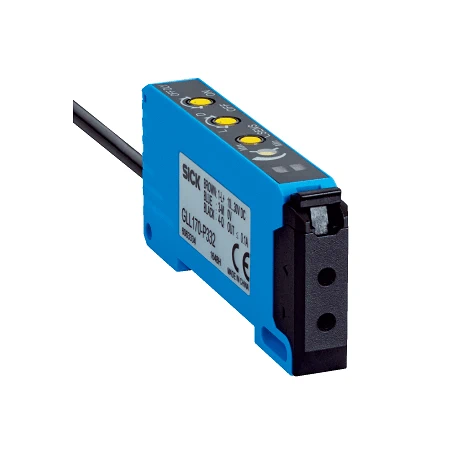
1. Counting separated parts through a fiber beam
A feeder can position a compatible through-beam fiber pair across a constrained component path and mount the amplifier where its sensitivity control is accessible. Separated parts interrupt the beam and change the PNP output. External control counts the transitions, with event timing constrained by the specified250 µs response and2 kHz switching frequency.
Problem Solved
A fiber-guided optical path supplies discrete count events in a confined feed location while the amplifier remains accessible for sensitivity adjustment and output-state review.
Fiber beam
PNP
2 kHz
2. Checking a part in a confined fixture
An assembly fixture can place a compatible reflective fiber head near the expected part position while locating the amplifier outside the crowded tooling area. The eight-turn potentiometer establishes a threshold between the selected part and background signals. The PNP output reports the resulting condition, and the green indicator helps assess the signal near that threshold.
Problem Solved
Separating the optical head from the adjustment unit supports a local fixture-presence check while preserving access to threshold control and the received-signal indicator.
Remote fiber head
Eight-turn adjustment
Presence check
3. Bridging short gaps in material feed
A material feeder can use a compatible fiber arrangement to monitor an occupied feed path and select the amplifier off-delay function. When a brief interruption changes the sensed light condition, the fixed40 ms delay postpones release of the configured output. A sustained absence allows the output to release after that delay, providing a changed PNP condition to external control.
Problem Solved
The selected off delay bridges short interruptions in the material signal, helping external control distinguish brief feed gaps from a sustained absence without adding a separate timing element.
Fixed40 ms off delay
Fiber sensing
PNP