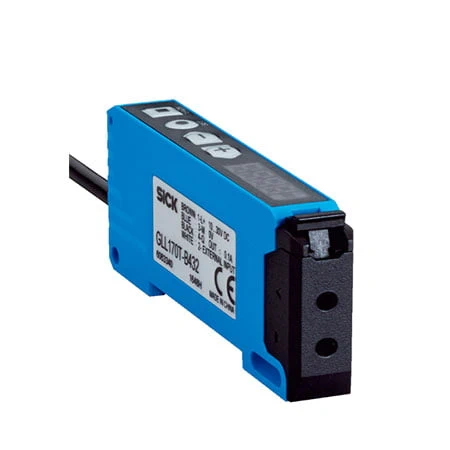
SICK 6063340 GLL170T-B432 PNP/NPN Fiber-Optic Amplifier

USD 100.62

GLL170T-B432 offers selectable PNP/NPN fiber-optic sensing, 50/250 µs response, a four-digit display, external teach-in and programmable timing.

SKU SICK-6063340 Category
SICK GLL170

SICK GLL170T-B432 PNP/NPN Fiber-Optic Amplifier

BrandSICK
Model IdentifierGLL170T-B432
Official Part Number6063340

Technical Overview

The SICK GLL170T-B432 is a stand-alone fiber-optic amplifier with one digital output configurable for PNP or NPN operation. Its 632 nm visible red LED works with a selected optical fiber cable, which determines the sensing principle and available range. A four-digit display, operating buttons and teach-in input support adjustment of the sensing condition. Selectable response settings of 250 µs and 50 µs correspond to switching frequencies of 2 kHz and 10 kHz. Programmable on-delay, off-delay and one-shot timing span 0–9,999 ms. The 2 m four-wire cable, 10–30 V DC operation and IP66 PC/POM housing support machine integration.

Stand-alone fiber amplifier with selectable PNP/NPN output, 50/250 µs response, four-digit display, external teach-in and programmable timing.

Key Features

  • Stand-alone fiber-optic amplifier; range depends on connected fiber
  • 632 nm visible red LED; LED free risk group
  • One digital output selectable PNP/NPN via menu
  • Selectable light/dark switching
  • Selectable response ≤250 µs or ≤50 µs
  • Corresponding switching frequency 2 kHz or 10 kHz
  • Four-digit numeric display with operating buttons
  • External teach-in via white wire
  • Programmable on-delay, off-delay and one shot, 0–9,999 ms
  • 10–30 V DC; 2 m four-wire cable; IP66 PC/POM housing

Set fiber sensing thresholds through the digital display or teach-in input, with selectable PNP/NPN output and programmable signal timing.

Technical Specification Matrix

ParameterValue
Functional principleFiber-optic amplifier; stand-alone
Sensing principle and rangeDependent on the optical fiber cable used
Light sourceLED, visible red light
Wavelength632 nm
LED risk groupFree group, EN 62471:2008-09 / IEC 62471:2006 modified
AdjustmentDisplay and operating buttons for parameters; wire input for sensing-range teach-in
Display7-segment, 4-digit display; green operating LED and yellow digital-output LED
Digital output1 × PNP or NPN, selectable via menu
Switching modeLight/dark switching
NPN signal voltage HIGH/LOWApproximately supply voltage / <1.5 V
Output current≤100 mA
Output protectionReverse polarity, overcurrent and short-circuit protected
Response timeSelectable ≤250 µs or ≤50 µs
Switching frequencyCorresponding settings: 2 kHz or 10 kHz
Time functionsNo delay, switch-on delay, off delay or one shot
Delay timeProgrammable 0–9,999 ms
Power supply10–30 V DC; limit values
Residual ripple≤10%; remain within supply-voltage limits
Current consumption≤40 mA without load
Protection classIII
Connection4-wire, 2 m PVC cable; do not bend below 0 °C
Conductor cross-section0.2 mm²
Cable diameterØ3.8 mm
Housing formRectangular
Housing materialPC/POM plastic
IP ratingIP66, EN 60529
Fixing-screw tightening torqueMaximum 0.5 Nm
Operating temperature−25 to +55 °C
Storage temperature−40 to +70 °C
Relative humidity35–95%, no condensation
Ambient light immunityArtificial light ≤5,000 lx; sunlight ≤60,000 lx
Shock resistance50 g, 11 ms, 18 shocks across X/Y/Z axes; EN 60068-2-27
Vibration resistance10–55 Hz, 1 mm amplitude, 3 ×30 min; EN 60068-2-6
Electromagnetic compatibilityEN 60947-5-2
UL fileNRKH2.E300503 and NRKH8.E300503
MTTFD300 years
Diagnostic coverage DCavg0%
Mission time20 years
Dimensions L x W x H (cm)7.25 x 1 x 3.17
Physical Weight (kg)0.066
PNP signal voltage HIGH/LOWApproximately supply voltage −1.5 V / 0 V
Teach-in inputWhite wire; sensing-range setting

Industrial Applications

1. Counting separated components through a fiber beam

A feeder can use a compatible through-beam fiber arrangement across a component path, with the amplifier evaluating the optical signal. Each separated opaque component interrupts the beam and changes the selected PNP or NPN output state. The chosen 50 µs or 250 µs response setting establishes transition timing, and the digital display supports threshold adjustment.

Problem Solved

Fiber-guided detection brings the sensing point into a constrained component path, supplying count events while the amplifier remains accessible for received-signal review and threshold adjustment.

Fiber-dependent optics PNP/NPN 50/250 µs

2. Changing part-presence settings at an assembly fixture

An assembly station can place a compatible reflective fiber head at the part position and use the external teach-in input to establish a sensing condition during product changeover. The four-digit display and operating buttons provide local adjustment, while the selected PNP or NPN output delivers the resulting presence signal to the controller.

Problem Solved

External teach-in supports updating a confined fixture’s detection condition without moving the fiber head, while the local display retains an accessible view of sensor functions and setup.

External teach-in Four-digit display PNP/NPN

3. Bridging short gaps in sheet feed

A sheet feeder can use a compatible fiber arrangement to monitor material in a narrow feed path. The amplifier evaluates the optical state and applies a programmed off delay so short gaps do not immediately release the output. A longer absence allows the configured 0–9,999 ms timing to expire and changes the controller signal.

Problem Solved

A maintained output bridges short interruptions in material presentation, helping the controller distinguish transient feed gaps from a sustained material absence at the monitored position.

Off delay 0–9,999 ms Fiber sensing

Select your currency