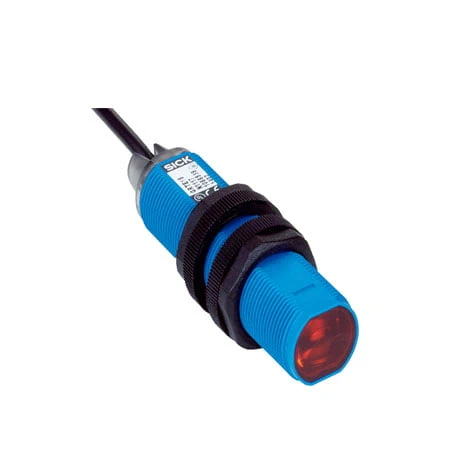
SICK 1066558 GRSE18-N1147 NPN Through-Beam Sensor Set

USD 92.56

GRSE18-N1147 offers 0–10 m through-beam sensing, complementary NPN outputs, 1,000 Hz switching, M18 threaded housings, 2 m cables and IP67 protection.

SKU SICK-1066558 Category
SICK GR18

SICK GRSE18-N1147 NPN Through-Beam Sensor Set

BrandSICK
Model IdentifierGRSE18-N1147
Official Part Number1066558

Technical Overview

The SICK GRSE18-N1147 is a cylindrical through-beam photoelectric sensor set with complementary NPN outputs. A separate sender and receiver detect opaque objects by interruption of their optical path, with a specified sensing range of 0–10 m and maximum range of 0–15 m. The 650 nm visible red PinPoint LED produces a 250 mm spot at 10 m, while a potentiometer adjusts reception. Response below 500 µs and 1,000 Hz switching support repeated transitions. Axial optics, M18 × 1 threaded ABS housings, 2 m cables, four supplied fastening nuts and IP67 protection support machine installation.

M18 through-beam sensor set with 0–10 m sensing, complementary NPN outputs, potentiometer adjustment, 2 m cables and IP67 protection.

Key Features

  • Through-beam detection with separate sender and receiver
  • 0–10 m sensing range; 0–15 m maximum
  • 650 nm visible red PinPoint LED; Ø250 mm spot at 10 m
  • Axial optical axis; M18 × 1 cylindrical housings
  • Potentiometer adjustment
  • Complementary NPN light/dark outputs
  • Response <500 µs; 1,000 Hz switching
  • 2 m four-wire PVC receiver connection
  • ABS housings with PMMA optics; IP67 protection
  • Four fastening nuts supplied; sender-off test input

Detect opaque objects across a 0–10 m sender–receiver path with complementary NPN outputs and M18 threaded mounting.

Technical Specification Matrix

ParameterValue
Functional principleThrough-beam photoelectric sensor set
Sensing range0–10 m
Maximum sensing range0–15 m
Light sourcePinPoint LED, visible red light
Wavelength650 nm
Light spot sizeØ250 mm at 10 m
AdjustmentPotentiometer
Optical axisAxial
Housing formCylindrical, M18 × 1 thread
Power supply10–30 V DC; short-circuit-protected network max. 8 A
Residual ripple<5 Vpp; remain within supply-voltage limits
Current consumption30 mA
Switching outputNPN, complementary
Switching modeLight/dark switching
NPN signal voltage HIGH/LOWApproximately supply voltage / ≤3 V
Output current≤100 mA; maximum 50 mA at supply >24 V or ambient temperature >49 °C
Response time<500 µs with resistive load
Switching frequency1,000 Hz at light/dark ratio 1:1
Connection4-wire, 2 m PVC cable; do not bend below 0 °C
Circuit protectionSupply/input/output reverse-polarity protection and output overcurrent/short-circuit protection
Protection classIII
Housing materialABS plastic
Optics materialPMMA plastic
IP ratingIP67
Items supplied4 fastening nuts
Test inputSender OFF when Test input is at 0 V
Operating temperature−25 to +55 °C at supply ≤24 V and output current <50 mA
Storage temperature−40 to +70 °C
Electromagnetic compatibilityEN 60947-5-2
UL fileE348498
Individual components2072233 GRS18-D1346 sender; 2072234 GRE18-N1137 receiver
Geometry basisManufacturer dimensions describe the sensor housing, not combined installed sender–receiver span
Dimensions L x W x H (cm)7.15 x 1.8 x 1.8

Industrial Applications

1. Counting separated cartons

A carton conveyor can mount the sender on one side and the receiver on the opposite side so each opaque carton interrupts the optical path. The documented 0–10 m sensing range supports the installed separation, while complementary NPN outputs report the received-light states. The 1,000 Hz switching frequency supports repeated carton transitions within the specified timing limits.

Problem Solved

Each separated carton passage produces a discrete electrical event without contact, supplying a counter input while the optical path spans the conveyor between two fixed mounting points.

Through-beam 0–10 m NPN

2. Monitoring load accumulation at a transfer

A transfer conveyor can place the through-beam path across a position where an opaque load remains when downstream handling pauses. Sustained beam blockage holds the receiver in the object-present condition. Complementary NPN light/dark outputs provide the controller signal, and M18 threaded housings support the sender and receiver mounting arrangement.

Problem Solved

A sustained interruption identifies an occupied transfer position, helping the controller coordinate upstream release before more loads enter the same constrained space during normal production.

Complementary NPN M18 × 1 Beam interruption

3. Checking opaque sheet continuity

A sheet feeder can direct the optical path through the expected material route so an opaque sheet normally blocks the received beam. A break or runout restores received light and changes the complementary NPN signals. The potentiometer sets reception for the installed sender–receiver spacing, while IP67 protection supports exposed machine mounting.

Problem Solved

A changed light state gives the controller an electrical indication of missing material at the monitored point, supporting a coordinated response to interrupted sheet feed.

Through-beam IP67 Material continuity

Select your currency