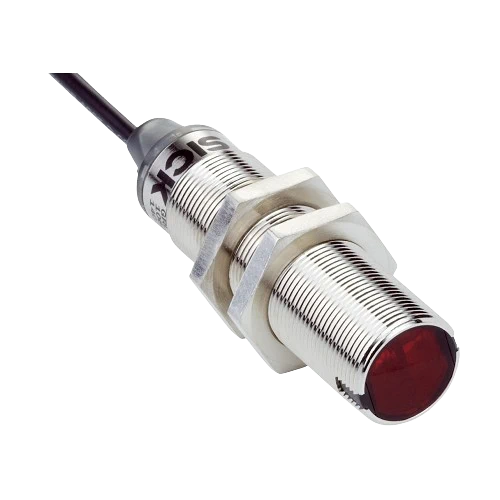
SICK 1066548 GRTE18-P1142 PNP Diffuse Photoelectric Sensor

USD 50.70

GRTE18-P1142 combines complementary PNP outputs, 10–400 mm reference-white diffuse sensing, 500 Hz switching, a 270° potentiometer and 2 m PVC cable.

SKU SICK-1066548 Category
SICK GR18

SICK GRTE18-P1142 PNP Diffuse Photoelectric Sensor

BrandSICK
Model IdentifierGRTE18-P1142
Official Part Number1066548

Technical Overview

The SICK GRTE18-P1142 is an energetic photoelectric proximity sensor with complementary PNP outputs and an axial M18 × 1 cylindrical housing. It evaluates target-reflected light from one mounting side. The sensing range is 10–400 mm and maximum range is 5–550 mm on 90% remission reference white. A 650 nm red PinPoint LED forms a 9 mm spot at 400 mm, while a 270° potentiometer adjusts reception. Response is below 1,000 µs with resistive load, with 500 Hz switching at a 1:1 light/dark ratio. A 2 m four-wire PVC cable connects the IP67 nickel-plated brass/ABS housing; operation spans −25 to +55 °C at supply ≤24 V and output current <50 mA.

PNP energetic diffuse sensor with 10–400 mm reference-white sensing, complementary outputs, M18 × 1 housing, 270° potentiometer and 2 m PVC cable.

Key Features

  • Energetic diffuse photoelectric sensing
  • 10–400 mm sensing range on 90% remission reference white
  • 5–550 mm maximum range on 90% remission reference white
  • 650 nm PinPoint LED; Ø9 mm spot at 400 mm
  • Axial optics; M18 × 1 cylindrical housing
  • 270° potentiometer adjustment
  • Complementary PNP light/dark outputs
  • Response <1,000 µs with resistive load; 500 Hz at 1:1 light/dark ratio
  • 2 m four-wire PVC cable; 10–30 V DC
  • IP67 nickel-plated brass and ABS housing; two fastening nuts supplied

Detect reflected target light from one mounting side with an adjustable M18 sensor and complementary PNP signals for machine control.

Technical Specification Matrix

ParameterValue
Functional principleEnergetic photoelectric proximity sensor
Sensing range10–400 mm on 90% remission reference white (DIN 5033)
Maximum sensing range5–550 mm on 90% remission reference white (DIN 5033)
Light sourcePinPoint LED, visible red light
Wavelength650 nm
Light spot sizeØ9 mm at 400 mm
AdjustmentPotentiometer, 270°
Optical axisAxial
Housing formCylindrical, M18 × 1 thread
Power supply10–30 V DC; short-circuit-protected network max. 8 A
Residual ripple<5 Vpp; remain within supply-voltage limits
Current consumption30 mA
Switching outputPNP, complementary
Switching modeLight/dark switching
Output current≤100 mA; maximum 50 mA at supply >24 V or ambient temperature >49 °C
Response time<1,000 µs with resistive load
Switching frequency500 Hz at light/dark ratio 1:1
Connection4-wire, 2 m PVC cable; do not bend below 0 °C
Circuit protectionSupply/input/output reverse-polarity protection and output overcurrent/short-circuit protection
Protection classIII
Housing materialMetal, nickel-plated brass and ABS
Optics materialPMMA plastic
IP ratingIP67
Items suppliedTwo metal fastening nuts; 24 mm across flats
Operating temperature−25 to +55 °C at supply ≤24 V and output current <50 mA
Storage temperature−40 to +70 °C
Electromagnetic compatibilityEN 60947-5-2
UL fileE348498
PNP signal voltage HIGH/LOWSupply voltage − (≤3 V) / approximately 0 V
Wire assignmentsCD-094: BN=L+; WH=Q complement; BU=M; BK=Q
IndicatorsGreen: power on; yellow: received-light status, on with object present and off with object absent
LED service lifeAverage 100,000 h at ambient +25 °C

Industrial Applications

1. Checking a workpiece in a fixture

An assembly fixture can position the sensor toward the expected face of an opaque workpiece, with clear optical separation from surfaces behind the detection point. Energetic sensing evaluates reflected target light, and the potentiometer sets reception for the installed geometry. Complementary PNP outputs supply the local presence state to the sequence controller.

Problem Solved

A contactless workpiece signal identifies an occupied fixture for the controller, supporting assembly sequencing without a mechanical feeler pressing against the part at the sensing position.

Energetic sensing PNP Potentiometer

2. Counting separated components on a conveyor

A conveyor can aim the sensor at a position crossed by separated opaque parts so each target presents reflected light to the receiver. The 9 mm at 400 mm optical spot defines the monitored region, while the potentiometer adapts reception to the target and background geometry. The 500 Hz switching frequency supports repeated transitions within the documented timing limits.

Problem Solved

Discrete reflected-light transitions mark individual part passages without contact, giving the controller a count input when the installed geometry separates each target from the empty path.

Ø9 mm at 400 mm 500 Hz Diffuse sensing

3. Checking opaque strip continuity

A feeder can direct the sensor toward an opaque strip at a fixed monitoring position so reflected light indicates material present. A break or runout removes the target from that optical position and changes the complementary PNP signals. IP67 protection supports exposed machine mounting, while the 2 m cable connects to local control wiring.

Problem Solved

A change in local material presence provides an electrical indication of interrupted strip feed, helping the controller coordinate a response before additional product enters the affected process section.

Material continuity IP67 PNP

Select your currency