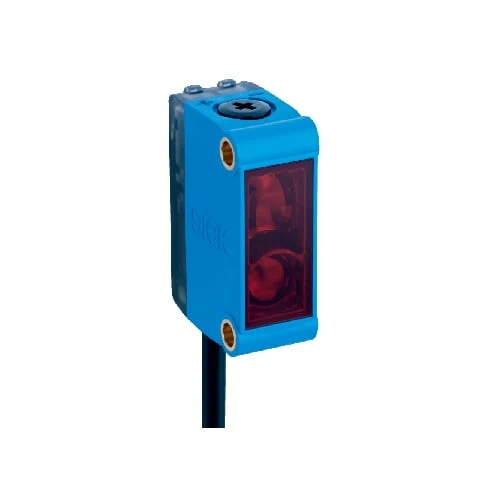
SICK 1066320 GTB6-N1211S38 NPN Background Suppression Sensor

USD 54.34

GTB6-N1211S38 offers 35–140 mm sensing, 650 nm red PinPoint LED light, five-turn range adjustment, selectable NPN switching and a 1.9 m three-wire PVC cable.

SKU SICK-1066320 Category
SICK G6

SICK GTB6-N1211S38 NPN Background Suppression Sensor

BrandSICK
Model IdentifierGTB6-N1211S38
Official Part Number1066320

Technical Overview

The SICK GTB6-N1211S38 is a photoelectric proximity sensor with background suppression and a single NPN output. Sensing spans 35–140 mm for the specified white, gray and black reference targets; maximum ranges depend on remission, reaching 250 mm on reference white. Its 650 nm red PinPoint LED produces a 6 mm spot at 100 mm. A five-turn mechanical spindle adjusts sensing distance and a separate rotary selector chooses light or dark switching. Response is below 625 µs with resistive load, with 1,000 Hz switching at a 1:1 light/dark ratio. The 10–30 V DC device uses a 1.9 m three-wire PVC cable, ABS/PC housing, PMMA optics and IP67 protection.

NPN background-suppression sensor with 35–140 mm sensing, five-turn range adjustment, selectable light/dark switching and a 1.9 m three-wire PVC cable.

Key Features

  • Photoelectric proximity sensing with background suppression
  • 35–140 mm sensing on specified white, gray and black reference targets
  • 5–250 mm maximum range on 90% remission reference white
  • 650 nm red PinPoint LED; Ø6 mm spot at 100 mm
  • Five-turn sensing-range spindle; separate light/dark rotary selector
  • Single NPN output; ≤100 mA, reduced to 50 mA above 24 V supply
  • <625 µs response with resistive load; 1,000 Hz at 1:1 light/dark ratio
  • 10–30 V DC; 30 mA without load; 1.9 m three-wire PVC cable
  • ABS/PC housing; PMMA optics; IP67; M3 mounting holes
  • −25 to +55 °C operation; temperature stability after adjustment ±10 °C

Set the sensing distance to distinguish a nearby target from a farther background and connect the selected NPN state to external control.

Technical Specification Matrix

ParameterValue
Functional principlePhotoelectric proximity sensor with background suppression
Sensing range35–140 mm on white 90%, gray 18% and black 6% reference targets
Maximum sensing range5–250 mm on 90% remission reference white (DIN 5033)
Reference-target rangesSensing / maximum: white 90% 35–140 / 5–250 mm; gray 18% 35–140 / 7–200 mm; black 6% 35–140 / 10–140 mm
Light sourceVisible red PinPoint LED
Wavelength650 nm
Light spot sizeØ6 mm at 100 mm
LED service lifeAverage 100,000 h at ambient +25 °C
AdjustmentSensing-range mechanical spindle, five turns
Switching outputNPN
Switching modeLight or dark switching, selectable via rotary switch
Signal voltage HIGH/LOWApproximately supply voltage / ≤3 V
Output current≤100 mA; maximum 50 mA at supply voltage >24 V
Response time<625 µs with resistive load
Switching frequency1,000 Hz at 1:1 light/dark ratio
Power supply10–30 V DC; limit values in a short-circuit-protected network, maximum 8 A
Ripple±10%; remain within supply tolerances
Current consumption30 mA without load
Connection1.9 m three-wire PVC cable; do not bend below 0 °C
Conductor cross-section0.14 mm²
Wire assignmentCD-043: BN=L+; BU=M; BK=Q
Circuit protectionA: supply reverse-polarity protection; B: inputs and output reverse-polarity protection; D: outputs overcurrent and short-circuit protection
Protection classIII
Housing materialABS/PC plastic
Optics materialPMMA plastic
IP ratingIP67
MountingM3 mounting holes
IndicatorsGreen: supply voltage active; yellow: received-light status
Operating temperature−25 to +55 °C; temperature stability following adjustment ±10 °C
Storage temperature−40 to +70 °C
UL filesNRKH.E348498 and NRKH7.E348498
Physical Weight (kg)0.06

Industrial Applications

1. Checking a dark insert in an assembly nest

An assembly nest can present a dark insert inside the adjusted target zone while an empty-nest surface lies farther away. The five-turn spindle sets background suppression using representative inserts and empty nests. External inspection logic samples the selected NPN state after the assembly settles, with setup checking actual remission, placement tolerance and the specified black-target sensing range.

Problem Solved

An insert-present reference helps external inspection logic identify an empty assembly position before the next operation, using a target zone adjusted for the actual part and nest.

Insert inspection Background suppression NPN output

2. Counting separated components beside a guide

A parts guide can carry separated opaque components past the red optical sensing point while the machine background remains farther away. The spindle sets the working distance and the selector matches light or dark NPN behavior to an external counter. Commissioning checks component remission, spot coverage, part gaps and transit speed against the response and switching-frequency specifications.

Problem Solved

A component-passage reference helps an external counter register separated parts from one mounting side, using background suppression and timing limits checked for the actual feed.

Parts counting Red optical spot Selectable NPN

3. Confirming a carrier against a transfer stop

A transfer stop can bring a defined opaque carrier surface within the adjusted sensing distance and leave the empty-stop background farther away. External sequencing logic samples the selected NPN signal after the carrier settles. Setup uses actual carriers to establish distance separation, checking seated-position tolerance, surface remission and the reference-target ranges before coordinating acceptance or release.

Problem Solved

A seated-carrier reference helps external sequencing logic coordinate transfer acceptance, using a sensing distance adjusted to distinguish the presented carrier from the empty-stop background.

Carrier arrival Transfer acceptance Range adjustment

Select your currency