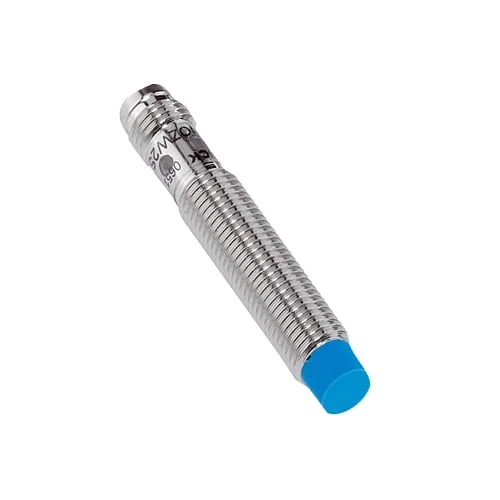
SICK 1040886 M8 PNP NO Inductive Sensor, 4 mm Non-flush

USD 34.06

IME08-04NPSZT0S provides 4 mm nominal inductive sensing, non-flush M8 installation, PNP NO output, 4,000 Hz switching and a three-pin M8 connector.

SKU SICK-1040886 Category
SICK IME

SICK IME08-04NPSZT0S M8 PNP Inductive Proximity Sensor

BrandSICK
Model IdentifierIME08-04NPSZT0S
Official Part Number1040886

Technical Overview

The SICK IME08-04NPSZT0S is a cylindrical M8 × 1 inductive proximity sensor for detecting nearby metal targets with non-flush installation. Its nominal sensing range is 4 mm and assured switching distance is 3.24 mm, with reference reduction factors for other target metals. The PNP normally open output uses DC three-wire wiring and supports 4,000 Hz switching with continuous current up to 200 mA. A three-pin M8 connector provides the electrical connection. The nickel-plated brass housing and PA 66 sensing face have IP67 protection, with operation from −25 to +75 °C. Two nickel-plated steel mounting nuts are supplied, and maximum tightening torque is 5 Nm.

M8 non-flush inductive sensor with 4 mm nominal range, 3.24 mm assured switching distance, PNP NO output, 4,000 Hz switching and M8 three-pin connection.

Key Features

  • Cylindrical M8 × 1 inductive sensor; non-flush installation
  • 4 mm nominal sensing range; 3.24 mm assured switching distance
  • PNP normally open output; DC three-wire wiring
  • 4,000 Hz switching; continuous output current ≤200 mA
  • M8 three-pin connector; pin 1=L+, pin 3=M, pin 4=NO
  • 10–30 V DC; ≤10 mA no-load current; ≤100 ms availability delay
  • Nickel-plated brass housing; PA 66 sensing face
  • IP67; −25 to +75 °C operation
  • Short-circuit and power-up pulse protection
  • Two nickel-plated steel mounting nuts supplied; maximum tightening torque 5 Nm

Detect nearby metal with a PNP normally open signal, applying the specified non-flush clearances and checking the actual target’s material-dependent range.

Technical Specification Matrix

ParameterValue
Functional principleInductive proximity sensing of metal targets
Housing designMetric cylindrical standard design; M8 × 1; Ø8 mm
Nominal sensing range Sn4 mm
Assured switching distance Sa3.24 mm
Installation typeNon-flush
Switching frequency4,000 Hz
Digital outputPNP; normally open
Electrical wiringDC three-wire
Continuous output current≤200 mA
Power supply10–30 V DC
Ripple≤10%
Voltage drop≤2 V at maximum output current
Availability delay≤100 ms
Hysteresis5–15%
Reproducibility≤2% of Sr at stated supply voltage and constant ambient temperature
Temperature drift±10% of Sr
No-load current≤10 mA
ConnectionM8 three-pin connector
Pin assignment1 BN=L+; 4 BK=NO; 3 BU=M (CD-002)
Protection functionsShort-circuit and power-up pulse protection
Housing materialNickel-plated brass
Sensing face materialPA 66 plastic
Housing length50 mm
Thread length30 mm
IP ratingIP67, EN 60529
Operating temperature−25 to +75 °C
Included accessoriesTwo nickel-plated steel mounting nuts
Maximum tightening torque≤5 Nm
Shock resistance30 g, 11 ms
Vibration resistance10–55 Hz, 1 mm
EMCEN 60947-5-2
Material reduction factorsReference values may vary: St37 steel 1; stainless steel V2A/304 ≈0.8; aluminum ≈0.45; copper ≈0.4; brass ≈0.4
Installation clearancesFollow labeled non-flush drawing: A=8 mm, B=18 mm, C=8 mm, D=12 mm, E=8 mm, F=32 mm
MTTFD1,735 years
DCavg0%
UL fileNRKH.E181493

Industrial Applications

1. Confirming a metal slide reaches a monitored position

A machine slide can present a metal target close to the sensor’s active face at a selected position. The PNP normally open output supplies a discrete position condition to external sequencing logic. Installation respects the non-flush clearances and checks the actual target metal, approach direction and gap against the assured switching distance and reference reduction factors.

Problem Solved

A nearby-metal position reference helps external sequencing logic recognize the slide at a monitored point, reducing reliance on elapsed movement time for the next ordinary process step.

Metal position PNP NO signal Non-flush mounting

2. Checking a metal insert in a presented fixture

A fixture can present an expected metal insert within the sensor’s working gap while the empty fixture leaves that region clear of interfering metal. External inspection logic samples the PNP output after the fixture is seated. Setup verifies the insert material, placement tolerance and surrounding metal geometry, using the applicable reduction factor and the required non-flush mounting arrangement.

Problem Solved

A metal-present reference helps external inspection logic check an expected insert before further assembly, supporting an omitted-part check when the fixture provides a suitable sensing gap.

Metal insert Fixture inspection Material-dependent range

3. Counting repeated metal flags on a mechanism

A rotating or reciprocating mechanism can move separated metal flags past the sensing face so the output changes as each flag enters and leaves the detection region. An external counter evaluates those pulses. Commissioning checks actual flag material, gap, spacing and movement rate against the sensing specifications and 4,000 Hz switching frequency, with non-flush clearances maintained around the sensor.

Problem Solved

Repeated metal-passage signals help external counting logic follow mechanism cycles or events, using a defined target geometry and verified spacing within the sensor’s switching capability.

Metal flag counting Cycle events Inductive pulses

Select your currency