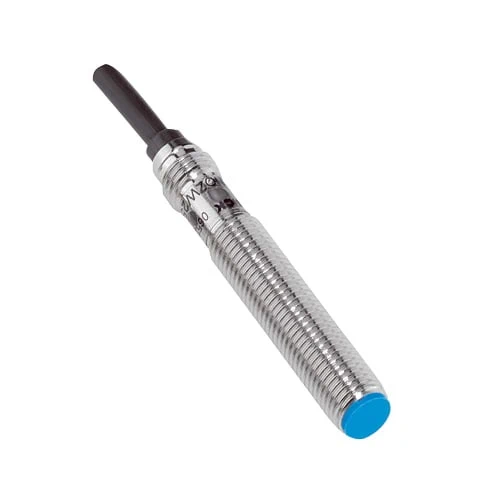
SICK 1040848 IME08-1B5NSZW2S 1.5 mm NPN Inductive Sensor

USD 30.16

IME08-1B5NSZW2S provides 1.5 mm nominal inductive sensing, flush M8 mounting, NPN normally open output, 4000 Hz switching and a 2 m PVC cable.

SKU SICK-1040848 Category
SICK IME

SICK IME08-1B5NSZW2S NPN Normally Open Inductive Sensor

BrandSICK
Model IdentifierIME08-1B5NSZW2S
Official Part Number1040848

Technical Overview

The SICK IME08-1B5NSZW2S is an M8 ×1 inductive proximity sensor for flush installation in metal. It specifies 1.5 mm nominal sensing distance and 1.215 mm assured sensing distance, with an NPN normally open output in a DC three-wire arrangement. Switching frequency is 4,000 Hz, supply is 10–30 V DC and continuous output current is no more than 200 mA. The nickel-plated brass housing and PA66 sensing face have IP67 protection for −25 to +75 °C operation. A 2 m three-wire PVC cable connects the device, and two nickel-plated steel mounting nuts are supplied. Actual target material, gap and surrounding metal must match the documented reduction factors and installation clearances.

Flush M8 inductive sensor with 1.5 mm nominal range, NPN normally open output, 4,000 Hz switching and 2 m PVC cable.

Key Features

  • M8 ×1 inductive sensor for flush installation
  • Nominal sensing distance Sn 1.5 mm; assured sensing distance Sa 1.215 mm
  • NPN normally open output; DC three-wire wiring
  • 4,000 Hz switching frequency
  • 10–30 V DC; ≤200 mA continuous output current; ≤10 mA without load
  • ≤100 ms delay before availability; short-circuit and power-up pulse protection
  • 2 m three-wire PVC cable
  • Nickel-plated brass housing; PA66 sensing face
  • Two nickel-plated steel mounting nuts supplied; maximum tightening torque ≤5 Nm
  • IP67 to EN 60529; −25 to +75 °C operation

Detect a nearby metal target through flush inductive sensing and supply an NPN normally open state to compatible external control.

Technical Specification Matrix

ParameterValue
Functional principleInductive proximity sensing
Housing designStandard metric body
Housing threadM8 ×1; Ø8 mm
InstallationFlush
Nominal sensing distance Sn1.5 mm
Assured sensing distance Sa1.215 mm
Switching outputNPN, normally open
Electrical wiringDC three-wire
Switching frequency4,000 Hz
Connection2 m three-wire PVC cable
Power supply10–30 V DC
Ripple≤10%
Voltage drop≤2 V at maximum output current
Delay before availability≤100 ms
Hysteresis5–15%
Reproducibility≤2% of Sr at constant supply voltage and ambient temperature
Temperature drift±10% of Sr
Continuous output current≤200 mA
No-load current≤10 mA
Electrical protectionShort-circuit protection and power-up pulse protection
EMCEN 60947-5-2
Shock resistance30 g for 11 ms
Vibration resistance10–55 Hz, 1 mm
Operating temperature−25 to +75 °C
Housing materialNickel-plated brass
Sensing-face materialPA66 plastic
Housing length52 mm
Thread length34 mm
Maximum tightening torque≤5 Nm
Items suppliedTwo nickel-plated steel mounting nuts; width across flats 13
IP ratingIP67, EN 60529
UL fileNRKH.E181493
MTTFD1,735 years
Diagnostic coverageDCavg 0%
Reduction factorsReference values, may vary: St37 steel 1; V2A/304 stainless approx. 0.8; aluminum approx. 0.45; copper approx. 0.4; brass approx. 0.4
Installation clearancesB=8 mm; C=8 mm; D=4.5 mm; F=12 mm
Cable materialPVC
Conductor cross-section0.25 mm²
Cable diameter3.9 mm
Wire assignmentCD-001: BN=L+; BK=NO output; BU=M

Industrial Applications

1. Confirming a metal carriage at its stop

A machine carriage can present a metal feature inside the sensor’s commissioned inductive range and feed the NPN normally open state to external sequencing logic. The flush mounting arrangement follows the documented clearances around metal structure. Setup checks actual target material and gap against the assured sensing distance and reduction factors before using the condition as a process-position reference.

Problem Solved

A metal-carriage arrival condition helps external sequencing coordinate the next process step, using an installed target gap and mounting geometry checked for the actual material.

Carriage stop Flush installation NPN output

2. Counting separated metal components through a guide

A guide can move separated metal components past the inductive sensing face and send output transitions to external counting electronics. Commissioning establishes the target gap and checks the effect of actual metal composition using the documented reduction factors. Part transit time and gaps are tested against the 4,000 Hz switching specification, while the connected input respects the output-current limit.

Problem Solved

A discrete metal-part passage signal helps external counting electronics register separated components, using commissioned target geometry and switching conditions matched to the actual feed.

Metal-part count Inductive sensing Switching frequency

3. Deriving rotation rate from a metal cam

A rotating mechanism can present a metal cam or marker to the sensor once per known mechanical interval. External timing electronics derive rotation rate from the NPN output transitions and the actual number of markers per turn. Setup checks target material, clearances and gap, then verifies the pulse pattern at the required speed against the sensor’s switching frequency and startup availability.

Problem Solved

A recurring metal-marker signal helps external timing electronics derive rotation rate from discrete transitions, using the commissioned marker count and verified sensing geometry for the rotating mechanism.

Cam timing Rotation rate External calculation

Select your currency