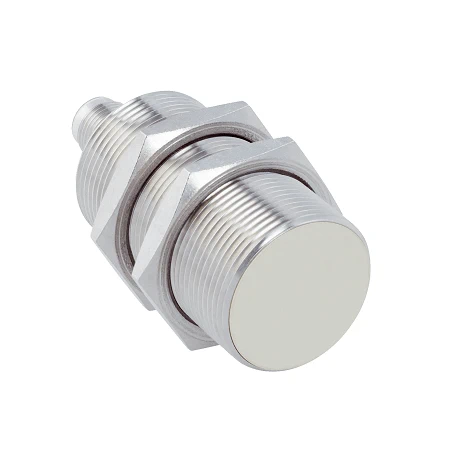
1. Confirming a metal carrier at a washdown station
A packaging station can present a qualified metal feature on a carrier near this sensor at the required transfer position. The flush installation, 15 mm nominal range and 12.15 mm assured range guide placement. The PNP normally-closed signal reports the local carrier condition, while IP68/IP69K protection and cleaning-agent resistance support the specified washdown environment. The normally-closed output is OFF when the target is detected; the controller selects the corresponding transition.
Problem Solved
A contactless carrier-position signal gives the sequence controller a reference before transfer, avoiding a mechanical feeler against the carrier at a station exposed to cleaning operations.
Washdown station
Metal carrier
PNP
2. Counting metal components at a guided feeder
A guided feeder can carry individual qualified metal components past the sensing face so each passage changes the normally-closed output. An external counter reads these transitions. The 500 Hz switching frequency and 3–20% hysteresis guide target spacing and timing, while the listed target-material reduction factors must be considered when qualifying different metal components. The normally-closed output is OFF when the target is detected; the controller selects the corresponding transition.
Problem Solved
A noncontact component-passage event supports quantity tracking at the feeder exit without a counting lever touching each part, with counting and feed decisions performed by the external controller.
Metal-part counting
500 Hz
Material factors
3. Aligning a metal actuator during fixture setup
A fixture setup can move an intended metal actuator toward the sensing face while the installer observes the visual adjustment indicator. The manufacturer installation-aid diagram distinguishes the target region between Sr and Sa, with Sa equal to 0.81 times the nominal range. Final mounting also follows the flush-installation clearances and target-material reduction factors.
Problem Solved
The local adjustment indication helps the installer establish a repeat actuator position in the specified detection zone, reducing reliance on repeated machine cycles simply to observe an output transition.
Visual setup aid
Actuator alignment
Flush mounting