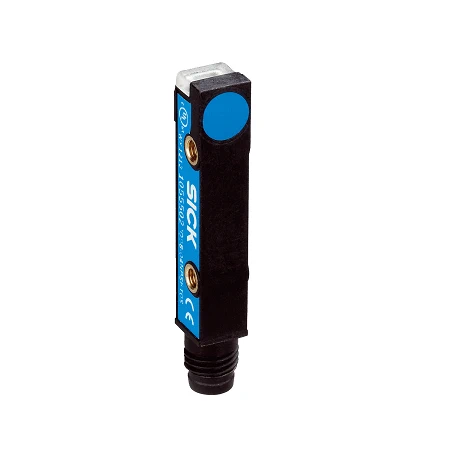
1. Checking a metal component at a fixture
An assembly fixture can bring a qualified metal component near the sensor at a defined inspection point. The 4 mm nominal and 3.24 mm assured ranges guide placement with non-flush installation. The PNP normally-open output supplies the local presence condition, while target-material reduction factors and the mounting clearances determine the final component position.
Problem Solved
A noncontact metal-presence signal lets the external controller identify an empty monitored fixture position before the next operation, without requiring a contact probe against the component.
Component presence
3.24 mm assured
PNP
2. Counting metal parts at a guided feeder
A guided feeder can present separated qualified metal parts across the sensing zone. An external counter reads the normally-open output transitions produced as each part passes. The 2,000 Hz switching frequency, 5–15% hysteresis and specified reproducibility guide spacing and event qualification, with the documented material reduction factors considered for the selected target.
Problem Solved
A part-passage event supports quantity tracking at the feeder exit without a counting lever touching the parts, while the external controller performs counting and regulates the feed sequence.
Metal-part counting
2,000 Hz
External counter
3. Referencing a metal flag on a small mechanism
A moving mechanism can carry an intended metal flag past the sensing face at its reference station. The M3 mounting holes and 20 mm pitch locate the sensor, while the 270° indicator aids local observation of its state. The controller reads the PNP output transition with the specified non-flush mounting clearances maintained.
Problem Solved
A discrete metal-flag reference input helps coordinate a repeat mechanism cycle without a contact cam switch, leaving sequence timing and the subsequent machine actions to the external controller.
Flag reference
M3 mounting
270° LED