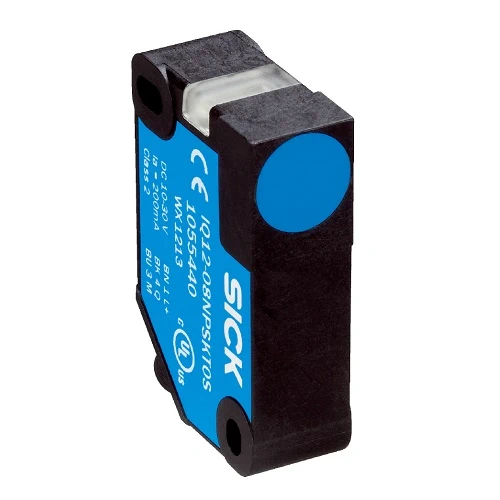
SICK 1055436 IQ12-08NPSKW2S PNP Inductive Sensor

USD 50.96

IQ12-08NPSKW2S offers 8 mm nominal and 6.48 mm assured sensing, non-flush rectangular mounting, PNP normally-open output and a 2 m three-wire PVC cable.

SKU SICK-1055436 Category
SICK IQB

SICK IQ12-08NPSKW2S PNP Rectangular Inductive Sensor

BrandSICK
Model IdentifierIQ12-08NPSKW2S
Official Part Number1055436

Technical Overview

The SICK IQ12-08NPSKW2S is a rectangular inductive proximity sensor for non-flush installation. Nominal sensing range is 8 mm and assured sensing range is 6.48 mm, with material-dependent reduction factors for stainless and nonferrous targets. Its PNP normally-open output switches at up to 2,000 Hz and supports continuous current up to 200 mA. The 10–30 V DC three-wire device has a 2 m PVC cable with 0.25 mm² conductors and 3.7 mm diameter. Both housing and sensing face use VISTAL plastic, with IP68 protection. M3 threaded mounting holes and a 270° LED indicator support installation. Operation spans −25 to +75 °C, with maximum tightening torque of 1 Nm.

Non-flush rectangular inductive sensor with 8 mm nominal range, 6.48 mm assured range, PNP normally-open output, VISTAL housing and 2 m PVC cable.

Key Features

  • Rectangular inductive proximity sensor for non-flush installation
  • 8 mm nominal sensing range; 6.48 mm assured sensing range
  • PNP normally-open output; DC three-wire configuration
  • 2,000 Hz switching frequency; continuous output current ≤200 mA
  • 10–30 V DC; 10 mA no-load current; voltage drop ≤3 V at maximum load
  • ≤100 ms time delay before availability; short-circuit and power-up pulse protection
  • 2 m three-wire PVC cable; 0.25 mm² conductors; 3.7 mm diameter
  • VISTAL plastic housing and sensing face; IP68
  • M3 threaded mounting holes; 270° LED indicator
  • −25 to +75 °C operation; tightening torque ≤1 Nm

Detect a nearby metal target with a non-flush rectangular VISTAL sensor, using M3 threaded mounting holes and a 2 m PVC cable for machine integration.

Technical Specification Matrix

ParameterValue
Functional principleInductive proximity sensor
Housing designRectangular
InstallationNon-flush
Nominal sensing range Sn8 mm
Assured sensing range Sa6.48 mm
Switching outputPNP
Output functionNormally open (NO)
Electrical wiringDC three-wire
Switching frequency2,000 Hz
Power supply10–30 V DC
Ripple≤10% of supply voltage
Voltage drop≤3 V at maximum output current
Time delay before availability≤100 ms
Hysteresis5–15%
Reproducibility≤2% of real sensing range Sr at constant supply voltage and ambient temperature
Temperature drift±10% of real sensing range Sr
Continuous output current≤200 mA
No-load current10 mA
Connection2 m three-wire PVC cable
Wire assignmentsCD-001: BN=L+; BK=normally-open output; BU=M
Short-circuit protectionProvided
Power-up pulse protectionProvided
Housing materialVISTAL plastic
Sensing face materialVISTAL plastic
Body length40 mm
MountingM3 threaded mounting holes
Indicator270° LED indicator
Tightening torque≤1 Nm
IP ratingIP68 according to EN 60529
Operating temperature−25 to +75 °C
Shock resistance30 g, 11 ms
Vibration resistance10–55 Hz, 1 mm amplitude
EMCAccording to EN 60947-5-2
MTTFD1,730 years
DCavg0%
Mission time20 years
Material reduction factorsReference values, may vary: stainless steel V2A/304 0.7; aluminum 0.5; copper 0.4; brass 0.5
Cable materialPVC
Conductor cross-section0.25 mm²
Cable diameter3.7 mm

Industrial Applications

1. Confirming a metal clamp at its seated position

A fixture can present a metal clamp target to the non-flush sensing face at a controlled final gap. External sequencing logic samples the PNP normally-open output after the clamp settles. Commissioning checks target material, thickness and placement tolerance against the nominal and assured ranges, accounting for material reduction factors before accepting the seated condition.

Problem Solved

A clamp-position reference helps external sequencing logic distinguish a seated metal target from an open location, using a non-flush inductive sensing point checked for the actual target material.

Clamp presence Non-flush installation PNP output

2. Counting separated metal flags on a moving mechanism

A moving mechanism can carry separated metal flags past the inductive sensing face and feed PNP transitions to external counting electronics. Setup checks flag material, coverage, passing gap and the separation between flags. Motion timing is verified against the 2,000 Hz switching frequency, and the connected input respects the continuous-current and voltage-drop limits.

Problem Solved

A metal-flag passage reference helps external counting electronics register repeated mechanical events, using contactless inductive switching checked for the actual target spacing, material and travel speed.

Metal-flag counting Inductive switching Timing checks

3. Referencing a carriage near a travel position

A carriage can bring a metal reference tab toward the non-flush-mounted sensor near a defined travel position. External motion logic reads the PNP normally-open state as a position reference. Installation checks tab material, approach geometry and allowable gap, while commissioning accounts for reproducibility, hysteresis and temperature drift so the reference remains meaningful over the expected operating conditions.

Problem Solved

A carriage-reference signal helps external motion logic identify a checked mechanical position, using inductive target detection and installation margins established for the actual approach geometry and temperature range.

Carriage reference Metal target Installation margins

Select your currency