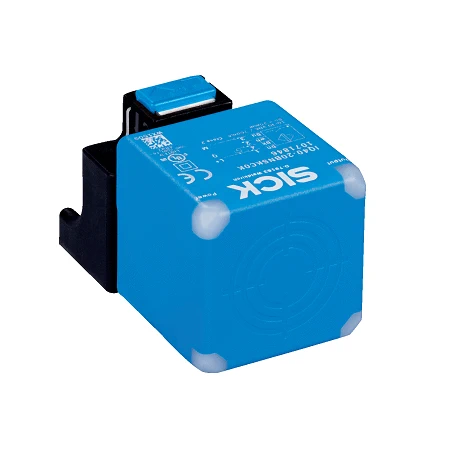
SICK 1071553 IQ40-20BPPKC0K Inductive Proximity Sensor

USD 65.78

Flush inductive sensor with 20 mm nominal range, complementary PNP outputs, 150 Hz switching, M12 connector and IP67/IP68/IP69K protection.

SKU SICK-1071553 Category
SICK IQG

SICK IQ40-20BPPKC0K Inductive Proximity Sensor

BrandSICK
Model IdentifierIQ40-20BPPKC0K
Official Part Number1071553

Technical Overview

The SICK IQ40-20BPPKC0K is a rectangular inductive proximity sensor for metal detection with complementary PNP outputs. Its 20 mm nominal sensing range and 16.2 mm assured sensing range support flush installation, subject to the documented target-material reduction factors and mounting clearances. The short-body housing uses an M12 four-pin male connector and DC four-wire wiring. Switching frequency is 150 Hz, with availability within 50 ms after power-up. The PA 66 housing and sensing face, IP67/IP68/IP69K enclosure ratings, 10–30 V DC supply and −25 to +85 °C operating range define integration conditions.

Flush inductive metal sensor with 20 mm nominal range, 16.2 mm assured range, complementary PNP outputs, 150 Hz switching and M12 four-pin connector.

Key Features

  • Inductive metal detection in a rectangular short-body housing
  • 20 mm nominal range; 16.2 mm assured sensing range
  • Flush installation; target-material reduction factors apply
  • Complementary PNP NO/NC outputs; DC four-wire
  • 150 Hz switching; power-up availability ≤50 ms
  • 10–30 V DC; continuous output current ≤200 mA
  • PA 66 housing and sensing face; maximum tightening torque 1.8 Nm
  • IP67, IP68 and IP69K enclosure ratings
  • −25 to +85 °C operating range; −40 to +85 °C storage
  • M12 four-pin male connector; push-lock mounting system supplied

Detect metal targets from a flush mounting position with a 20 mm nominal range and complementary PNP signals for the machine controller.

Technical Specification Matrix

ParameterValue
Functional principleInductive metal proximity detection
Housing formRectangular; short-body
Sensing range Sn20 mm nominal
Assured sensing range Sa16.2 mm
InstallationFlush
Switching frequency150 Hz
Switching outputPNP
Output functionComplementary NO and NC
Electrical wiringDC four-wire
ConnectionM12 four-pin male connector
Pin assignment1/BN: L+; 4/BK: NO; 3/BU: M; 2/WH: NC
Power supply10–30 V DC
Voltage drop≤2 V
Time delay before availability≤50 ms
Hysteresis3–15% of Sr
Reproducibility≤2%
Temperature drift±10% of Sr
Continuous output current≤200 mA
No-load current12.5 mA
Circuit protectionShort-circuit and power-up pulse protection
Shock resistance30 g, 11 ms
Vibration resistance10–55 Hz, 1 mm
Operating temperature−25 to +85 °C
Storage temperature−40 to +85 °C
Housing materialPA 66 plastic
Sensing face materialPA 66 plastic
Sensing face size40 × 40 mm
Maximum tightening torque1.8 Nm
Protection classII; reference voltage 50 V DC
IP ratingIP67, IP68, IP69K
UL fileE348498
MTTFD1,125 years
Diagnostic coverage DCavg0%
Mission time20 years
Target-material reduction factorsApproximate reference values, may vary: stainless steel V2A/304 0.71; aluminum 0.3; copper 0.25; brass 0.36
Mounting clearancesA=0 mm; B=40 mm; C=40 mm; D=60 mm; E=0 mm; F=70 mm; follow manufacturer installation diagram
Items suppliedPush-lock mounting system, 1 piece

Industrial Applications

1. Confirming a metal carrier at a stop

A conveyor stop can position this sensor flush in surrounding metal so a qualified metal feature on an approaching carrier enters its detection zone. The 20 mm nominal range and 16.2 mm assured range guide placement. The controller reads the PNP switching state before continuing transfer, while target material and the installation clearances determine the final mounting arrangement.

Problem Solved

A contactless carrier-arrival signal gives the transfer controller a discrete reference at the stop, avoiding a mechanical lever contacting each carrier during repeated positioning cycles.

Metal carrier Flush mounting PNP

2. Checking a metal insert in an assembly fixture

An assembly fixture can present a metal insert near the sensing face at a defined inspection position. Inductive detection reports the insert without requiring an optical contrast difference. Stainless steel, aluminum, copper and brass use the documented approximate reduction factors, so the target material must be qualified before the controller uses the signal as a presence check.

Problem Solved

The metal-presence indication lets the machine sequence identify an empty insert position before the next assembly step, supporting missing-insert checks where visual appearance varies between components.

Insert presence Inductive detection Material factors

3. Monitoring a metal cam reference on a mechanism

A mechanism can move a metal cam or flag past the sensing face to create a reference transition for an external controller. The 150 Hz switching frequency and documented hysteresis and reproducibility guide the achievable switching arrangement. Flush installation and the specified clearances must be maintained as the cam passes through the detection zone.

Problem Solved

A discrete cam-reference signal helps the controller coordinate a repeat machine cycle without an exposed contact switch, while leaving timing and position-sequence decisions to the external control program.

Cam reference 150 Hz Noncontact

Select your currency