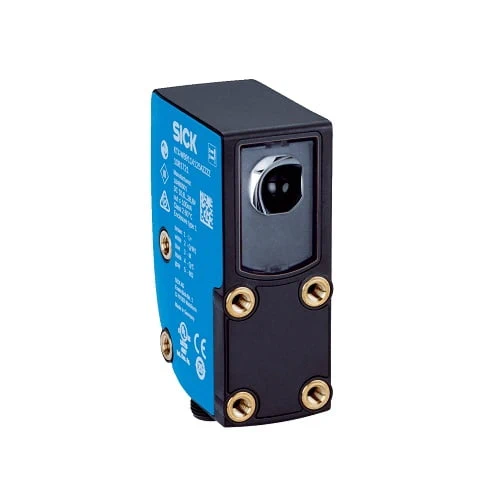
SICK 1222540 KTX RGB Contrast Sensor with PNP Output

USD 3,443.28

KTX-WP91141252ZZZZ combines RGB TwinEye contrast detection, a vertical 0.9 × 3.8 mm spot, PNP output, multiple teach modes and an M12 five-pin connector.

SKU SICK-1222540 Category

Out of stock

SICK KTX Prime

SICK KTX-WP91141252ZZZZ RGB Contrast Sensor

BrandSICK
Model IdentifierKTX-WP91141252ZZZZ
Official Part Number1222540

Technical Overview

The SICK KTX-WP91141252ZZZZ is an RGB LED contrast sensor with TwinEye technology and light emission from the long side of its housing. A vertical 0.9 × 3.8 mm spot detects contrast at the specified sensing distance of up to 13 mm, with ±5 mm tolerance. One-point, two-point, dynamic and automatic teaching support setup; dynamic teach-in is the delivery setting. The PNP output supports light/dark switching, with 50 kHz switching and 5 µs jitter under the stated conditions; one-point color mode uses 16 kHz and 15 µs jitter. A display, navigation buttons, five-pin M12 connection, VISTAL housing and COP optics support operation from −20 to +60 °C with IP67 protection.

RGB TwinEye contrast sensor with vertical 0.9 × 3.8 mm spot, PNP light/dark switching, multiple teach modes, display and M12 five-pin connection.

Key Features

  • RGB LED contrast sensing with TwinEye technology
  • Long-side light emission; vertical 0.9 × 3.8 mm spot relative to the long side
  • 470, 525 and 625 nm wavelengths; automatic optimum emitted-light selection during teaching
  • Specified sensing distance ≤13 mm; ±5 mm sensing-distance tolerance
  • One-point, two-point, dynamic and auto teach modes; dynamic teaching on delivery
  • PNP light/dark switching; total current of all outputs 100 mA
  • 50 kHz switching at 1:1 light/dark ratio; 16 kHz in one-point color mode
  • 10 µs response; 5 µs jitter, or 15 µs jitter in one-point color mode
  • Display, status LEDs, navigation buttons and five-pin M12 connector
  • VISTAL housing; COP optics; 94 g product weight; IP67; −20 to +60 °C operation

Teach the contrast between a mark and its background, then provide a PNP switching reference for external process control using the selected teaching mode.

Technical Specification Matrix

ParameterValue
Functional principleRGB LED contrast sensing
Device typeStandard; large housing design
Optical technologyTwinEye
Light emissionLong side of housing
Light spot size0.9 × 3.8 mm
Light spot directionVertical relative to long side of housing
Receiving filterNone
Wavelengths470 nm, 525 nm and 625 nm
LED service lifeAverage 100,000 h at +25 °C
Sensing distance≤13 mm
Sensing-distance tolerance±5 mm
Teach modesOne-point; two-point; dynamic; auto
Delivery settingDynamic teach-in
Parameter accessFull access to all settings
Emitted-light selectionOptimum emitted light selected automatically during teaching for RGB variants
Dynamic teachingMove at least mark and background through the spot; output active on mark when background occupies the field longer during teaching; threshold set midway between mark and background signals
Two-point teachingPresent mark and background separately; quality of teach displayed
Faulty-teach indicationBlinking pattern
Digital outputPNP; light/dark switching
Output signal voltageHIGH=Vs−3 V; LOW=0 V
Maximum output current100 mA total across all outputs
Switching frequency50 kHz at 1:1 light/dark ratio; 16 kHz in one-point teach-in color mode
Response time10 µs
Jitter5 µs; 15 µs in one-point teach-in color mode
External input functionsDatasheet lists teaching ET, blanking AT, fine/coarse F/C and light/dark L/D input functions; physical assignment follows configured inputs
Input activation levelsTeach / blanked / coarse / light: 10 V to below supply voltage for the respective listed function
ET retention time25 ms; nonvolatile memory
ConnectionM12 five-pin plug; movable connector shown in delivery and end-stop positions
Pin assignment1 BN=L+; 2 WH=Q/IN1; 3 BU=M; 4 BK=Q; 5 GY=IN2 (CD-382)
Power supply10.8–28.8 V DC; limit values 12 V −10% to 24 V +20%; short-circuit-protected network maximum 8 A
Ripple≤5 Vpp; remain within supply tolerances
Current consumption<100 mA without load
Protection classIII
Circuit protectionSupply connections reverse-polarity protected; output Q short-circuit protected; interference pulse suppression
Display and adjustmentDisplay, status LEDs and navigation buttons
Key lockStandard key-lock setting; activate/deactivate by holding + button for >10 s
MountingM5 threaded mounting holes
Housing materialVISTAL
Optics materialCOP
IP ratingIP67
Operating temperature−20 to +60 °C
Storage temperature−25 to +75 °C
Shock resistance30 g, 11 ms, IEC 60068-2-27
MTTFD291 years
UL fileE181493
Physical Weight (kg)0.094

Industrial Applications

1. Providing a registration reference for web cutting

A packaging web can carry repeated contrasting registration marks through the sensor’s light spot at the specified working distance. Teaching establishes the mark/background threshold and RGB illumination is selected automatically. The PNP output gives an external cutter controller a registration reference, with commissioning checking spot orientation, mark contrast, web speed and the switching/jitter limits for the selected teach mode.

Problem Solved

A contrast-mark reference helps an external cutter controller align its operation with repeated web graphics, using the taught mark transition and verified timing for the selected mode.

Web registration RGB contrast PNP timing

2. Checking an expected printed patch on a presented item

An inspection station can present a known printed patch and its surrounding surface beneath the sensor at a repeatable distance. Two-point teaching records the contrasting patch and background, and external inspection logic samples the PNP output during the expected presentation window. Setup verifies actual contrast and placement tolerance; the task uses a discrete taught condition rather than reading text or artwork.

Problem Solved

A taught contrast condition helps external inspection logic check whether an expected patch is presented at the monitored point, supporting a missing-print indication within a defined sampling window.

Printed-patch check Two-point teaching Discrete inspection

3. Setting up mark detection after a format change

A packaging station can run representative marked material through the light spot during dynamic teaching after changing the printed format. The sensor sets a threshold between mark and background signals and displays the quality of teach. The operator can also present the two surfaces separately with two-point teaching, checking the resulting switching condition before the external machine controller resumes normal operation.

Problem Solved

Displayed teaching quality and a repeatable mark/background setup help commissioning staff establish the contrast condition for a new format, reducing reliance on an unchanged setting from previous material.

Format setup Teaching quality Mark-background threshold

Select your currency