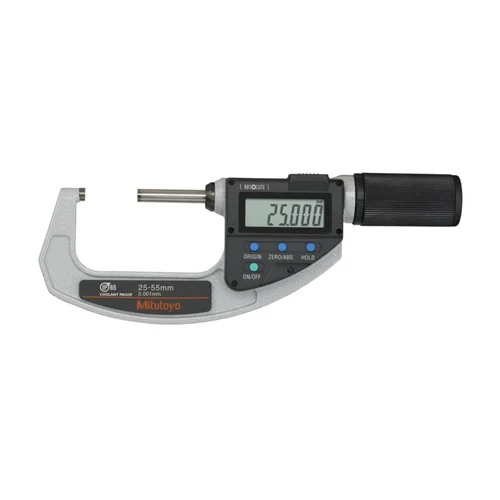
1. Rapid In-Process Inspection of Varied Precision Machined Shafts
In high-throughput CNC turning operations, operators must measure shafts of varying diameters directly on the shop floor. Standard micrometers with a 0.5 mm per revolution pitch are too slow, creating a production bottleneck. This micrometer solves this with a rapid 10 mm per revolution spindle feed, allowing operators to adjust and measure different sizes up to 20 times faster. Its IP65 rating enables safe use around splashing coolants and metal cutting fluids without risking damage to the digital encoder.
Problem SolvedBottlenecks in quality control on the shop floor caused by slow spindle adjustment speeds when inspecting workpieces of highly diverse diameters.
CNC turningSpindle feedIP65 protectionOutside diameterHigh-throughput inspection
2. Precision Measurement of Deformation-Sensitive Polymer Components
Engineers manufacturing high-precision rubber, plastic, or soft metal bushings with nominal sizes between 25 mm and 55 mm struggle with measurement errors caused by spindle rotation inducing shear forces or torsional deformation on the workpiece. This micrometer incorporates a non-rotating spindle and a constant-force ratchet stop (5 to 12 N), allowing the carbide measuring faces to close linearly on the material without inducing rotation-based torsion or compressive deformation, maintaining ±2 µm accuracy.
Problem SolvedMeasurement inaccuracy and surface scratching on soft, delicate, or deformation-sensitive polymer materials due to rotational friction from standard micrometer spindles.
Non-rotating spindleDeformation-sensitiveConstant forceCarbide measuring facesPolymer bushings
3. Statistical Process Control (SPC) Integration in Automotive Component Assembly
In automated or semi-automated automotive assembly lines, critical metal pins with diameters ranging from 25 mm to 55 mm must be verified and logged in real-time to comply with ISO 9001 and trace quality metrics. The micrometer's built-in Digimatic SPC data output allows direct connection to automated SPC software (via optional cables or U-WAVE wireless modules). This enables error-free, instant logging of the ±2 µm accurate measurements with a simple button press, eliminating transcription errors.
Problem SolvedHuman transcription errors and slow data logging times in high-volume, compliance-heavy manufacturing lines requiring SPC data tracking.
SPC data outputDigimatic interfaceAutomotive quality controlReal-time loggingMPE ±2 µm