1. Automotive Transmission Shaft Keyway Inspection
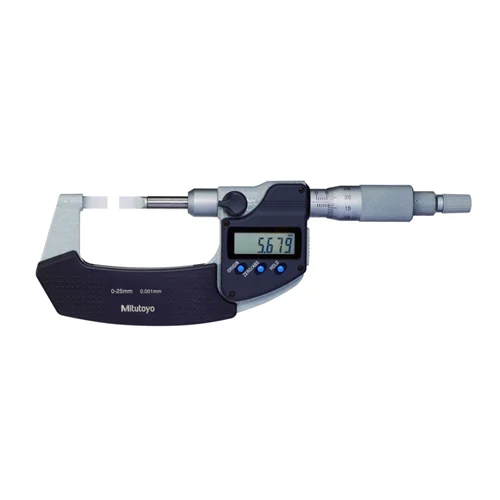
Quality control of precision-machined automotive transmission shafts requires verifying keyway groove depths. The 0.75 mm thin Type A blade easily slips into tight grooves, while the non-rotating spindle prevents damage to the newly machined keyway walls.
Problem SolvedStandard flat-faced micrometers cannot fit inside keyway grooves to measure root diameter, whereas standard rotating-spindle micrometers can twist and score precision-ground surfaces. The non-rotating blade design resolves both issues.
keyway measurementnon-rotating spindleType A bladegroove diameter
2. Robotic Gearbox Shaft Circlip Groove Verification
In robotic joint gearboxes, retaining ring (circlip) grooves must meet exact width and depth tolerances to prevent failure. This micrometer with ±3 µm accuracy and 0.001 mm resolution provides precise dimensional confirmation of the groove root diameter.
Problem SolvedUnintended variances in circlip groove depth can lead to snap rings popping out under high axial load. The high-resolution measurement ensures tight tolerance limits are verified before gearbox assembly.
circlip groovegroove root diameterhigh-resolution measurementrepeatable accuracy
3. Aerospace Micro-Turbine Spline Measurement
Measuring the minor diameter of external splines on small aerospace engine components requires a fine contact tip. The 0.75 mm blade can seat correctly between narrow splines to take high-accuracy measurements, with results logged instantly via SPC output.
Problem SolvedStandard micrometers are too bulky to fit between the teeth of fine splines. Manual tracking of measurements is slow and prone to transcription errors, which is completely bypassed using SPC digital integration.
spline diameternarrow spacingSPC data outputabsolute encoder