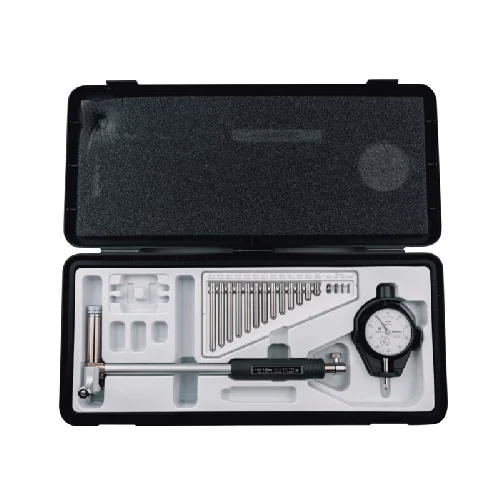
1. Automotive Cylinder Bore Inspection
Rebuilders and manufacturers of large automotive or marine engines use the bore gauge to measure engine block cylinder bores (typically around 100–160 mm) for wear, taper, and ovality.
Problem SolvedProlonged holding of conventional steel bore gauges causes thermal expansion of the tool, leading to measurement drift. The 511-714-20's hollow-structured grip reduces thermal transfer by 50%, maintaining ±2 µm accuracy throughout consecutive cylinder inspections.
Cylinder BoreTaper MeasurementOvalityThermal IsolationEngine Rebuilding
2. Hydraulic Cylinder Manufacturing and Quality Control
High-pressure hydraulic cylinders require extremely tight internal diameter tolerances to prevent fluid bypass under pressure. Quality control engineers use this gauge to inspect honed cylinder bodies prior to piston assembly.
Problem SolvedMeasuring deep bores up to 150 mm (expandable with rods) requires highly stable, repeatable centering. The pendulum guide structure and 0.5 µm repeatability of the 511-714-20 ensure concentric, uniform tolerance checks along the entire stroke of the hydraulic bore.
Hydraulic CylindersBore HoningInternal Diameter TolerancesPendulum Centering BridgeRepeatability
3. Heavy Machinery Bearing Housing Validation
Heavy industrial gearboxes and rotating machinery rely on press-fit bearings mounted in housing bores between 100 mm and 160 mm. Machinists use this gauge to verify the bore diameter is within specified limits before press-fitting.
Problem SolvedStandard steel contacts wear down quickly when measuring abrasive cast iron or hard steel housings, altering the baseline calibration. The carbide-tipped measuring faces of this gauge resist wear, ensuring long-term measurement consistency and preventing loose-fit bearing failures.
Bearing HousingPress-Fit TolerancesCarbide Contact PointsWear ResistanceMetrology Validation