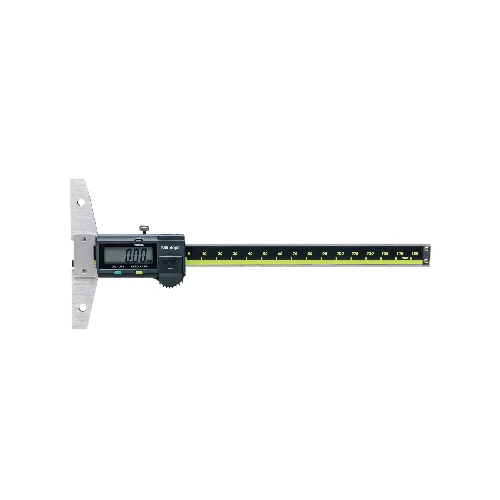
1. Machined Part Groove and Slot Inspection
Used in CNC machining facilities to measure the precise depth of milled slots, keyways, and recessed pockets up to 150 mm deep. The hardened, micro-lapped base provides stable positioning, while the ±0.02 mm accuracy ensures parts meet strict mechanical tolerances.
Problem SolvedPrevents out-of-tolerance depth defects in complex machined enclosures. By using the SPC data output, operators can transmit measurements directly to SPC software, reducing manual entry errors and maintaining high-throughput quality control.
CNC MachiningSlot Depth Measurement±0.02mm AccuracySPC Data OutputMicro-lapped Measuring Face
2. Injection Mold Core and Cavity Quality Control
Injection molding tools require exact cavity and step depths to ensure uniform plastic part wall thickness. The 571-201-30 allows metrologists to inspect ejector pin holes, cavity steps, and parting line recesses directly on the mold frame.
Problem SolvedPrevents molding flashing and structural wall failures caused by inaccurate mold plate depths. The ABSOLUTE linear encoder technology saves time by avoiding constant zero-point calibration when measuring multiple critical points across a large mold layout.
Injection MoldingMold Cavity DepthABSOLUTE Linear EncoderStep MeasurementRepeatability 0.01mm
3. Automotive Engine Block Blind Hole Depth Auditing
Ideal for automotive assembly lines to verify the depth of blind threaded holes and cylinder head bores before bolt fastening. The standard 100mm base spans the bore openings stably, and the slim beam easily reaches depths up to 150mm.
Problem SolvedEliminated the risk of bottoming out bolts in short-threaded blind holes, which can lead to improper clamping torque or engine block cracking. The unlimited response speed ensures that fast-moving technicians on the shop floor do not cause counting errors during high-speed sliding measurements.
Automotive AssemblyBlind Hole MeasurementUnlimited Response SpeedHardened Stainless SteelBore Depth Auditing