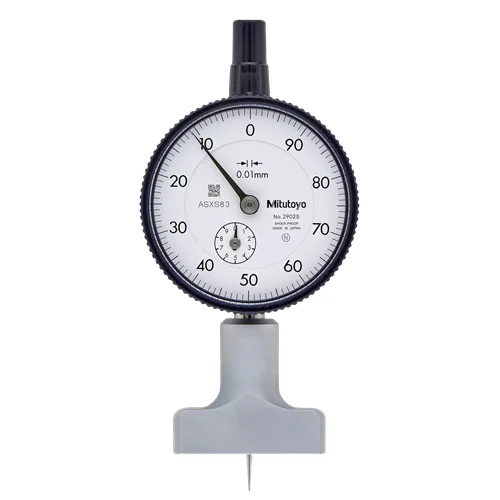
Mitutoyo 7210A Dial Depth Gauge

USD 201.00

Analog dial depth gauge with 0-10mm range, 0.01mm graduation, and ±15 µm accuracy. Features a 40x16mm hardened base and a sharp needle contact point.

SKU Mitutoyo-7210A Category
Top Brands > Mitutoyo > Mitutoyo Dial Depth Gauges

Mitutoyo 7210A Dial Depth Gauge

Model Identifier 7210A
Official Part Number 7210A
GTIN Standard 4946368851808

Technical Overview

Analog dial depth gauge with 0-10mm range, 0.01mm graduation, and ±15 µm accuracy. Features a 40x16mm hardened base and a sharp needle contact point.

Key Features

  • Hardened, precision ground, and micro-lapped rectangular reference base for maximum flatness
  • Back-plunger type dial indicator (Mitutoyo 2902AB) for convenient upward-facing readings
  • Equipped with a needle-point contact element (No. 137413) with a 0.2 mm radius for narrow grooves
  • Sturdy yet lightweight construction at approximately 205 grams
  • Measuring range of 0 to 10 mm with a stroke of 10 mm
  • High-accuracy reading with ±15 µm indication error limit and 0.01 mm graduation
  • Measuring force of 1.4 N or less to prevent workpiece deformation

Purely mechanical operation requiring no external power source or batteries

Technical Specification Matrix

ParameterValue
Measuring Range0 - 10 mm
Graduation0.01 mm
Accuracy±15 µm
Stroke10 mm
Base Flatness5 µm
Base Dimensions (W x T)40 mm x 16 mm
Measuring Force1.4 N or less
Contact PointNeedle point (Radius = 0.2 mm, No. 137413)
Dial Indicator Model2902AB
Total Height122 mm
Physical Weight (kg)0.21
Dimensions L x W x H (cm)4 x 5.7 x 12.2

Industrial Applications

1. Precision Groove Depth Inspection in Aerospace Machining

Verification of narrow turbine blade slots and internal micro-grooves that require microscopic depth precision without causing surface indentation or tooling damage.

Problem Solved

Standard ball-tipped probes cannot reach into thin channels, while high-force gauges can deform thin walls. The 7210A's 0.2 mm needle point easily accesses ultra-narrow channels with a low measuring force of 1.4 N to avoid micro-scratches.

groove depthneedle contact pointmicro-groovestoleranced depth

2. PCB Stencil and Solder Paste Pocket Depth Auditing

Continuous quality check of micro-machined apertures or tiny pocket steps on copper solder stencils to prevent soldering defects in electronics assembly.

Problem Solved

Ensures that the stencil foil thickness is uniform. The micro-lapped 40x16 mm rectangular base sits flat on tiny circuit boards and stencil frames, while the needle probe registers deviations within ±15 µm.

aperture depthlow measuring forceprecision stepnon-deformation

3. Step Height Calibration on Miniature Die-Cast Components

Measuring miniature step gaps and mating surfaces of tiny die-cast housings used in precise automotive sensor assemblies.

Problem Solved

Provides robust, rock-free seating on very narrow mating ledges where larger standard depth gauges overlap and wobble. The 5 µm flatness reference of the hardened base guarantees repeatable mechanical reference.

step heightblind holescompact basestable seatingmicro-lapped reference

Select your currency