1. Water Leak Detection under Raised Flooring in Server Rooms
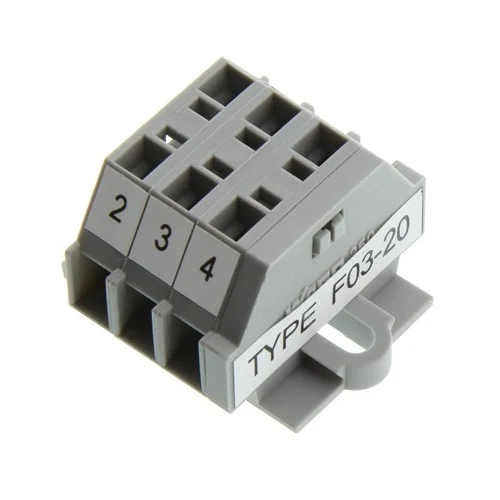
In modern data centers, chilled water lines run beneath raised floors to cool high-density server racks. Liquid sensing bands are laid directly onto the concrete subfloor to detect any pipe sweat or line breaks. The F03-20 terminal block is placed under the floor to securely join the flat sensing bands to the standard multi-conductor round signal cables routed back to the central K7L amplifier inside the main control cabinet.
Problem SolvedPrevents loose connections or signal loss caused by physical shifts under floor panels. The 1,000 VAC dielectric rating and stable spring-clamp termination maintain high-integrity monitoring of high-value IT infrastructure, preventing catastrophic short circuits.
Raised Floor DetectionData CentersSensing BandsSignal IntegrityUnderfloor Monitoring
2. Junction-Box Bridging in Cleanroom Chemical Leak Warning Systems
Semiconductor manufacturing sub-fab areas route highly corrosive chemical lines (acids, alkalis, and solvents). Bridging specialized fluoroplastic sensing bands (such as the F03-16PT) to the main panel cables requires a secure termination point. The F03-20 terminal block is mounted inside a sealed protective junction box near chemical tanks to facilitate this link.
Problem SolvedAlthough Nylon 6.6 is robust, directly exposing raw connections to chemical vapors can lead to degradation. Placing this compact, M3-mounted 3P block inside a localized junction box isolates the electrical termination, preventing chemical damage to the connection point and ensuring stable signal relay for low-conductivity chemicals.
Semiconductor CleanroomChemical Leak WarningFluoroplastic Sensing BandsJunction Box TerminationNylon 6.6 Housing
3. HVAC Condensate Pan Overflow Monitoring in Commercial Ceilings
In large commercial complexes, ceiling-mounted HVAC units use condensate drip pans that run the risk of overflowing and causing severe drywall and structural water damage. Point sensors (such as the F03-16PS) are placed in the pans to monitor level limits. The F03-20 acts as the local wiring aggregator, linking multiple parallel point sensors back to a single building automation controller.
Problem SolvedCeiling-mounted components are subjected to constant motor-induced vibrations. Standard screw-terminal blocks frequently back out or loosen over time, causing false sensor disconnections. The spring-tension clamping system in this terminal block maintains constant pressure on the wire cores, eliminating vibration-induced loose contacts in hard-to-access ceiling voids.
HVAC Condensate MonitoringVibration ResistancePoint SensorsSpring-Clamp TerminalsBuilding Automation