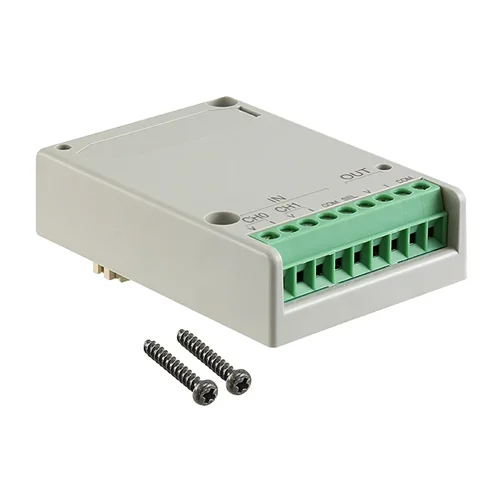
1. Precision Temperature Control in Industrial Furnaces
In industrial furnace applications, maintaining exact temperature profiles is crucial for material quality and energy efficiency. The AFPX-A21's 2-point 12-bit analog input can precisely read temperature sensor data (e.g., 0-10V from a transducer), while the 1-point 12-bit analog output can drive proportional control valves or heating elements (e.g., 4-20mA to a PID controller), allowing for accurate and stable temperature regulation.
Problem SolvedInaccurate temperature readings and unstable control loops leading to inconsistent product quality and wasted energy in heat treatment processes.
PID controltemperature sensoranalog signal processingfurnace automationclosed-loop control
2. Real-time Fluid Flow Monitoring and Regulation
For processes involving precise fluid dispensing or mixing, such as in chemical plants or pharmaceutical manufacturing, the AFPX-A21 provides essential analog I/O capabilities. Its 2-point analog input can acquire real-time data from multiple flow meters, and the 1-point analog output can command a proportional control valve, enabling a PLC to accurately monitor and adjust flow rates according to process requirements. The insulation ensures signal integrity in noisy industrial environments.
Problem SolvedInaccurate fluid flow rates resulting in incorrect mixture ratios, material waste, or product quality deviations.
Flow meterproportional valve controlchemical processingfluid dynamicsinsulated I/O
3. Machine Tool Positional Feedback and Speed Control
In machine tool applications requiring fine positional control or variable speed drive integration, the AFPX-A21 is ideal. Its 2-point analog inputs can receive feedback from linear displacement sensors or potentiometers (e.g., 0-10V signals) to monitor axis positions, while the 1-point analog output can provide a setpoint signal (e.g., 0-20mA) to a variable frequency drive (VFD) for precise motor speed control. This enables the PLC to execute complex motion profiles with high accuracy.
Problem SolvedLack of precision feedback mechanisms and control for motor speeds and positions in automated machinery, leading to reduced machining accuracy and efficiency.
Machine automationVFD controlpositional feedbacklinear displacement sensormotion control