1. Remote Temperature Monitoring in Process Control
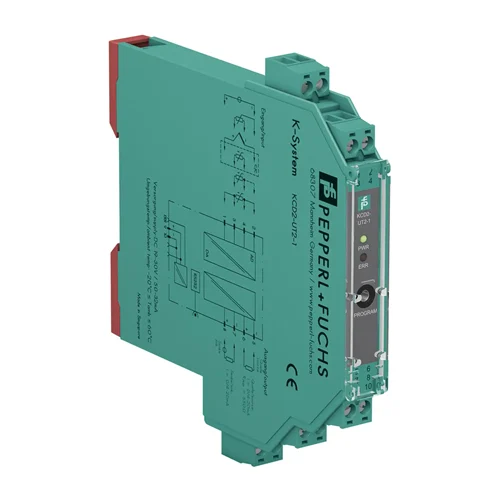
In a chemical processing plant, numerous reaction vessels and pipelines require precise temperature monitoring using various RTD or thermocouple sensors. The KCD2-UT2-1 can convert these diverse temperature sensor signals (RTD, Thermocouple) into a standardized 4-20mA current loop, which is then transmitted over long distances to the central control system (DCS or PLC). The galvanic isolation protects the control system from noise and potential ground loops originating in the noisy field environment.
Problem SolvedConverts diverse temperature sensor types to a unified, noise-immune 4-20mA signal for reliable long-distance transmission to control systems, while providing galvanic isolation.
RTDThermocouple4-20mA current loopgalvanic isolationprocess controlDCSPLCtemperature monitoring
2. Machine Health Monitoring in Manufacturing
Critical machinery (e.g., motors, bearings, gearboxes) in a manufacturing facility generates heat. Monitoring their temperature with RTD sensors is crucial for predictive maintenance. The KCD2-UT2-1 modules installed on a DIN rail convert the RTD signals into 4-20mA, feeding into an asset management system. Its SIL 2 rating ensures that temperature excursions triggering safety shutdowns are reliably detected, preventing catastrophic equipment failure and ensuring personnel safety.
Problem SolvedProvides reliable, safety-rated temperature signal conditioning for predictive maintenance and safety interlocks, converting RTD inputs to standard 4-20mA for asset management systems.
RTDmachine healthpredictive maintenance4-20mASIL 2safety shutdownasset managementmanufacturing
3. Building Automation for HVAC Temperature Control
In large commercial buildings, precise temperature control for HVAC systems is vital for energy efficiency and occupant comfort. Distributed temperature sensors (RTDs) throughout the building require conversion to a centralized control system. The KCD2-UT2-1 can convert these RTD inputs into standard 0-20mA or 4-20mA signals, allowing precise monitoring and control of ventilation and heating/cooling units. The ease of configuration via PACTware simplifies commissioning and maintenance.
Problem SolvedConverts multiple RTD temperature inputs to standardized current signals for efficient and centralized HVAC control, enhancing energy management and comfort.
HVACbuilding automationRTD0-20mA4-20mAenergy efficiencyPACTwaretemperature control