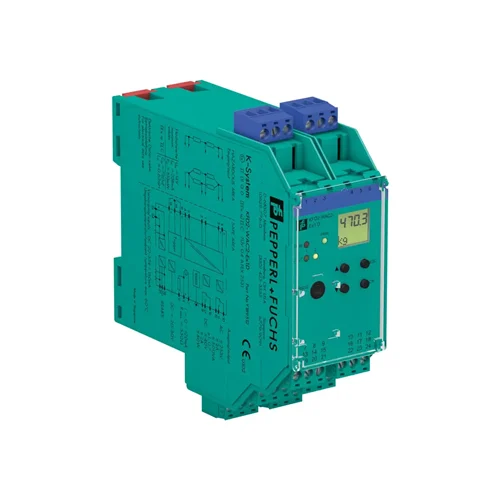
1. Hazardous Area Weighing Systems
This converter is ideally suited for connecting load cells and strain gauges in explosive atmospheres (e.g., chemical plants, oil and gas processing) where intrinsic safety (Ex ia Ga/Da/Ma) is paramount. It galvanically isolates the hazardous area input from the safe area output, ensuring personnel and plant safety while transmitting precise weight data.
Problem SolvedProvides a safe, isolated interface for weight measurement in Zone 0/1/2 or Division 1/2 hazardous locations, preventing ignition from electrical faults while maintaining high measurement accuracy.
Intrinsic SafetyHazardous AreaLoad CellsStrain GaugesGalvanic IsolationWeight Measurement
2. Industrial Tank Level Monitoring
In chemical storage or food processing facilities, strain gauge-based level sensors (load cells under tanks) can be precisely monitored. The KFD2-WAC2-EX1.D converts the mV signals from the strain gauges into standard 0/4-20 mA or 0/±10 V outputs for PLC/DCS integration, with programmable high/low alarms for critical level thresholds. Its IP20 rating requires installation within a suitable enclosure, typical for control cabinet mounting.
Problem SolvedAccurately and reliably converts low-level strain gauge signals from tank level sensors into robust analog signals for control systems, with built-in alarm capabilities for process safety and control.
Tank Level SensingStrain Gauge TransducersAnalog OutputProcess ControlProgrammable Alarms
3. Structural Health Monitoring of Bridges/Buildings
For long-term monitoring of stress and strain in civil structures, this converter can interface with arrays of strain gauges. Its RS-485 capability allows for networked data acquisition from multiple units over long distances, transmitting 20-bit resolution measurements to a central monitoring system, even in environments with temperatures ranging from -20 to 60 °C.
Problem SolvedEnables distributed, high-resolution data acquisition from strain gauges in large structures, facilitating continuous structural health monitoring and predictive maintenance through an RS-485 network.
Structural MonitoringStrain AnalysisRS-485 CommunicationData AcquisitionPredictive Maintenance