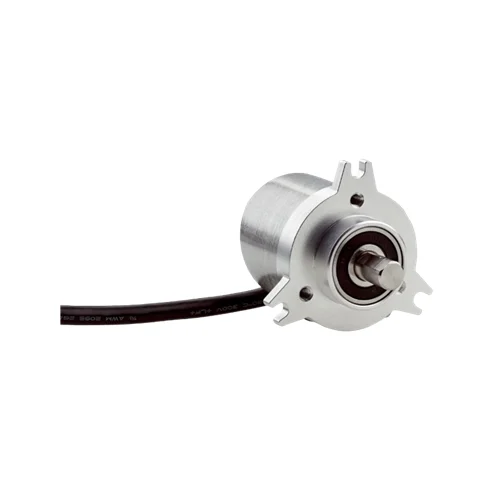
SICK 1109519 DBS50E-SKAK01024 TTL Incremental Encoder

USD 289.90

1,024-pulse TTL/RS-422 incremental encoder with 8 mm solid shaft, three-M4 face-mount flange, 4.5–5.5 V supply and 1.5 m eight-wire PVC cable.

SKU SICK-1109519 Category
SICK Encoders

SICK DBS50E-SKAK01024 TTL Incremental Encoder

BrandSICK
Model IdentifierDBS50E-SKAK01024
Official Part Number1109519

Technical Overview

The SICK DBS50E-SKAK01024 is a 1,024-pulse-per-revolution incremental encoder with six-channel TTL/RS-422 signaling. Its A, B and reference Z signals have complementary channels, with one 90° electrical reference signal logically gated with A and B. An 8 mm stainless steel solid shaft with flat and 13 mm shaft length connects the measured rotation, while the face-mount flange provides three M4 mounting points. The 4.5–5.5 V device uses a 1.5 m eight-wire universal PVC cable and initializes in less than 3 ms. Aluminum housing and flange provide IP65 protection. Continuous operation is specified at 6,000 rpm with a self-heating allowance; the 8,000 rpm maximum is restricted to non-permanent operation with decreasing signal quality.

1,024-pulse incremental encoder with six-channel TTL/RS-422 outputs, 8 mm solid shaft, three-M4 face-mount flange and 1.5 m cable.

Key Features

  • 1,024 pulses per revolution; incremental TTL/RS-422 interface
  • Six signal channels: A, B, Z and their complementary signals
  • One 90° electrical reference signal, logically gated with A and B
  • 4.5–5.5 V supply; initialization <3 ms; output frequency ≤300 kHz
  • 8 mm stainless steel solid shaft with flat; shaft length 13 mm
  • Face-mount flange with three M4 mounting points
  • 1.5 m eight-wire universal PVC cable; aluminum housing and flange
  • 6,000 rpm operating speed with 3.3 K per 1,000 rpm self-heating allowance
  • IP65; −20 to +85 °C standard operation; 90% humidity without condensation
  • Reverse-polarity protection; output short-circuit protection with correctly connected supply and ground

Provide differential incremental rotation and reference signals to a compatible counter or drive through a compact face-mounted solid-shaft encoder.

Technical Specification Matrix

ParameterValue
Product typeIncremental rotary encoder
Pulses per revolution1,024
Measuring step90° electrical / pulses per revolution
Measuring step deviation±18° / pulses per revolution
Error limits±54° / pulses per revolution
Duty cycle≤0.5 ±5%, as specified by manufacturer
Electrical interfaceTTL / RS-422
Signal channelsSix: A, complementary A, B, complementary B, Z, complementary Z
Reference signalOne; 90° electrical; logically gated with A and B
Initialization time<3 ms
Output frequency≤300 kHz
Load current≤30 mA
Operating current≤50 mA without load
Power supply4.5–5.5 V
Connection1.5 m eight-wire universal PVC cable
Conductor functionsWH=A; BN=complementary A; PK=B; BK=complementary B; VT=Z; YE=complementary Z; BU=GND; RD=+US
Protective functionsReverse-polarity protection; output short-circuit protection only with US and GND correctly connected
Mechanical designSolid shaft; face-mount flange, three M4 mounting points
Shaft diameter8 mm with flat
Shaft length13 mm
Shaft materialStainless steel
Flange materialAluminum
Housing materialAluminum
Nominal flange diameter50 mm
Start-up torque+0.9 Ncm at +20 °C
Operating torque0.6 Ncm at +20 °C
Permissible shaft loading30 N axial; 50 N radial
Operating speed6,000 rpm; allow self-heating of 3.3 K per 1,000 rpm
Maximum speed8,000 rpm; no permanent operation; decreasing signal quality
Rotor moment of inertia0.65 gcm²
Bearing lifetime2 × 10⁹ revolutions
Angular acceleration≤500,000 rad/s²
IP ratingIP65
Operating temperature−20 to +85 °C standard; −35 to +95 °C available on request
Storage temperature−40 to +100 °C without packaging
Relative humidity90%; condensation not permitted
Shock resistance100 g, 6 ms, EN 60068-2-27
Vibration resistance20 g, 10–2,000 Hz, EN 60068-2-6
EMCEN 61000-6-2 and EN 61000-6-3, class A
MTTFD600 years, EN ISO 13849-1; nominal loads, average ambient +40 °C, 8,760 h/year; all electronic failures considered hazardous; standard product, not a safety component
Physical Weight (kg)0.17

Industrial Applications

1. Tracking relative travel from a driven roller

A transport machine can couple the solid shaft to a suitable roller or drive shaft and count the A/B signals in external position electronics. The 1,024 pulses per revolution provide a rotational increment basis; the controller relates counts to roller circumference and gearing. Actual travel accuracy also depends on mechanical coupling and slip at the installed transport mechanism.

Problem Solved

Incremental shaft movement gives external position electronics a basis for tracking relative transport travel, helping coordinate motion against the machine’s measured count reference.

Relative travel 1,024 pulses A/B channels

2. Deriving shaft speed for drive monitoring

A compatible counter or drive can measure the rate of incremental pulses and calculate rotational speed. Six-channel TTL/RS-422 signaling provides the differential signal pairs, while the 300 kHz output limit and stated mechanical speed ratings define operating constraints. Drive integration accounts for the supply range, input characteristics and speed-dependent self-heating at the installed ambient temperature.

Problem Solved

Pulse-rate feedback gives external drive monitoring a rotation-rate reference, helping compare actual shaft motion with the commanded operating speed during normal machine operation.

Speed monitoring TTL/RS-422 Pulse rate

3. Establishing a repeatable rotational index for a machine cycle

A cyclic machine can use the Z reference signal to identify one position within each revolution after the controller has established its machine reference. The 90° electrical reference is logically gated with A and B, so compatible counting electronics can associate the index with the incremental phase sequence. The encoder supplies incremental rather than multi-turn absolute position.

Problem Solved

A reference event within each revolution gives external cycle logic an index for aligning repeated motion, helping associate incremental counts with the machine’s established rotational reference.

Rotational index Reference Z Cycle alignment

Select your currency