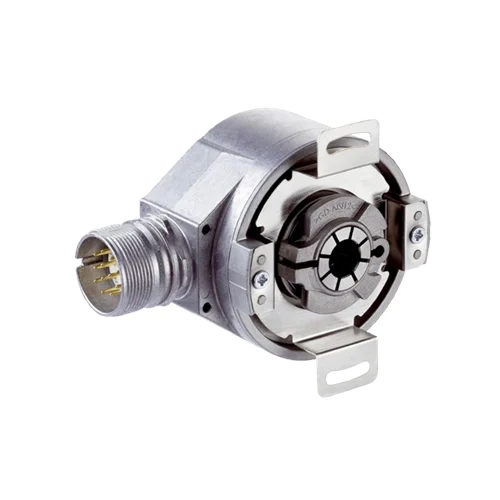
| Product type | Incremental rotary encoder |
| Pulses per revolution | 10,000; usable speed depends on pulse count and output-frequency limit |
| Measuring step | 90 electrical degrees / pulses per revolution |
| Measuring-step deviation | ±0.01° at non-binary number of lines |
| Error limits | ±0.05° |
| Signal interface | Six-channel TTL/HTL; programmable; factory output level TTL |
| Signal channels | A, B, Z and their inverted counterparts |
| Reference signal | One; 90 electrical degrees, logically gated with A and B |
| Electrical zero-pulse widths | 90° gated with A and B; 180° gated with B or A; 270° gated with A or B |
| Mechanical zero-pulse width | Programmable 1–359° of one mechanical shaft revolution |
| Initialization time | 32 ms; 30 ms with mechanical zero-pulse width |
| Output frequency | ≤600 kHz |
| Load current | ≤30 mA |
| Power consumption | ≤0.7 W without load |
| Power supply | 4.5–32 V |
| Connection | Radial M23 twelve-pin male connector |
| Pin assignment | M23: 1=B inverted; 3=Z; 4=Z inverted; 5=A; 6=A inverted; 8=B; 10=GND; 12=Us; 2, 9 and 11=not assigned |
| Cable screen | Screen connected to housing at encoder side; connected to ground at control side |
| Reverse-polarity protection | Provided |
| Output short-circuit protection | TTL at ≥5.5 V: other channel or GND, maximum 30 s; HTL or TTL at <5.5 V: other channel, Us or GND, maximum 30 s |
| Mechanical design | Blind hollow shaft |
| Shaft diameter | 14 mm; F7 bore tolerance; mating customer shaft j7 |
| Shaft engagement | Minimum 15 mm; maximum 42 mm |
| Shaft material | Stainless steel |
| Flange material | Aluminum |
| Housing material | Aluminum die cast |
| Start-up torque | 0.8 Ncm at +20 °C |
| Operating torque | 0.6 Ncm at +20 °C |
| Permissible static movement | ±0.3 mm radial; ±0.5 mm axial |
| Permissible dynamic movement | ±0.1 mm radial; ±0.2 mm axial |
| Operating speed | ≤6,000 rpm mechanical limit; also respect selected pulse count, ≤600 kHz output-frequency limit and manufacturer speed curve |
| Self-heating | Allow 3.3 K per 1,000 rpm when designing operating temperature range |
| Rotor moment of inertia | 40 gcm² |
| Bearing lifetime | 3.6 ×10^10 revolutions |
| Angular acceleration | ≤500,000 rad/s² |
| IP rating | IP67 housing/connector side with mating connector fitted; IP65 shaft side, IEC 60529 |
| Operating temperature | −40 to +100 °C with stationary cable; −30 to +100 °C with flexible cable; account for speed-related self-heating |
| Storage temperature | −40 to +100 °C without package |
| Relative humidity | 90%; condensation not permitted |
| Shock resistance | 70 g, 6 ms; EN 60068-2-27 |
| Vibration resistance | 30 g, 10–2,000 Hz; EN 60068-2-6 |
| EMC | EN 61000-6-2 and EN 61000-6-3 |
| MTTFD | 300 years, EN ISO 13849-1; standard product, not a safety component; calculation at nominal component load, average ambient +40 °C and 8,760 h/year, with all electronic failures considered hazardous |
| Listed programming tools | PGT-08-S 1036616; PGT-10-Pro 1072254; separate accessories |
| Physical Weight (kg) | 0.2 |