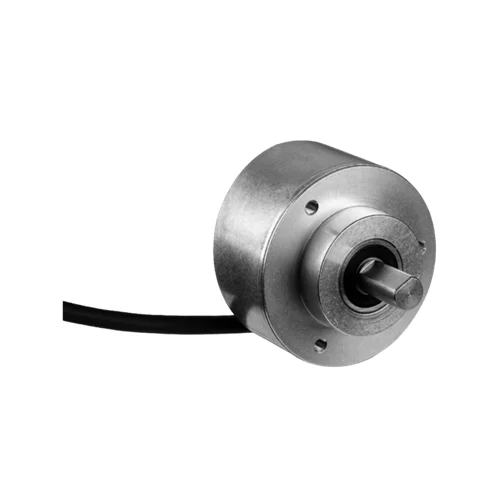
SICK 1037401 DFS60E-S4EK00200 HTL/push-pull Incremental Encoder

USD 305.24

200 pulses/rev, six-channel HTL/push-pull signals, a Ø10 × 19 mm solid shaft, face-mount flange and 1.5 m eight-wire universal cable provide rotary feedback.

SKU SICK-1037401 Category
SICK Encoders

SICK DFS60E-S4EK00200 HTL/push-pull Incremental Encoder

BrandSICK
Model IdentifierDFS60E-S4EK00200
Official Part Number1037401

Technical Overview

The SICK DFS60E-S4EK00200 is an incremental rotary encoder with 200 pulses per revolution and six HTL/push-pull signal channels. Its A/B quadrature signals and complementary channels support external evaluation of rotary movement, while one reference pulse is gated with A and B over 90 electrical degrees. The solid stainless-steel shaft measures Ø10 × 19 mm and uses a face-mount flange with an aluminum flange and die-cast aluminum housing. Connection uses a 1.5 m eight-wire universal cable, and supply is 10–32 V DC. Maximum output frequency is 300 kHz, with operation up to 9,000 rpm subject to self-heating. Protection is IP65 at the shaft and IP67 at the housing/cable-connection side.

Incremental encoder with 200 pulses/rev, six HTL/push-pull channels, Ø10 × 19 mm solid shaft, face-mount flange and 1.5 m eight-wire universal cable.

Key Features

  • 200 pulses per revolution; incremental A/B quadrature signals
  • Six HTL/push-pull channels: A/A̅, B/B̅ and Z/Z̅
  • One reference pulse, 90° electrical and logically gated with A and B
  • Maximum output frequency ≤300 kHz; 40 ms initialization
  • Ø10 × 19 mm stainless-steel solid shaft; face-mount flange
  • 1.5 m eight-wire universal cable; 10–32 V DC
  • Operating speed ≤9,000 rpm with self-heating of 3.3 K per 1,000 rpm
  • Permissible shaft load 80 N radial and 40 N axial
  • Aluminum flange and die-cast aluminum housing
  • IP65 shaft side; IP67 housing/cable-connection side

Provide incremental rotary signals and a once-per-revolution reference to external motion control through the selected HTL/push-pull interface.

Technical Specification Matrix

ParameterValue
Functional principleIncremental rotary encoder
Pulses per revolution200
Measuring step90° electrical / pulses per revolution
Measuring-step deviation±0.2° for non-binary pulse counts
Error limits±0.3°
Electrical interfaceHTL/push-pull
Signal channelsSix: A, A̅, B, B̅, Z and Z̅
Initialization time40 ms
Maximum output frequency≤300 kHz
Load current≤30 mA
Power supply10–32 V DC
Reference signalOne reference pulse; 90° electrical, logically gated with A and B
Connection1.5 m eight-wire universal cable
Output short-circuit protectionShort circuit to another channel, US or GND permissible for a maximum of 30 s
Mechanical designSolid shaft; face-mount flange
Shaft diameter10 mm, with flat
Shaft length19 mm
Shaft materialStainless steel
Flange materialAluminum
Housing materialDie-cast aluminum
Start-up torque0.5 Ncm at +20 °C
Operating torque0.3 Ncm at +20 °C
Permissible shaft load80 N radial; 40 N axial
Operating speed≤9,000 min⁻¹; allow for self-heating of 3.3 K per 1,000 rpm
Rotor inertia6.2 gcm²
Bearing life3.6 × 10¹⁰ revolutions
Angular acceleration≤500,000 rad/s²
EMCEN 61000-6-2 and EN 61000-6-4
IP ratingIP67 housing/cable-connection side; IP65 shaft side, IEC 60529
Relative humidity90%; condensation not permitted
Operating temperature0 to +85 °C
Storage temperature−40 to +100 °C without packaging
Shock resistance50 g, 6 ms; EN 60068-2-27
Vibration resistance20 g, 10–2,000 Hz; EN 60068-2-6
MTTFD300 years, EN ISO 13849-1; nominal component load, average ambient +40 °C and 8,760 h/year; standard product, not a safety component
Universal cable outletPermits cable routing in a radial or axial direction without bends at the outlet
Conductor functionsWH=A; BN=A̅; PK=B; BK=B̅; VT=Z; YE=Z̅; BU=GND; RD=+US
Cable diameter5.6 ±0.2 mm
Cable bend radius30 mm
Centering hubØ36 mm f8
Mounting holesThree M4 holes, 6 mm deep, on Ø48 ±0.05 mm pitch circle at 120°
Shield connectionScreen connected to encoder housing; connect to ground at the control side
Power consumption≤0.5 W without load
Reverse-polarity protectionProvided
Physical Weight (kg)0.3

Industrial Applications

1. Regulating conveyor drive speed

A conveyor drive can couple its rotating shaft to the encoder and feed the six-channel HTL/push-pull signals to a compatible external counter or drive input. The controller derives speed from pulse timing using 200 pulses per revolution and compares it with the commanded motion. Installation accounts for the shaft interface, documented load limits, output-frequency ceiling and speed-related self-heating.

Problem Solved

Pulse timing gives the external drive controller a measured rotation-rate reference, helping it regulate conveyor speed as operating load and commanded motion change.

Speed feedback HTL/push-pull 200 pulses/rev

2. Measuring material feed length from roller rotation

A material-feed machine can mechanically couple the encoder to a feed roller and let an external counter accumulate A/B pulses during each feed cycle. Known roller circumference and transmission ratio convert rotation into relative feed length. Direction evaluation distinguishes forward feed from reverse travel, while setup checks mechanical slip, counter capacity and the encoder’s specified pulse count and output-frequency limit.

Problem Solved

Accumulated rotary pulses give the feed controller a relative travel reference, supporting length-based sequencing through the machine’s known roller geometry and transmission ratio.

Relative feed length A/B direction External counter

3. Establishing a cyclic shaft reference for a machine sequence

A cyclic machine can use the Z reference signal to establish one phase reference per shaft revolution, then track subsequent A/B movement in external sequence logic. The reference pulse is logically gated with A and B over 90 electrical degrees. Commissioning associates that recurring mark with the machine’s mechanical cycle and establishes the required startup reference before relative position is used.

Problem Solved

A recurring reference pulse gives external sequencing logic a consistent cycle-origin event, helping relate subsequent incremental movement to a defined mechanical phase after referencing.

Cycle phase Z reference External sequencing

Select your currency