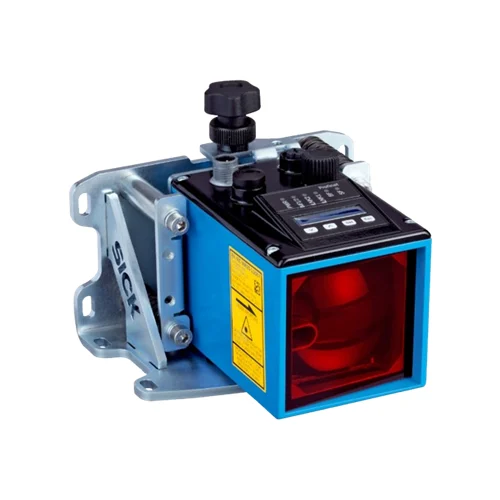
SICK 1086985 DL100-22AA2212 200 m PROFINET Laser Distance Sensor

USD 1,545.96

Measure 0.15–200 m to Diamond Grade tape with PROFINET, 2 ms response, 1 ms measurement cycle, two push-pull outputs and a local dot-matrix display.

SKU SICK-1086985 Category
Laser Distance Sensors - SICK Dx100

SICK DL100-22AA2212 200 m PROFINET Laser Distance Sensor

BrandSICK
Model IdentifierDL100-22AA2212
Official Part Number1086985

Technical Overview

The SICK DL100-22AA2212 is a High Feature time-of-flight distance sensor for Diamond Grade reflective tape over 0.15–200 m. A visible Class 2 red laser supports a 2 ms response, 1 ms measurement cycle and 1 ms output time. PROFINET and two push-pull PNP/NPN outputs connect distance, speed or service conditions to external control. Resolution is adjustable, while the 1 mm repeatability specification requires constant environmental conditions and at least 10 minutes of warm-up. The 18–30 V DC unit uses an aluminum die-cast housing, PMMA window, M12 connections and IP65 protection. A six-digit dot-matrix display and local controls support commissioning and observation.

High Feature 0.15–200 m reflector distance sensor with PROFINET, Class 2 red laser, two push-pull outputs and local display.

Key Features

  • 0.15–200 m measuring range on Diamond Grade reflective tape
  • High Feature version with PROFINET, network load Class III
  • Visible red Class 2 laser to IEC/EN 60825-1:2014
  • 2 ms response; 1 ms measurement cycle and output time
  • Adjustable 0.1/0.125/1/10/100 mm resolution
  • 1 mm repeatability at 1σ with constant environment and ≥10 min warm-up
  • ±2.5 mm accuracy; up to ±4 mm at 150–180 mm range
  • Two push-pull PNP/NPN outputs with distance, speed and service functions
  • 15 m/s maximum movement speed; ≤15 m/s² maximum acceleration
  • 18–30 V DC; M12 connections; aluminum/PMMA; IP65; six-digit display

Provide reflector-based distance feedback through PROFINET while using configurable outputs for distance, speed or service conditions.

Technical Specification Matrix

ParameterValue
Functional principleOptical time-of-flight distance sensing
Feature scopeHigh Feature
TargetDiamond Grade reflective tape
Measuring range0.15–200 m on Diamond Grade reflective tape
Resolution0.1 / 0.125 / 1 / 10 / 100 mm; freely adjustable
Repeatability1 mm, statistical error 1σ, constant environmental conditions and minimum 10 min warm-up
Measurement accuracy±2.5 mm; may reach ±4 mm at 150–180 mm measuring range
Response time2 ms
Measurement cycle time1 ms
Output time1 ms
Light sourceVisible red laser; average service life 100,000 h at +25 °C
Laser class2; IEC 60825-1:2014 and EN 60825-1:2014
Typical spot size5 mm + 2 mm ×distance in meters
Maximum movement speed15 m/s
Maximum acceleration≤15 m/s²
PROFINETProvided; network load Class III
Digital outputsTwo push-pull PNP/NPN outputs
Output functionsDistance switching; speed output; service warning; laser-off; preset
Service-warning conditionsSensor aging; excessive damping such as contamination; internal temperature outside permitted range; measured-value plausibility error; laser not ready; heating switched on
Output current≤100 mA; load maximum 100 nF / 20 mH
Output HIGH/LOW>Vs −3 V / <2 V
Multifunction inputOne MF1; HIGH >12 V, LOW <3 V
Power supply18–30 V DC, limit values
Current consumption<250 mA at 24 V DC
Ripple5 Vpp; remain within supply-voltage tolerances
Modulation frequencyFixed
Initialization timeTypical 1.5 s; <40 ms after reflector loss
DisplaySix-digit 5 ×7 dot-matrix display, LEDs and control elements
ConnectionM12 male connector, SPEEDCON compatible; PROFINET port 1/2 and Ethernet connections shown
Supply pin assignment1 BN=L+; 2 WH=MF2; 3 BU=M; 4 BK=MF1
Ethernet pin assignment1=Tx+; 2=Rx+; 3=Tx−; 4=Rx−
Housing materialAluminum die-cast metal
Window materialPMMA plastic
IP ratingIP65
Protection classIII
Operating temperature−20 to +55 °C; −20 to +75 °C with cooling case
Cold operationBelow −10 °C requires typical 7 min warm-up
Storage temperature−40 to +75 °C
Air-pressure influence0.3 ppm/hPa
Air-temperature influence1 ppm/K
Temperature driftTypical 0.1 mm/K
Typical ambient-light immunity≤100,000 lx
Mechanical-load standardsShock EN 60068-2-27; sine EN 60068-2-6; noise EN 60068-2-64
EMCEN 61000-6-2 and EN 61000-6-4; Class A device
MountingM5 threaded mounting holes
MTTFD101 years
DCavg0%
Physical Weight (kg)0.8

Industrial Applications

1. Providing a travel-position reference for a storage crane

A storage-crane axis can carry Diamond Grade reflective tape facing the fixed sensor along its travel direction. PROFINET transfers the measured distance to external motion control, which establishes the required machine-coordinate reference. Commissioning accounts for tape alignment, the 0.15–200 m range, accuracy near the minimum distance, environmental influences and warm-up, while assessing intended motion against the documented speed and acceleration limits.

Problem Solved

Reflector-based distance feedback gives external crane control a travel-position reference along the installed optical path, supporting coordination of movement with the established machine coordinate.

Travel feedback PROFINET Reflective tape

2. Reporting a configured speed condition on a moving carriage

A guided carriage can present its reflective target along the sensor path while external control configures an output for the documented speed function. The push-pull signal supplies a discrete process condition to a compatible input. Setup relates the selected condition to the intended carriage sequence and checks target tracking, receiver behavior and the stated 15 m/s movement and acceleration limits.

Problem Solved

A configured speed-related output gives external sequencing logic a carriage-motion condition, helping coordinate process operations with movement measured along the reflector path.

Speed condition Push-pull output Carriage sequencing

3. Monitoring service conditions on a long optical path

A maintenance system can configure a push-pull output for service warnings while the sensor operates against its reflector. The documented warning conditions include excessive damping, aging, internal temperature limits, plausibility errors and laser readiness. Maintenance relates the signal to the available local display and device information, then inspects alignment, optical surfaces or environmental conditions according to the observed fault context.

Problem Solved

A service-warning condition gives external maintenance logic an early process reference for investigating degraded optical or device conditions before relying only on a missing distance response.

Service warning Optical damping Maintenance

Select your currency