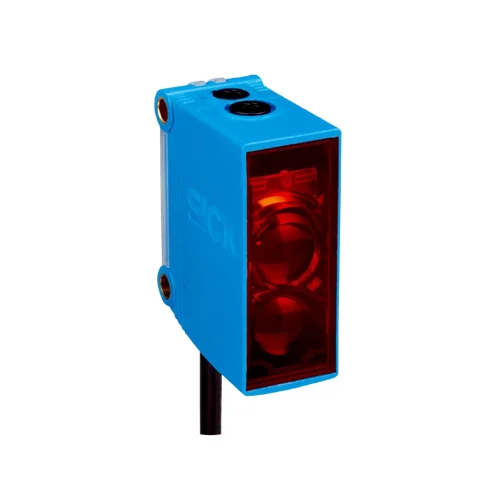
SICK 1065888 GL10-N1211 NPN Retro-reflective Sensor

USD 56.68

GL10-N1211 combines polarized retro-reflective sensing, 0.15–12 m range with PL80A, red PinPoint LED, NPN output, 1,000 Hz switching and 2 m cable.

SKU SICK-1065888 Category
SICK G10

SICK GL10-N1211 NPN Retro-reflective Sensor

BrandSICK
Model IdentifierGL10-N1211
Official Part Number1065888

Technical Overview

The SICK GL10-N1211 is a polarized retro-reflective photoelectric sensor with a dual-lens optical system and a minimum reflector distance. With a PL80A reflector, sensing range is 0.15–12 m and maximum range is 0.08–15 m; ranges differ with other reflectors. Its 625 nm red PinPoint LED produces a 58 mm spot at 5 m. A 270° potentiometer adjusts the sensing range, while a separate selector sets light or dark switching for the single NPN output. Response is no more than 500 µs with a resistive load, and switching frequency is 1,000 Hz at a 1:1 light/dark ratio. The IP67 ABS housing uses PMMA optics and a 2 m three-wire PVC cable.

Polarized retro-reflective sensor with 0.15–12 m PL80A sensing range, red PinPoint LED, NPN output, light/dark selection and 2 m PVC cable.

Key Features

  • Polarized retro-reflective sensing; dual-lens system with minimum reflector distance
  • PL80A: 0.15–12 m sensing range; 0.08–15 m maximum range
  • P250: 0.15–10 m sensing range; 0.08–12 m maximum range
  • 625 nm visible red PinPoint LED; Ø58 mm spot at 5 m
  • 270° sensing-range potentiometer and separate light/dark selector
  • Single NPN output; output current ≤100 mA
  • ≤500 µs response with resistive load; 1,000 Hz at 1:1 light/dark ratio
  • 10–30 V DC; 20 mA consumption; 2 m three-wire PVC cable
  • Yellow received-light indicator and green power indicator; Ø4.2 mm mounting holes
  • ABS housing; PMMA optics; IP67; −30 to +60 °C operation

Establish a reflected optical path to a separate reflector and send beam-interruption events to external counting, material-flow or occupancy logic.

Technical Specification Matrix

ParameterValue
Functional principlePolarized retro-reflective photoelectric sensing; dual-lens system with minimum reflector distance
Sensing range0.15–12 m with PL80A reflector; 0.15–10 m with P250 reflector
Maximum sensing range0.08–15 m with PL80A reflector; 0.08–12 m with P250 reflector
Light sourceVisible red PinPoint LED; 625 nm
Light spot sizeØ58 mm at 5 m
Average LED service life100,000 h at +25 °C
AdjustmentSensing-range potentiometer, 270°
Switching modeLight/dark switching, selected with separate rotary selector
Switching outputSingle NPN output
Output current≤100 mA
Response time≤500 µs signal transit time with resistive load
Switching frequency1,000 Hz at 1:1 light/dark ratio
Power supply10–30 V DC; short-circuit-protected network, maximum 8 A
Ripple<5 Vpp; remain within supply-voltage tolerances
Current consumption20 mA
Connection2 m three-wire PVC cable; do not bend cable below 0 °C
Conductor cross-section0.14 mm²
Wire assignmentCD-044: BN=L+; BU=M; BK=Q
Circuit protectionSupply and input/output reverse-polarity protection; interference suppression; output overcurrent and short-circuit protection
Protection classIII
Housing materialABS plastic
Optics materialPMMA plastic
IP ratingIP67
Mounting holesØ4.2 mm
IndicationYellow received-light indicator; green power indicator
Operating temperature−30 to +60 °C
Storage temperature−40 to +70 °C
EMCEN 60947-5-2
UL filesNRKH.E348498; NRKH7.E348498
UL 325 conditionUse requires a sturdy protective hood, for example BEF-G10WSG (2071960)
Physical Weight (kg)0.09

Industrial Applications

1. Counting separated opaque loads across a conveyor

A conveyor can place the sensor on one side and a separate PL80A reflector on the other, with each opaque load interrupting the returned beam. External counting logic reads NPN transitions in the selected light/dark mode. Commissioning checks reflector separation, target coverage of the light spot, conveyor speed and load spacing against the specified optical and switching limits.

Problem Solved

Beam interruption creates a defined passage event for external counting logic, helping track separated opaque loads through a fixed conveyor location with the reflector across the path.

Opaque-load counting Separate reflector NPN transitions

2. Monitoring continuity of an opaque sheet feed

An opaque sheet feeder can arrange the returned beam through the normal material path, with a separate reflector beyond the sheet. Material holds the optical path interrupted; a break or exhausted roll exposes the reflector and changes beam reception. External feed logic evaluates the selected NPN light/dark state, while commissioning checks actual material opacity and installed reflector spacing.

Problem Solved

A change from sustained interruption to beam reception gives external feed logic a material-loss condition, helping recognize an opening caused by a break or exhausted opaque sheet.

Opaque sheet Material continuity Light/dark selection

3. Timing sustained blockage at a transfer position

A conveyor transfer can position the sensor and a separate reflector across the expected load path. Brief beam interruptions represent passing opaque loads, while external machine logic measures the duration of a continuous interruption to identify sustained occupancy. Setup establishes reflector alignment using the received-light indicator and checks the selected output polarity against the controller input.

Problem Solved

The same optical condition can provide external timing logic with occupancy duration, helping coordinate upstream release when an opaque load remains across the monitored transfer position.

Transfer occupancy External dwell timer Received-light indicator

Select your currency