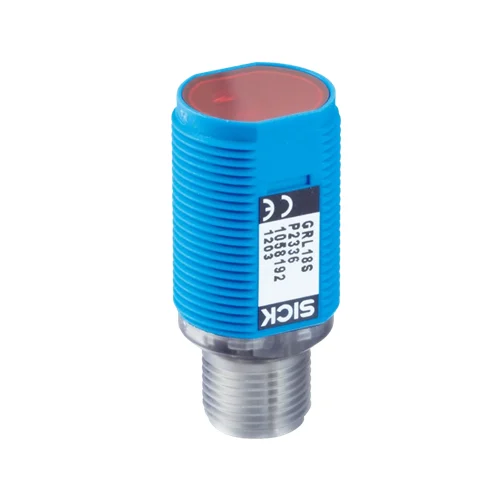
SICK 1064147 GRL18S-P1356 PNP Polarized Retro-Reflective Sensor

USD 54.08

GRL18S-P1356 offers 0.06–6 m PL80A sensing, polarized red PinPoint LED optics, PNP light switching, 1,000 Hz and a 2 m three-wire PVC cable.

SKU SICK-1064147 Category
SICK GR18S

SICK GRL18S-P1356 PNP Polarized Retro-Reflective Sensor

BrandSICK
Model IdentifierGRL18S-P1356
Official Part Number1064147

Technical Overview

The SICK GRL18S-P1356 is an axial M18 × 1 retro-reflective photoelectric sensor with a dual-lens system and polarizing filter. Its 650 nm red PinPoint LED provides 0.06–6 m sensing and 0.03–7.2 m maximum range with a PL80A reflector. The single PNP output uses light switching, with no sensitivity adjustment. Response is below 500 µs with resistive load, and switching is rated at 1,000 Hz for a 1:1 light/dark ratio. The ABS housing uses PMMA optics, a 2 m three-wire PVC cable and IP67 protection. Two fastening nuts and a P250 reflector are supplied. Output-current derating and the specified supply/temperature conditions apply.

Polarized axial M18 retro-reflective sensor with 0.06–6 m PL80A sensing, PNP light switching, no adjustment and a 2 m three-wire PVC cable.

Key Features

  • Axial M18 × 1 dual-lens retro-reflective sensing with polarizing filter
  • 0.06–6 m sensing and 0.03–7.2 m maximum with PL80A
  • 650 nm visible red PinPoint LED; Ø175 mm spot at 7 m
  • Fixed sensitivity; no adjustment
  • Single PNP light-switching output; <500 µs response with resistive load
  • 1,000 Hz at 1:1 light/dark ratio; ≤100 mA output with derating
  • At supply >24 V or ambient >49 °C, maximum output current is 50 mA
  • 2 m three-wire PVC cable; ABS housing and PMMA optics; IP67
  • Two fastening nuts and P250 reflector supplied; green power and yellow received-light indicators
  • −25 to +55 °C operating range specified at supply ≤24 V and output current <50 mA

Detect interruptions of a polarized returned-light path with fixed sensitivity and a PNP light-switching signal, using the supplied P250 reflector within its specified range.

Technical Specification Matrix

ParameterValue
Functional principlePhotoelectric retro-reflective sensing; dual-lens system with minimum reflector distance
Polarizing filterProvided
Housing and optical axisCylindrical M18 × 1; axial
Sensing range0.06–6 m with PL80A
Maximum sensing range0.03–7.2 m with PL80A
Other reflector rangesSensing / maximum: PL40A 0.06–5.2 / 0.03–6.2 m; PL20A 0.06–2.9 / 0.03–3.8 m; P250 0.06–5.4 / 0.03–6.4 m; PL22 0.06–1.9 / 0.03–2.2 m; REF-Plus 3436 tape 0.08–1.6 / 0.06–2.0 m
Light source650 nm visible red PinPoint LED
LED service lifeAverage 100,000 h at +25 °C
Light spot sizeØ175 mm at 7 m; diagram: Ø8 mm at 0.2 m, Ø25 mm at 1 m, Ø75 mm at 3 m
AdjustmentNone
Switching outputSingle PNP; light switching
Signal voltage HIGH/LOWSupply voltage −(≤3 V) / approximately 0 V
Output current≤100 mA; at supply >24 V or ambient >49 °C, maximum 50 mA
Response time<500 µs signal transit time with resistive load
Switching frequency1,000 Hz at 1:1 light/dark ratio
Power supply10–30 V DC; short-circuit-protected network maximum 8 A
Ripple<5 Vpp; remain within supply tolerances
Current consumption30 mA
Connection2 m three-wire PVC cable; do not bend below 0 °C
Wire assignmentCD-044: BN=L+; BU=M; BK=Q
Circuit protectionSupply and input/output reverse-polarity protection; output overcurrent and short-circuit protection
Protection classIII
Housing materialABS plastic
Optics materialPMMA plastic
Items suppliedTwo fastening nuts; P250 reflector
Mounting detailsPlastic fastening nut with 22 mm hex shown; mounting ring shown in drawing
IndicationGreen steady: power on; yellow steady: object not present, yellow off: object present
IP ratingIP67
Operating temperature−25 to +55 °C at supply ≤24 V and output current <50 mA
Storage temperature−40 to +70 °C
EMCEN 60947-5-2
UL fileNRKH.E348498 and NRKH7.E348498
ECOLAB certificateListed by manufacturer
MTTFD2,712 years
DCavg0%
Mission time20 years

Industrial Applications

1. Counting separated opaque packages on a conveyor

A conveyor can place the sensor opposite the supplied P250 reflector and pass separated opaque packages through the returned-light path. The P250 sensing range is 0.06–5.4 m, with a separately listed 0.03–6.4 m maximum range. External counting logic evaluates PNP light-switching transitions, while commissioning verifies optical coverage and package spacing against the 500 µs response limit and 1,000 Hz rating.

Problem Solved

An interrupted returned-light path gives external counting logic package-passage events, helping register separated opaque loads using the sensor’s integrated receiver and supplied reflector.

Package count P250 reflector PNP light switching

2. Monitoring continuity of an opaque material feed

A feeder can place the reflector path across a location normally covered by an opaque strip or sheet. A break or exhausted feed clears the returned-light path and changes the PNP light-switching condition. The fixed-sensitivity optical path is aligned using representative material, while external monitoring distinguishes persistent material loss from intended gaps and verifies sufficient coverage at the chosen sensor-to-reflector distance.

Problem Solved

A sustained change in the returned-light condition gives external feed monitoring a continuity reference, helping identify missing material before a dependent machine operation proceeds.

Material continuity Fixed sensitivity Opaque feed

3. Timing occupancy at a conveyor discharge

A conveyor discharge can place the returned-light path across the load receiving point and time how long an opaque package interrupts it. External control compares sustained blockage with the expected passage interval. Installation respects the selected reflector’s minimum distance and usable range, while the yellow received-light and green power indicators provide local context when aligning and checking the optical path.

Problem Solved

Timing a blocked optical path gives external discharge control an occupancy reference, helping recognize a load that remains in place before another package is released.

Discharge occupancy External timing Optical alignment

Select your currency