Skip to content

Contact Us:
sales@inosaki.com

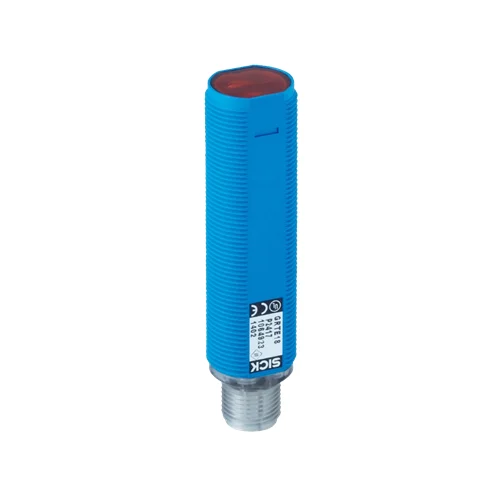
SICK 1066546 GRTE18-P2447 PNP Diffuse Photoelectric Sensor

SICK 1066546 GRTE18-P2447 PNP Diffuse Photoelectric Sensor

USD 53.56

Axial M18 energetic sensing with 10–400 mm reference-white range, 650 nm PinPoint LED, complementary outputs, M12 four-pin connection and IP67.

SKU: SICK-1066546 Category:
SICK GR18

SICK GRTE18-P2447 PNP Diffuse Photoelectric Sensor

BrandSICK
Model IdentifierGRTE18-P2447
Official Part Number1066546

Technical Overview

The SICK GRTE18-P2447 is a cylindrical energetic photoelectric proximity sensor with an axial 650 nm red PinPoint LED and M18 ×1 mounting thread. Its 270° potentiometer sets sensitivity for reflected-light detection, with a 10–400 mm sensing range on 90% remission reference white and shorter ranges on gray or black targets. Complementary PNP outputs connect through an M12 four-pin male connector, with response below 1,000 µs at resistive load and 500 Hz switching at a 1:1 light/dark ratio. Output current is limited to 50 mA above 24 V supply or 49 °C ambient. The IP67 ABS housing has PMMA optics and two supplied plastic fastening nuts; the −25 to +55 °C rating applies at ≤24 V and <50 mA output.

M18 axial energetic photoelectric sensor with 10–400 mm reference-white sensing, complementary PNP outputs and M12 four-pin connection.

Key Features

  • Energetic reflected-light proximity sensing with axial optical axis
  • 10–400 mm sensing and 5–550 mm maximum on 90% reference white
  • 650 nm red PinPoint LED; Ø9 mm spot at 400 mm
  • 270° sensitivity potentiometer; green power and yellow object indicators
  • Complementary PNP outputs, Q and Q inverted
  • Response <1,000 µs with resistive load; 500 Hz at 1:1 light/dark ratio
  • ≤100 mA output; derated to 50 mA above 24 V or 49 °C
  • 10–30 V DC supply; M12 four-pin male connector
  • M18 ×1 ABS housing, PMMA optics and IP67 protection
  • Two plastic fastening nuts supplied; −25 to +55 °C at ≤24 V and <50 mA output

Set sensitivity locally and provide complementary PNP target conditions from an axial M18 reflected-light sensing point.

Technical Specification Matrix

ParameterValue
Functional principleEnergetic photoelectric proximity sensing
Housing designCylindrical; axial optical axis
Mounting threadM18 ×1
Sensing range10–400 mm on 90% remission reference white, DIN 5033
Maximum sensing range5–550 mm on 90% remission reference white, DIN 5033
Black-target ranges6% remission: 20–90 mm sensing; 15–120 mm maximum, per range diagram
Gray-target ranges20% remission: 15–170 mm sensing; 10–250 mm maximum, per range diagram
Light source650 nm visible red PinPoint LED
Light spot sizeØ9 mm at 400 mm
Average LED service life100,000 h at ambient +25 °C
Adjustment270° sensitivity potentiometer
Switching outputPNP; complementary Q and Q inverted
Switching modeLight/dark switching
Signal voltage HIGH/LOWVs − (≤3 V) / approximately 0 V
Output current≤100 mA; maximum 50 mA when supply >24 V or ambient >49 °C
Response time<1,000 µs signal transit time with resistive load
Switching frequency500 Hz with light/dark ratio 1:1
Power supply10–30 V DC; limit values; short-circuit-protected network, maximum 8 A
Ripple<5 Vpp; remain within supply-voltage tolerances
Current consumption30 mA
ConnectionM12 four-pin male connector
Pin assignmentCD-084: 1 BN=L+; 2 WH=Q inverted; 3 BU=M; 4 BK=Q
IndicatorsGreen steady on: power on; yellow steady on: object present; yellow off: object absent
Circuit protectionSupply reverse-polarity protection; inputs/output reverse-polarity protection; outputs overcurrent and short-circuit protected
Protection classIII
Housing materialABS plastic
Optics materialPMMA plastic
IP ratingIP67
Items suppliedTwo plastic fastening nuts; width across flats 22 mm
EMCEN 60947-5-2
Operating temperature−25 to +55 °C at supply ≤24 V and output current <50 mA
Storage temperature−40 to +70 °C
UL fileE348498
Certificate listedECOLAB

Industrial Applications

1. Checking an insert in an assembly nest

An assembly nest can present an insert at a repeatable distance facing the axial sensing surface. The potentiometer establishes a reflected-light sensitivity condition, and external inspection logic samples the complementary PNP outputs after the assembly settles. Commissioning evaluates actual insert remission and the surrounding fixture because energetic detection depends on returned light, with shorter documented ranges for darker targets.

Problem Solved

An insert-present condition helps external inspection logic identify an empty assembly location before the next operation, using reflected light from a repeatably presented target surface.

Insert presence Sensitivity adjustment PNP outputs

2. Counting separated packages along a compact feed lane

A compact feed lane can pass separated packages through the axial red sensing spot and send PNP switching transitions to an external counter. The 500 Hz rating and response below 1,000 µs with resistive load inform timing assessment alongside package size, spacing and controller response. Setup establishes sensitivity with representative package surfaces and respects supply- and temperature-dependent output-current limits.

Problem Solved

Package-passage transitions provide discrete events for external counting logic, helping track separated material movement through one compact sensing point without an opposed optical receiver.

Package counting 500 Hz Axial red LED

3. Reporting a stack reaching a selected replenishment level

A replenishment station can mount the threaded sensor beside a stack of consistent opaque components at the selected level. Reflected light from the approaching stack surface changes the complementary PNP condition for external replenishment logic. The potentiometer establishes sensitivity using representative material, while commissioning evaluates target color, mounting gap and background reflections within the appropriate target-dependent sensing range.

Problem Solved

A stack-at-level condition gives external replenishment logic a discrete material reference, helping coordinate replenishment from the installed sensing height using light returned from the components.

Stack level M18 mounting Complementary outputs

Select your currency