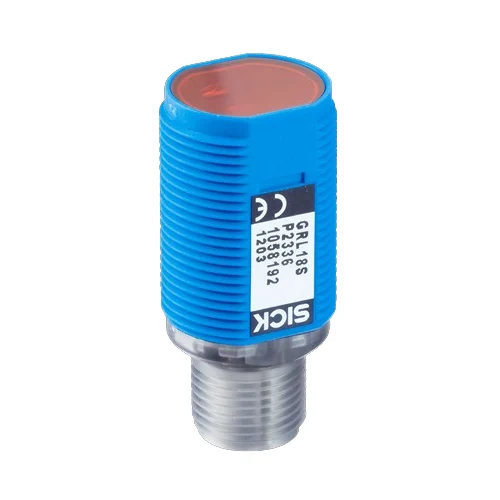
SICK 1069122 GRTE18S-P2467 PNP Diffuse Photoelectric Sensor

USD 59.28

GRTE18S-P2467 offers 10–800 mm reference-white sensing, 650 nm red LED, complementary PNP outputs, 270° adjustment, 500 Hz and M12 four-pin connection.

SKU SICK-1069122 Category
SICK GR18S

SICK GRTE18S-P2467 PNP Diffuse Photoelectric Sensor

BrandSICK
Model IdentifierGRTE18S-P2467
Official Part Number1069122

Technical Overview

The SICK GRTE18S-P2467 is an energetic photoelectric proximity sensor with axial optics in a short M18 × 1 plastic housing. It provides 10–800 mm sensing and a separately listed 5–1,000 mm maximum range on 90% remission reference white. A 650 nm red LED forms a 45 mm spot at 800 mm, and a 270° potentiometer adjusts the reflected-light sensing condition. Complementary PNP outputs provide light/dark states through an M12 four-pin male connector. Response is below 1,000 µs with resistive load and switching frequency is 500 Hz at a 1:1 light/dark ratio. ABS housing, PMMA optics, two fastening nuts and green/yellow indicators accompany IP67 protection and stated supply/load/temperature limits.

Energetic M18 proximity sensor with 10–800 mm reference-white range, complementary PNP outputs, 270° adjustment and M12 four-pin connector.

Key Features

  • Energetic proximity sensing with axial optics; short M18 × 1 plastic housing
  • 10–800 mm sensing; 5–1,000 mm maximum on 90% remission white reference
  • 650 nm visible red LED; Ø45 mm spot at 800 mm
  • 270° sensing-range potentiometer
  • Complementary PNP light/dark outputs
  • Response <1,000 µs with resistive load; 500 Hz at 1:1 light/dark ratio
  • M12 four-pin male connector; two fastening nuts supplied
  • 10–30 V DC; output current derates above 24 V or +49 °C
  • Green power LED and yellow target-presence LED
  • ABS housing, PMMA optics, IP67 and protection class III

Adjust one-sided reflected-light sensing and provide complementary PNP states for external process logic and ordinary input diagnostics.

Technical Specification Matrix

ParameterValue
Functional principleEnergetic photoelectric proximity sensing
Sensing range10–800 mm on 90% remission reference white, DIN 5033
Maximum sensing range5–1,000 mm on 90% remission reference white, DIN 5033
Target-dependent rangesBlack 6%: 20–200 mm sensing, 15–300 mm typical maximum; gray 20%: 15–360 mm sensing, 10–500 mm typical maximum
Light sourceVisible red LED; 650 nm
Average LED service life100,000 h at +25 °C
Light spot sizeØ45 mm at 800 mm
Additional spot sizesØ9 mm at 40 mm; Ø12 mm at 200 mm; Ø60 mm at 1,000 mm
AdjustmentSensing-range potentiometer, 270°
Switching outputComplementary PNP
Switching modeLight/dark switching
Response time<1,000 µs signal transit time with resistive load
Switching frequency500 Hz at 1:1 light/dark ratio
ConnectionM12 four-pin male connector
Pin assignmentCD-084: 1 BN=L+; 2 WH=complementary Q; 3 BU=M; 4 BK=Q
Housing designCylindrical; axial optical axis
Mounting threadM18 × 1
Items suppliedTwo fastening nuts
Mounting detailsPlastic fastening nut, 22 mm hex; mounting ring shown in drawing
IndicationGreen: power on; yellow on: object present; yellow off: object not present
UL fileNRKH.E348498 and NRKH7.E348498
ECOLABManufacturer certificate listed
Power supply10–30 V DC; short-circuit-protected network, maximum 8 A
Ripple<5 Vpp; remain within supply-voltage tolerances
Current consumption30 mA
Output current≤100 mA; maximum 50 mA when supply >24 V or ambient >+49 °C
Circuit protectionSupply and input/output reverse-polarity protection; output overcurrent and short-circuit protection
Protection classIII
Housing materialABS plastic
Optics materialPMMA plastic
IP ratingIP67
Operating temperature−25 to +55 °C at supply ≤24 V and output current <50 mA
Storage temperature−40 to +70 °C
EMCEN 60947-5-2

Industrial Applications

1. Detecting an article arriving at a loading station

A loading station can aim the sensor at an opaque article surface and read a PNP transition when it arrives. Energetic sensing evaluates reflected light from one mounting side, and the 270° potentiometer adapts detection to the installed target. Commissioning uses actual surface remission and distance, with darker materials assessed against their shorter documented ranges.

Problem Solved

One-sided optical detection gives external sequence logic an article-arrival reference, helping coordinate loading without a receiver or reflector installed across the working space.

Article arrival Adjustable sensing PNP output

2. Counting separated opaque packages on a conveyor

A feed conveyor can move separated opaque packages through the optical field and send PNP transitions to external counting logic. The 500 Hz rating and response below 1,000 µs define the timing basis. Commissioning checks package coverage, remission and spacing at the installed distance, using the 45 mm spot specification at 800 mm when assessing the target presentation.

Problem Solved

Distinct target transitions give external counting electronics package-passage events, helping track separated loads with a short cylindrical sensor installed from one side of the conveyor.

Package count 500 Hz Red LED

3. Comparing complementary signals during ordinary input diagnostics

A fixture can connect Q and complementary Q to two ordinary controller inputs and compare their settled states during a known article-presentation cycle. Both PNP outputs derive from the same reflected-light condition. External diagnostic logic accounts for switching transitions before recording an unexpected input relationship for maintenance review, while the green and yellow indicators provide local power and presence context.

Problem Solved

Opposing output observations give ordinary external diagnostics a reference for recognizing an inconsistent input relationship, helping focus maintenance on wiring or input-reading faults.

Complementary signals Input diagnostics Local indication

Select your currency