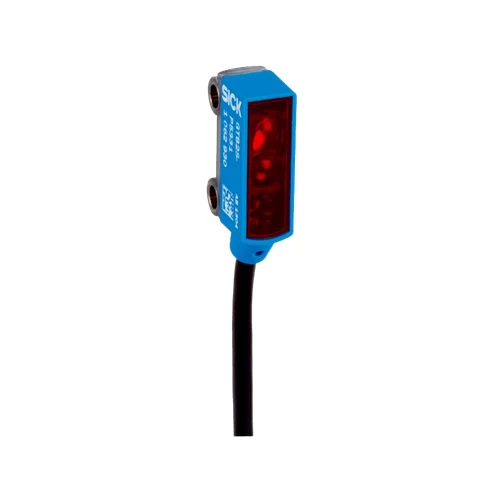
SICK 1064354 GTB2S-E1331 NPN Background-Suppression Sensor

USD 65.78

GTB2S-E1331 uses fixed background suppression, a 640 nm PinPoint LED, Ø3 mm spot at 15 mm, dark-switching NPN output and a 2 m PVC cable.

SKU SICK-1064354 Category
SICK G2S

SICK GTB2S-E1331 NPN Background-Suppression Sensor

BrandSICK
Model IdentifierGTB2S-E1331
Official Part Number1064354

Technical Overview

The SICK GTB2S-E1331 is a miniature rectangular photoelectric proximity sensor with fixed background suppression for small-object detection. Its 640 nm red PinPoint LED forms a Ø3 mm spot at 15 mm, and the maximum sensing range is 1–36 mm on 90% remission reference white. Background suppression typically begins at 38 mm, with no local range adjustment. A dark-switching NPN output carries up to 50 mA, with response below 0.6 ms under resistive load and 800 Hz switching at a 1:1 light/dark ratio. The 10–30 V DC sensor uses a 2 m three-wire PVC cable, IP67 ABS housing and PMMA optics, with operation from −25 to +50 °C.

Miniature fixed-background-suppression sensor with 640 nm red light, dark-switching NPN output, 1–36 mm maximum reference-white range and 2 m cable.

Key Features

  • Photoelectric proximity sensing with fixed background suppression for small objects
  • 1–36 mm maximum sensing range on 90% remission reference white
  • Background suppression typically from 38 mm; no local adjustment
  • 640 nm visible red PinPoint LED; Ø3 mm spot at 15 mm
  • Dark-switching NPN output; output current ≤50 mA
  • Response <0.6 ms with resistive load; 800 Hz at 1:1 light/dark ratio
  • 10–30 V DC; 20 mA current consumption without load
  • 2 m three-wire PVC cable, Ø3 mm; do not bend below 0 °C
  • ABS housing, PMMA optics and IP67 protection; Ø3.2 mm mounting holes
  • Operation −25 to +50 °C; storage −40 to +75 °C

Place a fixed red-light detection point on a small target and suppress a more distant background, using a miniature NPN sensor with no local range adjustment.

Technical Specification Matrix

ParameterValue
Functional principlePhotoelectric proximity sensor with background suppression
Housing designMiniature rectangular housing
Maximum sensing range1–36 mm on 90% remission reference white, DIN 5033
Background suppressionTypically from 38 mm
Light source640 nm visible red PinPoint LED
Average LED service life100,000 h at +25 °C
Light spot sizeØ3 mm at 15 mm
AdjustmentNone; fixed optics
Manufacturer special applicationDetecting small objects
Power supply10–30 V DC; short-circuit-protected network, maximum 8 A
Ripple<5 Vpp; remain within supply tolerances
Current consumption20 mA without load
Switching outputNPN; maximum output current ≤50 mA
Switching modeDark switching
Response time<0.6 ms; signal transit time with resistive load
Switching frequency800 Hz at 1:1 light/dark ratio
Connection2 m three-wire PVC cable; Ø3 mm; do not bend below 0 °C
Wire assignmentCD-043: BN=L+; BU=M; BK=dark-switching output
Circuit protectionSupply reverse-polarity protection; interference suppression; output overcurrent and short-circuit protection
Housing materialABS
Optics materialPMMA
IP ratingIP67
Mounting holesTwo Ø3.2 mm holes; 15 mm center spacing
IndicatorsGreen: supply voltage; yellow: received-light-beam status
Operating temperature−25 to +50 °C
Storage temperature−40 to +75 °C
UL fileNRKH.E181493
MTTFD3,378 years
DCavg0%
Physical Weight (kg)0.0175

Industrial Applications

1. Confirming a small component at an assembly nest

An assembly nest can present a small white reference-like component near the sensor, with the intended target at a controlled short distance. The Ø3 mm spot at 15 mm helps place the optical point on the selected feature. Fixed background suppression and the dark-switching NPN output provide a presence state to external sequencing logic after target and background geometry are established.

Problem Solved

A localized reflected-light point gives external assembly logic a component-presence condition, helping distinguish the selected target from a background beyond the fixed suppression region.

Small component Ø3 mm at 15 mm Background suppression

2. Counting separated parts through a narrow inspection point

A narrow feed track can carry separated white reference-like parts through the sensor spot at a fixed distance. External counting logic evaluates NPN output transitions as the targets enter and leave the optical point. Response below 0.6 ms and 800 Hz switching define device timing, while commissioning accounts for part spacing, reflectance, target width and controller input sampling.

Problem Solved

Repeated reflected-light transitions provide external counting logic with part-passage events at a confined inspection point, helping track separated items without fitting an opposed receiver.

Part counting 800 Hz NPN transitions

3. Monitoring release from a compact pickup station

A compact pickup station can observe a target face before and after the gripper removes a white reference-like component. External monitoring compares the dark-switching NPN state with the expected transfer sequence and flags a component that remains at the observation point. The miniature rectangular housing, fixed optics and two-metre cable suit a stationary sensor beside the pickup tooling.

Problem Solved

A target-presence check after the transfer command gives external sequence monitoring evidence of a retained component, helping identify a pickup or release cycle that did not clear the observation point.

Pickup verification Retained component Fixed optics

Select your currency