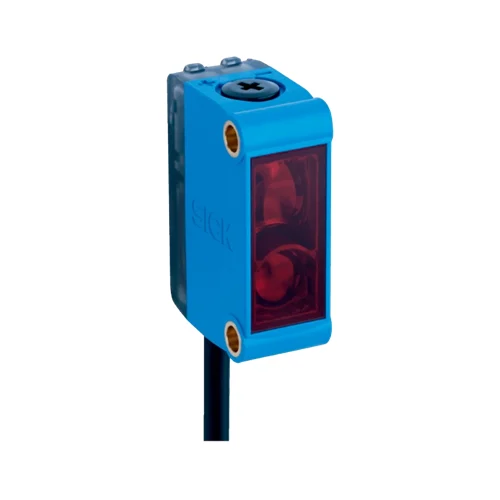
SICK 1066319 GTB6-N1212S37 NPN BGS Photoelectric Sensor

USD 187.46

GTB6-N1212S37 offers background suppression, NPN light/dark switching, five-turn range adjustment, 1,000 Hz, a 1.9 m PVC cable and mounting bracket.

SKU SICK-1066319 Category
SICK G6

SICK GTB6-N1212S37 NPN BGS Photoelectric Sensor

BrandSICK
Model IdentifierGTB6-N1212S37
Official Part Number1066319

Technical Overview

The SICK GTB6-N1212S37 is a miniature photoelectric proximity sensor with background suppression and a single NPN output. Its sensing range is 35–140 mm, with a 5–250 mm maximum range on 90% remission reference white. The 650 nm red PinPoint LED forms a 6 mm spot at 100 mm. A five-turn mechanical spindle adjusts sensitivity, while a separate rotary selector sets light or dark switching. Response is below 625 µs with resistive load and switching frequency is 1,000 Hz at a 1:1 light/dark ratio. The IP67 ABS/PC housing connects through a 1.9 m three-wire PVC cable; a BEF-W100-A stainless steel mounting bracket is supplied.

Miniature background-suppression sensor with NPN light/dark selection, five-turn adjustment, 1.9 m three-wire PVC cable and supplied mounting bracket.

Key Features

  • Photoelectric proximity sensor with background suppression
  • 35–140 mm sensing range; 5–250 mm maximum on 90% remission reference white
  • 650 nm red PinPoint LED; Ø6 mm spot at 100 mm
  • Five-turn mechanical spindle for sensing adjustment
  • Single NPN output; separate light/dark rotary selector
  • Response <625 µs with resistive load; 1,000 Hz at 1:1 light/dark ratio
  • 1.9 m three-wire PVC cable; 0.14 mm² conductors
  • 10–30 V DC; output derates to 50 mA above 24 V
  • ABS/PC housing and PMMA screen; IP67; −25 to +55 °C operation
  • BEF-W100-A stainless steel 1.4301/304 mounting bracket supplied

Set the sensing condition with a five-turn spindle and use background suppression with selectable NPN light/dark behavior for nearby target detection.

Technical Specification Matrix

ParameterValue
Functional principlePhotoelectric proximity sensing with background suppression
Sensing range35–140 mm
Maximum sensing range5–250 mm on 90% remission reference white, DIN 5033
Target-dependent maximum rangesGray 18%: 7–200 mm; black 6%: 10–140 mm; sensing range 35–140 mm in manufacturer diagram
Light sourceVisible red PinPoint LED; 650 nm
Average LED service life100,000 h at +25 °C
Light spot sizeØ6 mm at 100 mm
Additional spot sizesØ6.6 mm at 50 mm; Ø5.6 mm at 150 mm; Ø5.3 mm at 250 mm
AdjustmentMechanical spindle, five turns
Switching outputSingle NPN
Switching modeLight/dark selectable by separate rotary switch: L=light; D=dark
NPN signal HIGH/LOWApproximately supply voltage / ≤3 V
Output current≤100 mA; maximum 50 mA when supply >24 V
Response time<625 µs signal transit time with resistive load
Switching frequency1,000 Hz at 1:1 light/dark ratio
Power supply10–30 V DC; short-circuit-protected network, maximum 8 A
Ripple±10%; remain within supply-voltage tolerances
Current consumption30 mA without load
Circuit protectionSupply and input/output reverse-polarity protection; output overcurrent and short-circuit protection
Protection classIII
Connection1.9 m three-wire PVC cable; do not bend below 0 °C
Conductor cross-section0.14 mm²
Conductor functionsCD-043: BN=L+; BU=M; BK=Q
Housing designRectangular
Housing materialABS/PC plastic
Front screen materialPMMA plastic
MountingM3 mounting holes
Items suppliedBEF-W100-A stainless steel 1.4301/304 mounting bracket
IndicationGreen: supply voltage; yellow: received-light condition
IP ratingIP67
Operating temperature−25 to +55 °C; temperature stability following adjustment ±10 °C
Storage temperature−40 to +70 °C
UL fileNRKH.E348498 and NRKH7.E348498
Physical Weight (kg)0.06

Industrial Applications

1. Checking a component in a presentation fixture

A fixture can present an opaque component within the configured sensing range and use the NPN output to report its presence to external sequence logic. The five-turn spindle sets the sensing condition with background suppression. Commissioning positions the fixture background behind the target and assesses the actual component remission and separation using the manufacturer’s target-dependent data.

Problem Solved

Background-suppressed proximity sensing provides a component-presentation reference to external sequence logic, helping distinguish the intended nearby target from a more distant fixture background.

Fixture check Background suppression NPN output

2. Counting separated pieces on a small feeder

A feeder can move separated opaque pieces through the red sensing spot and send NPN transitions to an external counter. The 1,000 Hz switching rating and response below 625 µs define the timing basis. The mounting bracket supports positioning, while commissioning establishes sufficient piece coverage, target remission and spacing to produce distinct passage events.

Problem Solved

A compact reflected-light sensing point supplies external counting electronics with piece-passage events, helping track separated feeder output without placing a receiver across the path.

Feeder count 1,000 Hz Mounting bracket

3. Timing a waiting article at an assembly handoff

An assembly handoff can hold an opaque article at a defined sensing position while external control times the selected light-switching output state. A sustained presence beyond the expected transfer interval indicates continued occupancy to that controller. The separate light/dark selector adapts the signal to the station logic, and local LEDs provide supply and received-light context.

Problem Solved

Timing a maintained target-present state gives external handoff logic a basis for recognizing a waiting article and coordinating release of the next assembly.

Handoff occupancy External timing Light/dark selection

Select your currency