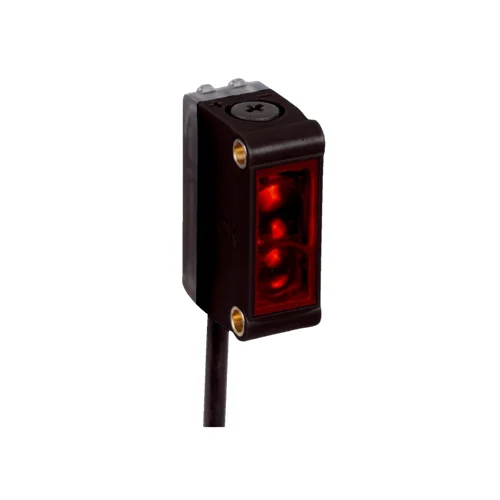
SICK 1069066 GTB6-P1441S46 PNP Infrared BGS Sensor

USD 59.28

Background suppression with 50–350 mm sensing, 850 nm infrared LED, five-turn adjustment, PNP light switching, 500 Hz operation and a 2 m PVC cable.

SKU SICK-1069066 Category
SICK G6

SICK GTB6-P1441S46 PNP Infrared BGS Sensor

BrandSICK
Model IdentifierGTB6-P1441S46
Official Part Number1069066

Technical Overview

The SICK GTB6-P1441S46 is an infrared photoelectric proximity sensor with background suppression and a PNP light-switching output. Its specified sensing range is 50–350 mm, while the maximum 5–450 mm range is referenced to 90% remission white under DIN 5033. The 850 nm LED forms a 9 mm spot at 100 mm, and a five-turn mechanical spindle adjusts detection. Response is below 1 ms with a resistive load, with 500 Hz switching at a 1:1 light/dark ratio. The 10–30 V DC sensor has a 2 m three-wire PVC cable, M3 mounting holes, ABS/PC housing, PMMA front screen and IP67 protection.

Infrared background-suppression sensor with 50–350 mm sensing, PNP light switching, five-turn adjustment and a 2 m three-wire PVC cable.

Key Features

  • Background-suppression photoelectric proximity sensing
  • Specified sensing range 50–350 mm
  • Maximum 5–450 mm range on 90% remission reference white
  • 850 nm infrared LED; Ø9 mm spot at 100 mm
  • Five-turn mechanical spindle adjustment
  • One PNP light-switching output; ≤100 mA, reduced to 50 mA above 24 V
  • Response <1 ms with resistive load; 500 Hz at 1:1 light/dark ratio
  • 10–30 V DC; 30 mA consumption without load
  • 2 m three-wire PVC cable with 0.14 mm² conductors
  • M3 mounting holes; ABS/PC and PMMA construction; IP67

Set the detection distance with five-turn adjustment and background suppression to report nearby targets in front of a more distant machine surface.

Technical Specification Matrix

ParameterValue
Functional principlePhotoelectric proximity sensor with background suppression
Sensing range50–350 mm
Maximum sensing range5–450 mm on 90% remission white target, DIN 5033
Light sourceInfrared LED
Wavelength850 nm
Light spot sizeØ9 mm at 100 mm
AdjustmentMechanical spindle, five turns
Digital outputPNP; one switching output
Switching modeLight switching
PNP signal voltage HIGH/LOWSupply voltage −(≤3 V) / approximately 0 V
Output current≤100 mA; maximum 50 mA at supply voltage >24 V
Response time<1 ms with resistive load
Switching frequency500 Hz at light/dark ratio 1:1
Power supply10–30 V DC; limit values in a short-circuit-protected network with maximum 8 A
Ripple±10%; supply tolerances must not be exceeded
Current consumption30 mA without load
Protection classIII
Circuit protectionA: supply reverse-polarity protection; B: inputs and output reverse-polarity protection; D: output overcurrent and short-circuit protection
Connection2 m three-wire PVC cable; do not bend below 0 °C
Conductor cross-section0.14 mm²
Wire assignmentBN=brown L+; BU=blue M; BK=black Q (CD-043)
Housing materialABS/PC plastic
Front screen materialPMMA plastic
Mounting holesM3
IndicatorsGreen: supply voltage; yellow: received light beam
IP ratingIP67
Operating temperature−25 to +55 °C; temperature stability following adjustment ±10 °C
Storage temperature−40 to +70 °C
UL fileNRKH.E348498 & NRKH7.E348498
MTTFD2,116 years
DCavg0%
LED average service life100,000 hours at ambient temperature +25 °C
Physical Weight (kg)0.02

Industrial Applications

1. Checking a component in front of a fixture backplate

An assembly fixture can present a component between the sensor and a more distant backplate. Background suppression and the five-turn adjustment establish a nearby detection region, while the PNP light-switching signal reports the presented component to external inspection logic. Setup verifies actual target remission, seated distance and background separation within the specified sensing range.

Problem Solved

A nearby-target reference helps external inspection logic distinguish a loaded fixture from an empty location even when a more distant backplate remains in view.

Fixture check Background suppression Five-turn adjustment

2. Counting separated parts along a guided conveyor

A guide can keep successive opaque parts at a repeatable distance from the sensor while leaving the more distant machine structure behind them. Each part changes the PNP light-switching state for an external counter. Commissioning verifies target reflectance and separation, and evaluates part transit and gaps against the below-1-ms resistive-load response and 500 Hz rating.

Problem Solved

Distinct part passages provide electrical events to external counting logic, with background suppression helping keep a more distant frame from becoming the selected target.

Part counter 500 Hz PNP output

3. Monitoring continuity of a supported opaque strip

A strip-feeding station can aim the infrared sensor at a supported opaque strip with a more distant surface behind the path. Adjustment places the expected strip within the detection region, and background suppression separates it from that background. External feed logic interprets a sustained absence state as a possible break or runout after material-specific commissioning.

Problem Solved

A strip-present condition gives external feed logic a continuity reference, helping identify loss of material while the sensor and wiring remain on one mounting side.

Strip continuity Infrared light Background separation

Select your currency