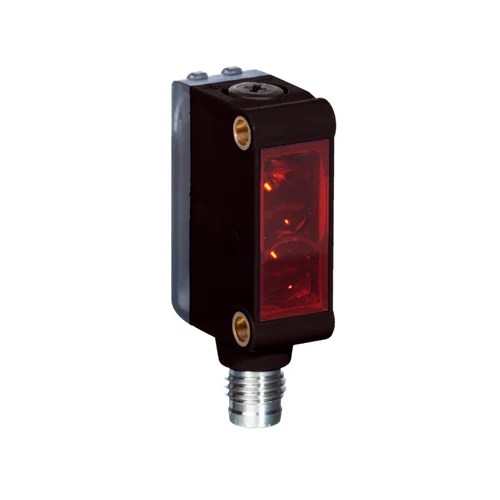
SICK 1082863 GTB6-P4241 PNP Infrared Background-Suppression Sensor

USD 70.72

GTB6-P4241 offers 50–350 mm sensing, 850 nm infrared LED light, PNP light/dark switching, five-turn spindle adjustment and an M8 four-pin connector.

SKU SICK-1082863 Category
SICK G6

SICK GTB6-P4241 PNP Infrared Background-Suppression Sensor

BrandSICK
Model IdentifierGTB6-P4241
Official Part Number1082863

Technical Overview

The SICK GTB6-P4241 is a photoelectric proximity sensor with background suppression and 850 nm infrared LED illumination. Specified sensing range is 50–350 mm, with a 5–450 mm maximum range on 90% remission reference white. A five-turn mechanical spindle adjusts sensing distance, while a local light/dark rotary switch sets the single PNP output polarity. The beam spot is Ø8 mm at 100 mm, response is below 1 ms with resistive load and switching frequency is 500 Hz at a 1:1 light/dark ratio. The 10–30 V DC device uses an M8 four-pin male connector, ABS/PC housing, PMMA front screen and IP67 protection. Output current derates to 50 mA above 24 V.

Infrared background-suppression sensor with 50–350 mm sensing, single PNP output, five-turn spindle adjustment, local light/dark selection and M8 connection.

Key Features

  • Background-suppression proximity sensing with 850 nm infrared LED
  • 50–350 mm specified sensing; 5–450 mm maximum on 90% remission white
  • Ø8 mm spot at 100 mm; Ø12 mm at 300 mm; Ø17 mm at 450 mm
  • Five-turn mechanical spindle for sensing-distance adjustment
  • Single PNP output; local light/dark rotary switch
  • Response <1 ms with resistive load; 500 Hz at 1:1 light/dark ratio
  • 10–30 V DC; 30 mA no-load current; ≤100 mA output, reduced to 50 mA above 24 V
  • M8 four-pin male connector; output on pin 4, pin 2 unused
  • ABS/PC housing, PMMA front screen and IP67 protection
  • Operation −25 to +55 °C; temperature stability following adjustment ±10 °C

Set a localized infrared detection distance with a five-turn spindle and report target presence through a selectable PNP output while suppressing a farther background.

Technical Specification Matrix

ParameterValue
Functional principlePhotoelectric proximity sensing with background suppression
Sensing range50–350 mm
Maximum sensing range5–450 mm on 90% remission reference white, DIN 5033
Target-dependent range diagram6% black: sensing 50–350 mm, maximum 10–350 mm; 90% white: sensing 50–450 mm, maximum 5–450 mm, as shown separately in manufacturer diagram
Light source850 nm infrared LED
Average LED service life100,000 h at +25 °C
Light spot sizeØ8 mm at 100 mm; Ø12 mm at 300 mm; Ø17 mm at 450 mm
AdjustmentFive-turn mechanical spindle
Power supply10–30 V DC; short-circuit-protected network, maximum 8 A
Ripple±10%; remain within supply tolerances
Current consumption30 mA without load
Protection classIII
Switching outputSingle PNP output
Switching modeLight/dark switching; local rotary selector shown in manufacturer drawing
PNP signal voltage HIGH/LOWSupply voltage −(≤3 V) / approximately 0 V
Output current≤100 mA; maximum 50 mA at supply >24 V
Response time<1 ms; signal transit time with resistive load
Switching frequency500 Hz at 1:1 light/dark ratio
Circuit protectionSupply and input/output reverse-polarity protection; output overcurrent and short-circuit protection
Housing designRectangular
ConnectionM8 four-pin male connector
Pin assignmentCD-066: 1 BN=L+; 2 WH=not connected; 3 BU=M; 4 BK=Q
Housing materialABS/PC
Front screen materialPMMA
IP ratingIP67
Operating temperature−25 to +55 °C; temperature stability following adjustment ±10 °C
Storage temperature−40 to +70 °C
UL filesNRKH.E348498 and NRKH7.E348498
MountingM3 holes; 25.4 mm spacing
IndicatorsGreen: supply voltage; yellow: received-light-beam status
MTTFD1,905 years
DCavg0%
Physical Weight (kg)0.02

Industrial Applications

1. Confirming a component in front of a machine background

An assembly nest can position a component within the sensor field and a more distant machine surface behind it. The five-turn mechanical spindle establishes sensing distance, while background suppression separates the intended target condition from that surface. The single PNP output reports presence to external sequencing, with target remission and distance assessed against the documented sensing and maximum ranges.

Problem Solved

A target-focused infrared condition gives external assembly logic a component-presence event while suppressing a more distant background, helping identify the intended occupied nest position.

Background suppression Five-turn spindle PNP presence

2. Counting separated parts at a fixed feed-track point

A feed track can move separated parts through the infrared sensing point at a fixed distance. External counting logic evaluates PNP transitions as each part enters and leaves the field. The Ø8 mm spot at 100 mm helps locate the optical point, while 500 Hz switching and response below 1 ms inform compatible part spacing and input sampling.

Problem Solved

Repeated reflected-light transitions give external counting logic a part-passage event from one mounting side, helping track separated items without fitting an opposed receiver.

Part counting Ø8 mm at 100 mm 500 Hz

3. Checking removal from a compact pickup station

A pickup station can observe the component face before and after a transfer command using the fixed sensor position. External monitoring compares the PNP state with the expected sequence and flags a target that remains in the nest. The local light/dark rotary switch sets signal polarity, while background suppression and the adjusted sensing distance establish the selected observation geometry.

Problem Solved

A target-presence check after the transfer command gives external sequencing evidence of a retained component, helping identify a pickup cycle that did not clear the observation point.

Pickup verification Light/dark polarity Retained component

Select your currency