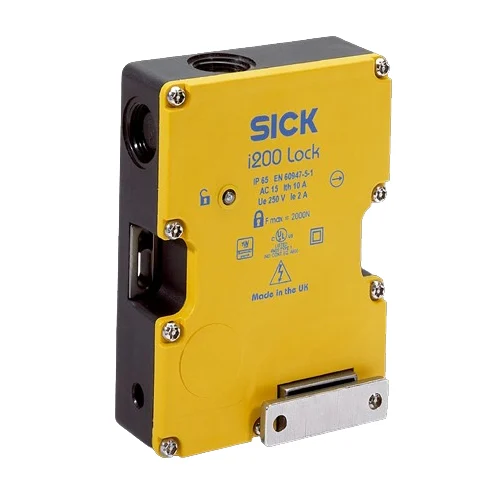
1. Holding a guard through an engineered stopping interval
A machine designer can use the power-to-release lock to retain a movable guard while external safety logic manages the machine’s stopping interval and release permission. The solenoid is energized only when the validated sequence permits unlocking. Installation establishes a compatible actuator and fixing arrangement, observing the 2,000 N FZh and the fixing-screw condition on maximum locking force.
Problem Solved
Physical guard retention gives the engineered control sequence a means to delay access until its release condition is satisfied, using externally established stopping and unlocking logic.
Guard retention
Power to release
Controlled unlocking
2. Evaluating guard-door position before a machine cycle
A safety-control design can individually wire the two positive-action NC door-monitoring contacts into its external diagnostic logic and use the additional NO contact for the intended indication. A compatible actuator follows guard movement within the documented approach-speed and actuation limits. Commissioning validates door-position transitions and the overall machine-start condition, with fault detection supplied by the connected safety-related logic.
Problem Solved
Door-position contacts give the external control design a guard-state reference before a machine cycle, helping distinguish the intended closed condition from actuator withdrawal within the validated installation.
Door-state evaluation
Positive-action contacts
Individual wiring
3. Distinguishing a closed guard from a confirmed locked guard
External diagnostic logic can evaluate the separate locking-monitoring and door-monitoring contacts during a controlled lock/unlock sequence. The exact switching-element-41 diagram distinguishes inserted-and-locked, inserted-and-unlocked and actuator-removed states. Commissioning checks these transitions against the installed wiring and actuator arrangement, and uses the LED status indication as a local maintenance reference while the external logic performs fault detection.
Problem Solved
Separate door and locking observations help external diagnostics distinguish guard closure from confirmed locking, providing a clearer reference when investigating a failed lock or unlock sequence.
Lock-state feedback
Door/lock distinction
External diagnostics