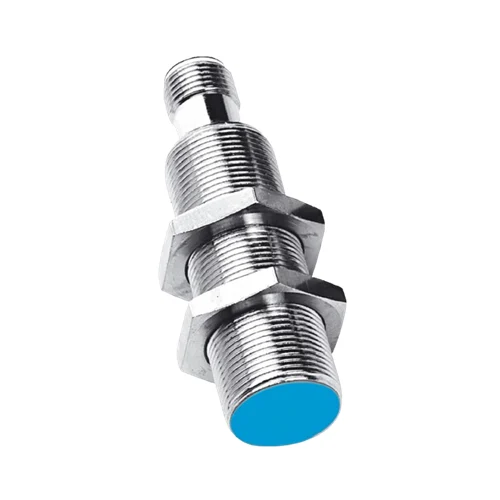
SICK 7902931 IM18-05BPP-ZC1 Complementary PNP Inductive Sensor

USD 75.92

IM18-05BPP-ZC1 combines 5 mm nominal inductive sensing, flush M18 mounting, complementary PNP outputs, 1,000 Hz switching and M12 four-pin connection.

SKU SICK-7902931 Category
SICK IM Standard

SICK IM18-05BPP-ZC1 Complementary PNP Inductive Sensor

BrandSICK
Model IdentifierIM18-05BPP-ZC1
Official Part Number7902931

Technical Overview

The SICK IM18-05BPP-ZC1 is an IM Standard inductive proximity sensor with a 5 mm nominal sensing range and flush M18 × 1 installation. Its complementary PNP outputs provide normally-open and normally-closed signals through an M12 four-pin male connector. The standard-length brass and nickel-plated brass housing has a plastic sensing face, 63 mm housing length and 35 mm threaded section. Switching frequency is 1,000 Hz, and the device operates from 10–30 V DC with short-circuit and power-up pulse protection. IP68 protection to EN 60529 and an operating range of −25 to +70 °C support integration at a metal-target sensing location; installation follows the manufacturer’s specified clearances.

Flush M18 inductive proximity sensor with 5 mm nominal sensing, complementary PNP outputs, 1,000 Hz switching and an M12 four-pin connector.

Key Features

  • 5 mm nominal inductive sensing range
  • Flush installation in a standard-design M18 × 1 housing
  • Complementary PNP normally-open and normally-closed outputs
  • 1,000 Hz switching frequency
  • M12 four-pin male connector; DC four-wire connection
  • 10–30 V DC supply; continuous current Ia ≤400 mA
  • Voltage drop ≤0.8 V at maximum Ia; availability delay ≤100 ms
  • Short-circuit and power-up pulse protection
  • Brass and nickel-plated brass housing; plastic sensing face; display LED
  • IP68 to EN 60529; −25 to +70 °C operation

Connect separate normally-open and normally-closed metal-target signals to machine control from a flush-mounted M18 inductive sensing point.

Technical Specification Matrix

ParameterValue
Functional principleInductive proximity sensing
Nominal sensing range Sn5 mm
InstallationFlush; observe manufacturer installation diagram
Housing designMetric; standard design
Mounting threadM18 × 1
Housing diameter18 mm
Housing length63 mm
Thread length35 mm
Fastening nutsTwo metal nuts; 24 mm across flats, as shown in drawing
Maximum tightening torque≤40 Nm
Switching outputComplementary PNP: normally open and normally closed
Switching frequency1,000 Hz
Electrical wiringDC four-wire
ConnectionM12 four-pin male connector
Pin assignmentCD-006: 1 BN=L+; 4 BK=NO; 2 WH=NC; 3 BU=M
Power supply10–30 V DC
Ripple≤10%
Voltage drop≤0.8 V at maximum continuous current Ia
Availability delay≤100 ms
Continuous current Ia≤400 mA
Hysteresis2–10%
Reproducibility≤5% of Sr at constant supply voltage and ambient temperature
Temperature drift±10% of Sr
Circuit protectionShort-circuit protection; power-up pulse protection
Housing materialBrass; nickel-plated brass
Sensing face materialPlastic
IndicationDisplay LED identified in manufacturer drawing
IP ratingIP68 according to EN 60529
Operating temperature−25 to +70 °C
Shock resistance30 g, 11 ms
Vibration resistance10–55 Hz, 1 mm
EMCEN 60947-5-2
MTTFD88 years
DCavg0%
Installation clearancesManufacturer diagram letters: B=18 mm; C=18 mm; D=15 mm; F=40 mm

Industrial Applications

1. Confirming a metal carrier at a transfer stop

A transfer station can bring a metal carrier target to a repeatable gap in front of the flush sensing face. Complementary PNP normally-open and normally-closed signals connect to external sequencing inputs. Setup checks the actual target material and geometry against the 5 mm nominal range and manufacturer installation clearances before using the signal as the carrier-arrival condition.

Problem Solved

A discrete metal-target reference helps external transfer logic recognize a carrier at the stop and coordinate the next handling operation using the selected PNP signal.

Carrier arrival Flush mounting Complementary PNP

2. Counting separated metal tabs on a moving mechanism

A rotating or translating mechanism can present separated metal tabs to the sensor and send PNP transitions to an external counter. The 1,000 Hz switching specification provides the sensor timing basis. Commissioning checks tab size, gap, material and passage timing so that each target produces a distinct transition at the installed sensing location.

Problem Solved

Distinct metal-tab transitions give external counting logic passage events from one sensing point, helping track mechanism cycles while keeping evaluation and counting in the controller.

Metal-tab counter 1,000 Hz PNP transitions

3. Checking a metal insert in an assembly fixture

An assembly fixture can present a metal insert within a controlled sensing gap while the sensor is installed flush in the fixture structure. External inspection logic samples one of the complementary PNP states after the part settles. Setup verifies the insert material, presentation tolerance and surrounding-metal clearances, using the stated reproducibility conditions when assessing the repeatable inspection position.

Problem Solved

A metal-insert presence condition helps external inspection logic identify an empty assembly location before processing continues, using a compact threaded sensing point in the fixture.

Insert presence Assembly inspection Threaded mounting

Select your currency