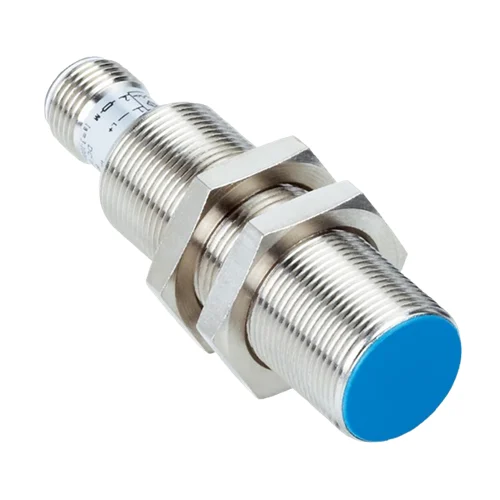
SICK 1017443 IM18-08NNS-ZUK Short NPN NO Inductive Sensor

USD 75.92

M18 non-flush inductive sensor with 8 mm nominal range, NPN normally open output, 1,000 Hz switching and a 2 m three-wire PUR/PVC cable.

SKU SICK-1017443 Category
SICK IM Standard

SICK IM18-08NNS-ZUK NPN NO Inductive Sensor

BrandSICK
Model IdentifierIM18-08NNS-ZUK
Official Part Number1017443

Technical Overview

The SICK IM18-08NNS-ZUK is a short-body inductive proximity sensor with an M18 ×1 mounting thread for non-flush installation. It provides 8 mm nominal sensing with an NPN normally open output and 1,000 Hz switching. The 10–30 V DC device uses a 2 m three-wire PUR/PVC cable and allows continuous output current up to 300 mA. Wire-break, short-circuit and power-up pulse protection support connection to external machine inputs. Its nickel-plated brass housing, plastic sensing face and IP67 enclosure are specified for −25 to +75 °C operation. Two metal mounting nuts locate the threaded body, with a maximum 25 Nm tightening torque.

Non-flush M18 NPN normally open inductive sensor with 8 mm nominal range, 1,000 Hz switching and 2 m three-wire PUR/PVC cable.

Key Features

  • Short-body M18 ×1 housing; non-flush installation
  • 8 mm nominal sensing range
  • NPN normally open output; DC three-wire
  • 1,000 Hz switching frequency
  • 10–30 V DC; ripple ≤10%
  • Continuous output current ≤300 mA; voltage drop ≤1.5 V at maximum output current
  • Wire-break, short-circuit and power-up pulse protection
  • 2 m three-wire PUR/PVC cable; 0.25 mm² conductors
  • Nickel-plated brass housing; plastic sensing face; IP67
  • Display LED; two metal mounting nuts; −25 to +75 °C operation

Use a non-flush M18 inductive face to detect metal position and provide an NPN normally open signal to external sequencing or inspection logic.

Technical Specification Matrix

ParameterValue
Functional principleInductive proximity sensing
Housing designMetric short-body
Mounting threadM18 ×1
Housing diameter18 mm
InstallationNon-flush
Nominal sensing range Sn8 mm
Switching outputNPN, normally open; DC three-wire
Switching frequency1,000 Hz
Power supply10–30 V DC
Ripple≤10%
Voltage drop≤1.5 V at maximum output current
Time delay before availability≤10 ms
Hysteresis1–10%
Reproducibility≤2% of Sr at constant supply voltage and ambient temperature
Temperature drift±10% of Sr
Continuous output current≤300 mA
Circuit protectionWire-break protection; short-circuit protection; power-up pulse protection
Connection2 m three-wire PUR/PVC cable
Conductor functionsCD-001: BN=L+; BK=NO output; BU=M
Housing materialNickel-plated brass
Sensing face materialPlastic
Housing axial extent40 mm
Thread axial extent30 mm
Maximum tightening torque25 Nm
Fastening nutsTwo metal nuts, 24 mm across flats
DisplayLED
Installation clearancesManufacturer figure labels: A=18 mm; B=36 mm; C=18 mm; D=24 mm; E=16 mm; F=64 mm
IP ratingIP67, EN 60529
Operating temperature−25 to +75 °C
Shock resistance30 g, 11 ms
Vibration resistance10–55 Hz, 1 mm
EMCEN 60947-5-2
Conductor cross-section0.25 mm²
Cable materialPUR/PVC

Industrial Applications

1. Confirming a metal slide has reached its stop

A fixture slide can bring a metal target toward the non-flush sensing face at its intended end position. External sequencing logic reads the NPN normally open signal after motion settles. The 8 mm nominal sensing range provides the initial distance basis, while commissioning checks target material, geometry and actual gap; the threaded body and two nuts maintain the selected alignment.

Problem Solved

A metal-target position reference lets external sequencing distinguish the reached stop from an intermediate slide position before the next controlled machine operation begins.

Slide position NPN NO Non-flush mounting

2. Counting separated metal features on a rotating disc

A rotating disc can carry separated metal features across the inductive field and send NPN state transitions to an external counter. The 1,000 Hz switching rating defines the sensor frequency basis. The machine establishes feature width, separation and working gap so successive features produce distinct events, with external logic selecting the event edge appropriate to the normally open output.

Problem Solved

Distinct metal-feature transitions provide external counting logic with a rotation-related event stream, supporting machine-cycle tracking without depending on an optical mark or surface color.

Metal-feature counting 1,000 Hz NPN NO

3. Checking a metal insert in an indexed assembly nest

An assembly nest can hold an expected metal insert within the commissioned sensing zone while nearby tooling stays outside the documented installation clearances. External inspection logic samples the NPN state during the stationary inspection window and interprets it according to the specified output function. The non-flush arrangement and reproducibility conditions provide the basis for evaluating repeated target presentations.

Problem Solved

An inductive insert-present reference helps external inspection logic identify an empty nest before assembly continues, using metal detection rather than printed appearance or target color.

Insert inspection Stationary sampling IP67

Select your currency