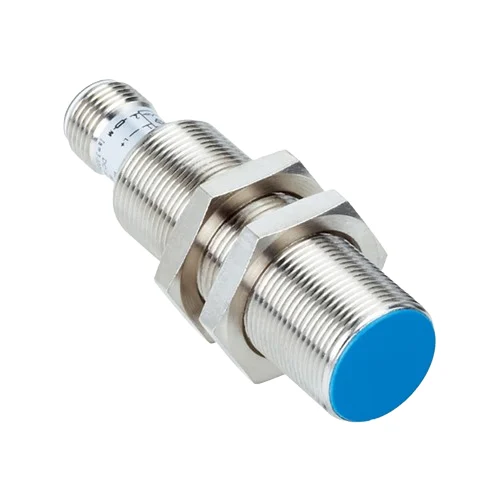
1. Confirming a seated metal clamp target
A fixture can present a metal target on a clamp to the non-flush sensing face after the clamp reaches its seated position. External sequence logic reads the PNP normally-open state before starting the next process step. The installed gap and surrounding metal clearances are established for the actual target, using the 8 mm nominal range and documented non-flush installation graphic.
Problem Solved
A contactless target-present signal gives external sequence logic a clamp-position reference, helping distinguish the seated mechanism from a clamp that has not reached that location.
Clamp position
PNP normally open
Non-flush M18
2. Counting separated metal flags on a rotating mechanism
A rotating mechanism can carry separated metal flags past the fixed sensor, producing PNP transitions for an external counter. Flag geometry, spacing and rotational speed are chosen so that each target clears the sensing zone between events. The 600 Hz switching rating provides a timing reference, while commissioning establishes detection at the actual installed gap and target geometry.
Problem Solved
Individual metal-target transitions let an external counter track repeated mechanical cycles without a contacting limit switch, providing a cycle reference for machine monitoring.
Cycle counting
600 Hz
Metal flags
3. Monitoring prolonged occupancy at a metal-part transfer
A transfer station can place the sensing face beside a location where a metal part should pause briefly before release. The controller times the PNP normally-open state and compares it with the normal transfer sequence. IP67 protection and the nickel-plated brass housing support installation near the mechanism, with non-flush clearances maintained around the sensing face.
Problem Solved
A persistent target-present state provides external transfer logic with an occupancy-duration reference, helping identify a metal part that remains at the transfer point beyond its expected dwell.
Transfer dwell
IP67
Metal-part occupancy