Skip to content

Contact Us:
sales@inosaki.com

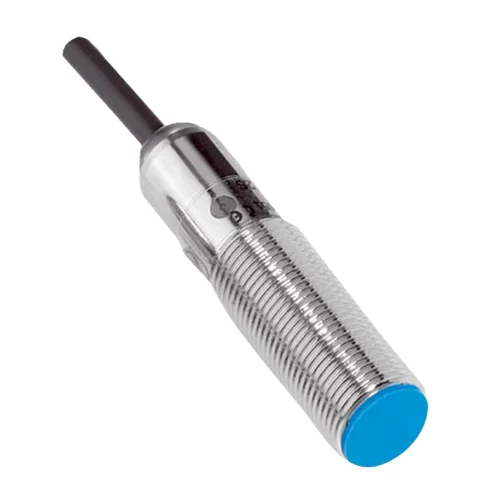
SICK 1072274 IME12-04BDSZY2K Two-wire Inductive Sensor

SICK 1072274 IME12-04BDSZY2K Two-wire Inductive Sensor

USD 32.50

M12 flush inductive sensor with 4 mm nominal range, DC two-wire normally-open output, 2,000 Hz switching, 2 m PVC cable and IP67 protection.

SKU: SICK-1072274 Category:
SICK IME

SICK IME12-04BDSZY2K Two-wire Inductive Sensor

BrandSICK
Model IdentifierIME12-04BDSZY2K
Official Part Number1072274

Technical Overview

The SICK IME12-04BDSZY2K is a flush-mounting M12 × 1 inductive proximity sensor with 4 mm nominal range and 3.24 mm assured range. Its DC two-wire normally-open circuit provides 2,000 Hz switching through a 2 m two-wire PVC cable with 0.25 mm² conductors. The two-wire interface requires at least 3 mA load current, permits up to 100 mA continuous current and has off-state current no greater than 0.8 mA. The nickel-plated brass housing and PA66 sensing face provide IP67 protection and −25 to +75 °C operation. Two mounting nuts are supplied, and documented material reduction factors apply when sensing non-reference metals.

Flush M12 inductive sensor with 4 mm nominal range, DC two-wire normally-open circuit, 2,000 Hz switching and 2 m PVC cable.

Key Features

  • Flush-mounting M12 × 1 inductive proximity sensor
  • 4 mm nominal range; 3.24 mm assured range
  • DC two-wire normally-open output; 2,000 Hz switching
  • 2 m two-wire PVC cable; 0.25 mm² conductors; Ø3.9 mm
  • 10–30 V DC supply; time delay before availability ≤100 ms
  • Nickel-plated brass housing and PA66 plastic sensing face
  • IP67 to EN 60529; −25 to +75 °C operation
  • Minimum load ≥3 mA; off-state current ≤0.8 mA; continuous current ≤100 mA
  • Oil-resistant cable; two nickel-plated brass nuts, 17 mm across flats
  • Short-circuit protection; power-up pulse ≤5 ms

Detect nearby metal with a flush M12 sensing face and normally-open signal for external machine sequencing.

Technical Specification Matrix

ParameterValue
Functional principleInductive proximity sensing
Housing designMetric, short-body
Mounting threadM12 × 1
InstallationFlush
Nominal sensing range Sn4 mm
Assured sensing range Sa3.24 mm
Output circuitDC two-wire normally-open
Output functionNormally open (NO)
Electrical wiringDC two-wire
Switching frequency2,000 Hz
Power supply10–30 V DC
Ripple≤10%
Voltage drop≤4 V at 30 mA; ≤4.5 V at maximum continuous current
Time delay before availability≤100 ms
Hysteresis5–15%
Reproducibility≤2% of Sr at constant supply voltage and ambient temperature
Temperature drift of Sr±10%
Continuous current≤100 mA
Connection2 m two-wire PVC cable; oil-resistant
Conductor cross-section0.25 mm²
Cable diameter3.9 mm
Conductor functionsCD-012: BN=L+; BU=M
Short-circuit protectionPresent
Housing materialBrass, nickel-plated
Sensing face materialPA66 plastic
Housing length44 mm
Thread length29 mm
Tightening torque≤12 Nm
Items suppliedTwo nickel-plated brass mounting nuts; 17 mm across flats
Material reduction factorsReference values which may vary: St37 steel 1; V2A/304 stainless steel approximately 0.8; aluminum approximately 0.45; copper approximately 0.4; brass approximately 0.4
Flush installation clearancesManufacturer diagram keys B=24 mm; C=12 mm; D=12 mm; F=32 mm
IP ratingIP67 to EN 60529
Operating temperature−25 to +75 °C
Shock resistance30 g, 11 ms
Vibration resistance10–55 Hz, 1 mm
EMCEN 60947-5-2
UL fileNRKH.E181493
MTTFD1,103 years
DCavg0%
Off-state current≤0.8 mA
Minimum load current≥3 mA
Power-up pulse≤5 ms
Mission time20 years

Industrial Applications

1. Confirming a metal fixture at its seated position

A fixture can present a metal target at a controlled gap beside the flush sensing face. The DC two-wire normally-open circuit reports target arrival to external sequence logic. The installation uses the 4 mm nominal and 3.24 mm assured ranges with the actual target geometry and material reduction factors, preserving the documented clearances around the sensing location. The input load also accounts for minimum load and off-state current.

Problem Solved

A discrete metal-position reference helps external machine logic distinguish the expected seated fixture from an open location before advancing a dependent operation.

Fixture position Flush mounting Normally open

2. Counting metal tabs on a rotating mechanism

A rotating mechanism can move separated metal tabs past the sensor and deliver switching transitions to an external counter. The 2,000 Hz rating provides a basis for evaluating tab passage rate and spacing. Installation assesses actual target material and geometry, keeps the sensing gap controlled and respects the documented flush-mounting clearances. External counting electronics accommodate the two-wire load and leakage conditions.

Problem Solved

Repeated metal-target transitions give external counting electronics cycle or index events, helping track mechanism movement without a contacting switch beside the rotating tabs.

Tab count 2,000 Hz Inductive switching

3. Monitoring metal stock at a feed reference

A metal-feeding station can mount the sensor beside a reference location normally occupied by stock. The normally-open state changes when the metal leaves that location, and external feed logic times the absence against the expected process sequence. Material reduction factors and the assured sensing range guide the chosen gap for the installed stock.

Problem Solved

A sustained target-absence condition provides external feed monitoring with a stock-continuity reference, helping identify a missing metal section before a dependent process step.

Stock continuity External timing Metal sensing

Select your currency