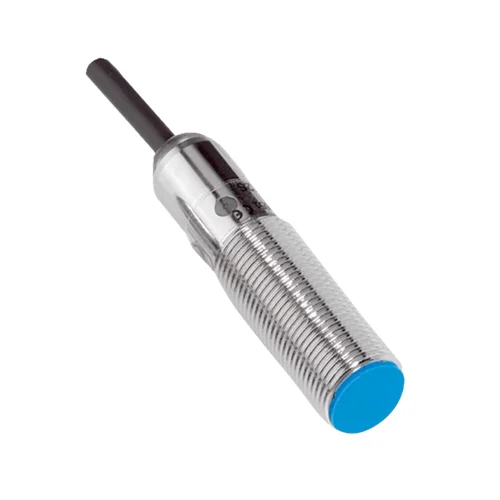
SICK 1095533 6 mm PNP NO Inductive Sensor with 7 m Cable

USD 100.36

Short-body M12 sensor with quasi-flush installation, 6 mm nominal range, PNP normally-open output, 800 Hz switching and 7 m three-wire PVC cable.

SKU SICK-1095533 Category
SICK IME

SICK IME12-06BPSZWDK Short-body 6 mm PNP Inductive Sensor

BrandSICK
Model IdentifierIME12-06BPSZWDK
Official Part Number1095533

Technical Overview

The SICK IME12-06BPSZWDK is a short-body M12 × 1 inductive proximity sensor for quasi-flush installation, with 2 mm protrusion in the documented mounting arrangement. Nominal range is 6 mm and assured range is 4.86 mm, with material-dependent reduction factors. Its PNP normally-open output provides 800 Hz switching through a 7 m three-wire PVC cable with 0.25 mm² conductors and 3.9 mm outside diameter. The nickel-plated brass housing has a PA 66 sensing face and IP67 protection, with 44 mm housing length and 29 mm thread length. Two mounting nuts are supplied, and operating and storage temperatures span −25 to +75 °C.

Quasi-flush M12 inductive sensor with 6 mm nominal range, PNP normally-open output, 800 Hz switching and 7 m three-wire PVC cable.

Key Features

  • M12 × 1 short-body housing; quasi-flush installation with 2 mm protrusion
  • 6 mm nominal range and 4.86 mm assured range; triple sensing range
  • PNP normally-open output; DC three-wire operation
  • 800 Hz switching; availability delay ≤50 ms
  • 7 m three-wire PVC cable; 0.25 mm² conductors; Ø3.9 mm cable diameter
  • 10–30 V DC; continuous output current ≤200 mA; no-load current ≤10 mA
  • Nickel-plated brass housing; PA 66 sensing face; IP67
  • 44 mm housing length; 29 mm thread length
  • Two nickel-plated brass nuts supplied; 17 mm across flats; ≤12 Nm tightening torque
  • Short-circuit and power-up pulse protection; −25 to +75 °C operation and storage

Detect a nearby metal target through a quasi-flush M12 installation and provide an 800 Hz PNP normally-open signal to external machine logic.

Technical Specification Matrix

ParameterValue
Functional principleInductive proximity sensing
Housing formShort-body
Mounting threadM12 × 1
Housing diameter12 mm
InstallationQuasi-flush; 2 mm protrusion E in manufacturer installation diagram
Nominal sensing range Sn6 mm
Assured sensing range Sa4.86 mm
Special featureTriple sensing range
Switching outputPNP, normally open
Electrical wiringDC three-wire
Switching frequency800 Hz
Connection7 m three-wire PVC cable
Conductor functionsCD-001: BN=L+; BK=NO output; BU=M
Power supply10–30 V DC
Ripple≤10%
Voltage drop≤2 V at maximum output current
Time delay before availability≤50 ms
Hysteresis1–15%
Reproducibility≤5% of Sr with constant supply voltage and ambient temperature
Temperature drift±10% of Sr
Continuous output current≤200 mA
No-load current≤10 mA
Short-circuit protectionProvided
Power-up pulse protectionProvided
Shock resistance30 g, 11 ms
Vibration resistance10–55 Hz, 1 mm
EMCEN 60947-5-2
Operating temperature−25 to +75 °C
Storage temperature−25 to +75 °C
Housing materialNickel-plated brass
Sensing face materialPA 66 plastic
Housing length44 mm; excludes flexible cable
Thread length29 mm
Maximum tightening torque≤12 Nm
Items suppliedTwo nickel-plated brass mounting nuts; 17 mm across flats
Installation clearancesManufacturer quasi-flush figure: A=6 mm; B=25 mm; C=12 mm; D=18 mm; E=2 mm; F=60 mm
Material reduction factorsReference values, may vary: St37 steel 1; stainless steel V2A/304 approximately 0.75; aluminum approximately 0.52; copper approximately 0.45; brass approximately 0.54
IndicatorDisplay LED
IP ratingIP67 according to EN 60529
UL fileNRKH.E181493
MTTFD1,735 years
DCavg0%
Conductor cross-section0.25 mm²
Cable diameter3.9 mm

Industrial Applications

1. Confirming a metal clamp at its seated position

An assembly fixture can present a metal clamp target to the sensing face at a defined seated gap. External sequencing reads the PNP normally-open state after the clamp settles. Mechanical setup uses the 6 mm nominal and 4.86 mm assured ranges with the actual target-material reduction factor, while the quasi-flush installation retains the specified 2 mm protrusion and surrounding clearances.

Problem Solved

An inductive seated-target condition gives external sequencing a position reference for the metal clamp, helping coordinate the next assembly operation after the fixture has settled.

Clamp position 6 mm nominal Quasi-flush

2. Counting separated metal flags on a rotating mechanism

A rotating mechanism can pass separated metal flags across the sensing face and feed PNP transitions to external counting electronics. The 800 Hz switching rating supplies the basis for selecting flag spacing and movement speed. Setup verifies the actual metal, gap and controller input behavior, then starts counting after the specified availability delay has elapsed.

Problem Solved

Repeated metal-feature transitions give the external counter passage events for tracking mechanism cycles, helping record movement without mechanically contacting the rotating flags.

Metal-feature count 800 Hz PNP NO

3. Checking that a metal carrier departs from a transfer stop

A transfer station can present a defined metal carrier feature within the inductive observation zone while the carrier rests at a stop. External sequencing samples the normally-open output before release and again after the movement command. Departure removes the metal target from the sensing zone; a retained detected condition lets external timing logic identify a carrier that has not cleared the transfer position.

Problem Solved

A before-and-after metal-presence check gives external transfer logic evidence of departure, helping identify a retained carrier before another carrier reaches the same stop.

Carrier departure Metal presence Transfer sequence

Select your currency