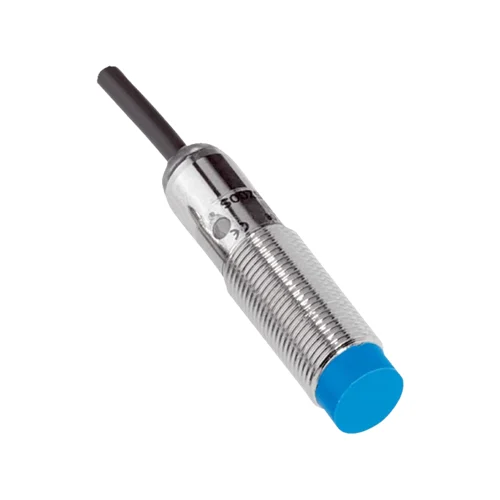
1. Confirming a seated metal component in an assembly fixture
An assembly fixture can present a seated metal component to the non-flush sensing face and read the PNP normally-open state after the part settles. The M12 threaded housing and three-wire cable support installation at the reference point. Setup considers the 6.48 mm assured range, the actual target metal and the documented clearance diagram when positioning the sensor.
Problem Solved
A seated-target reference helps external inspection logic distinguish a presented metal component from an empty fixture location, supporting the next step of the assembly sequence.
Assembly presence
Non-flush M12
PNP output
2. Counting separated metal tabs on a moving guide
A moving guide can carry separated metal tabs across the sensing face and deliver PNP transitions to an external counter. The 2,000 Hz switching rating supports repeated events when tab width, spacing, gap and transit speed provide distinct output intervals. Target-material reduction factors and the non-flush installation clearances guide setup for the actual moving hardware.
Problem Solved
Inductive transitions provide external counting logic with tab-passage events, helping track repeated metal features without mechanical contact between the sensing face and the moving guide.
Tab counting
2,000 Hz
Inductive transitions
3. Recording repeated actuator arrivals with a metal flag
A machine actuator can bring a metal flag to a fixed end-position reference on each cycle. The PNP output supplies the arrival state to external timing logic, which records the interval between commanded motion and detected arrival. The 44 mm housing length supports mechanical planning, while the documented reproducibility conditions inform evaluation of the installed target gap.
Problem Solved
Repeated flag detection gives external timing logic a consistent position event for comparing actuator cycles, helping identify changes in arrival timing within the machine sequence.
Cycle timing
Metal flag
PNP position event