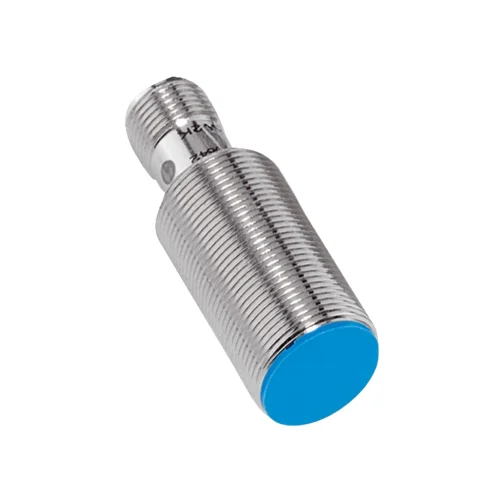
SICK 1040937 IME18-05BPOZC0K PNP NC Inductive Proximity Sensor

USD 27.30

IME18-05BPOZC0K offers 5 mm nominal sensing, flush M18 mounting, PNP normally-closed output, 1,000 Hz operation and an M12 four-pin connector.

SKU SICK-1040937 Category
SICK IME

SICK IME18-05BPOZC0K PNP NC Inductive Proximity Sensor

BrandSICK
Model IdentifierIME18-05BPOZC0K
Official Part Number1040937

Technical Overview

The SICK IME18-05BPOZC0K is a short-body M18 × 1 inductive proximity sensor for flush installation. Nominal sensing range is 5 mm and assured range is 4.05 mm, with reference reduction factors for different target metals. Its PNP normally-closed output switches at 1,000 Hz through a DC three-wire circuit using an M12 four-pin male connector; the NC signal is on pin 2 and pin 4 is unconnected. The 10–30 V DC sensor provides short-circuit and power-up pulse protection. Nickel-plated brass construction, a PA 66 sensing face and IP67 protection support machine mounting, with two metal fastening nuts supplied. Operating temperature spans −25 to +75 °C.

Flush M18 inductive sensor with 5 mm nominal range, PNP normally-closed output on M12 pin 2, 1,000 Hz switching and IP67 protection.

Key Features

  • Short-body M18 × 1 inductive sensor for flush installation
  • 5 mm nominal and 4.05 mm assured sensing range
  • PNP normally-closed output; DC three-wire circuit; 1,000 Hz switching
  • M12 four-pin male connector; pin 2=NC output, pin 4=not connected
  • 10–30 V DC; continuous output current ≤200 mA; no-load current ≤10 mA
  • ≤2 V drop at maximum output current; availability delay ≤100 ms
  • Short-circuit and power-up pulse protection
  • Nickel-plated brass housing, PA 66 sensing face and IP67 protection
  • 50 mm housing length, 33 mm thread; two 24 mm-across-flats metal nuts
  • Operation −25 to +75 °C; maximum tightening torque ≤40 Nm

Sense a nearby metal target through a flush M18 face and provide a PNP normally-closed signal on pin 2 of the M12 connector.

Technical Specification Matrix

ParameterValue
Functional principleInductive proximity sensing
Housing designMetric short-body; M18 × 1 thread
InstallationFlush
Nominal sensing range Sn5 mm
Assured sensing range Sa4.05 mm
Switching frequency1,000 Hz
Switching outputPNP
Output functionNormally closed; DC three-wire
ConnectionM12 four-pin male connector
Pin assignmentCD-008: 1 BN=L+; 2 WH=NC output; 3 BU=M; 4 BK=not connected
Power supply10–30 V DC
Ripple≤10%
Voltage drop≤2 V at maximum output current
Continuous output current≤200 mA
No-load current≤10 mA
Availability delay≤100 ms
Hysteresis5–15%
Reproducibility≤2% of Sr at constant supply voltage and ambient temperature
Temperature drift±10% of Sr
Short-circuit protectionYes
Power-up pulse protectionYes
Housing materialNickel-plated brass
Sensing face materialPA 66
Housing length50 mm
Thread length33 mm
Maximum tightening torque≤40 Nm
Items suppliedTwo nickel-plated brass mounting nuts; 24 mm across flats
IP ratingIP67; EN 60529
Operating temperature−25 to +75 °C
Shock resistance30 g, 11 ms
Vibration resistance10–55 Hz, 1 mm
EMCEN 60947-5-2
UL fileNRKH.E181493
MTTFD1,735 years
DCavg0%
Material reduction factorsReference values may vary: St37 steel 1; stainless steel V2A/304 approximately 0.8; aluminum approximately 0.45; copper approximately 0.4; brass approximately 0.4
Installation clearancesManufacturer flush-installation diagram: B=18 mm; C=18 mm; D=15 mm; F=40 mm

Industrial Applications

1. Confirming the seated position of a metal clamp

A machining fixture can present a metal clamp target to the flush sensing face at a repeatable seated gap. The PNP normally-closed output changes state as the target enters the inductive field. External sequencing evaluates that polarity after the clamp settles, using the nominal and assured sensing ranges and the relevant material reduction factor to establish the installed target gap.

Problem Solved

A contactless metal-target condition gives external fixture sequencing a clamp-position reference, helping distinguish the seated target from the open position without mechanical contact at the sensing face.

Clamp position PNP normally closed Flush installation

2. Counting separated metal lugs on a feed mechanism

A feed mechanism can move separated steel lugs past the sensor at a controlled gap. Each entry and exit changes the PNP normally-closed state for an external counter. The 1,000 Hz switching rating and documented hysteresis inform the event timing, while commissioning includes lug width, spacing, movement speed, target material and the controller sampling interval.

Problem Solved

Repeated inductive transitions give external counting logic a metal-lug passage event, helping track mechanical feed cycles at a fixed observation point without contacting the moving targets.

Metal-lug count 1,000 Hz External counter

3. Monitoring repeated return timing of a metal carriage

A machine can mount the sensor flush beside a metal carriage return position and timestamp the normally-closed transitions in its controller. External monitoring compares successive return intervals with the expected process timing and identifies a delayed or absent return. Stable mounting and the specified reproducibility under constant supply and ambient temperature support a consistent observation point.

Problem Solved

Repeated metal-target position events provide external monitoring with a return-time reference, helping identify a carriage movement that falls outside the established process interval.

Return timing Position events Reproducibility

Select your currency