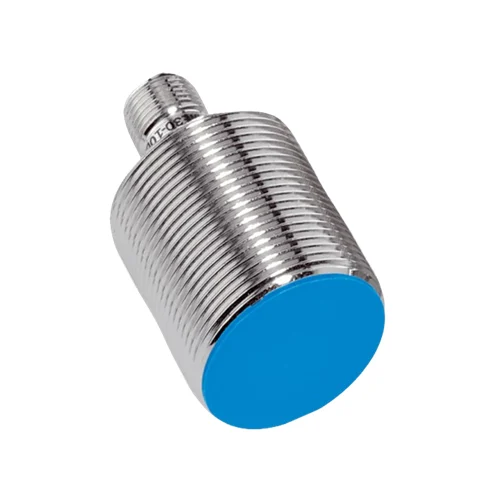
1. Confirming a metal clamp at its seated position
A fixture can present a metal clamp target to the sensor when the clamp reaches its seated position. External sequencing interprets the normally-closed PNP state as the target enters the observation zone. Mechanical setup uses the 20 mm nominal and 16.2 mm assured ranges with the actual metal reduction factor, and retains the documented quasi-flush protrusion and surrounding clearances.
Problem Solved
An inductive seated-position condition gives external sequencing evidence that the metal target has reached the intended fixture location, helping coordinate the next assembly operation.
Clamp position
20 mm nominal
Quasi-flush
2. Counting separated metal flags on a moving mechanism
A moving mechanism can pass separated metal flags across the sensing face and send normally-closed PNP transitions to an external counter. The 200 Hz rating supplies the switching-frequency basis for choosing flag spacing and movement speed. Setup verifies the actual flag material, sensing gap and controller input behavior, then enables counting after the specified warm-up period.
Problem Solved
Repeated inductive transitions give external counting logic metal-feature passage events, helping track mechanism cycles or feed movement without mechanically contacting the moving flags.
Metal-feature count
200 Hz
PNP NC
3. Checking that a metal carrier clears a transfer stop
A transfer stop can bring a defined metal carrier feature into the inductive observation zone. External sequencing checks the NC output before release and after the movement command, interpreting the change as target departure. A carrier that remains at the stop holds the detected target condition, allowing external timing logic to identify an uncleared transfer position.
Problem Solved
A before-and-after metal-presence check gives external transfer logic evidence of departure, helping identify a retained carrier before another carrier reaches the same stop.
Carrier departure
Metal presence
NC state