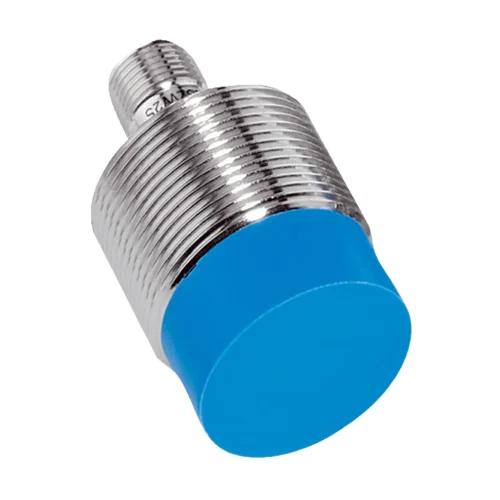
SICK 1041053 IME30-20NNSZC0K 20 mm NPN Inductive Sensor

USD 36.14

IME30-20NNSZC0K offers non-flush M30 mounting, 20 mm nominal and 16.2 mm assured range, NPN normally-open output, 500 Hz switching and M12 connection.

SKU SICK-1041053 Category
SICK IME

SICK IME30-20NNSZC0K 20 mm NPN Inductive Sensor

BrandSICK
Model IdentifierIME30-20NNSZC0K
Official Part Number1041053

Technical Overview

The SICK IME30-20NNSZC0K is a short-body M30 × 1.5 inductive proximity sensor for non-flush installation. It detects metal targets with a 20 mm nominal sensing range and 16.2 mm assured range; reference reduction factors account for different target metals. The NPN normally-open output supports 500 Hz switching and continuous current up to 200 mA. An M12 four-pin male connector connects the three-wire DC circuit to a 10–30 V supply. Nickel-plated brass housing and a PA 66 sensing face provide IP67 protection, with operation from −25 to +75 °C. Two nickel-plated brass mounting nuts are supplied, and the 52 mm housing has a 22 mm threaded section.

Non-flush M30 inductive sensor with 20 mm nominal range, NPN normally-open output, 500 Hz switching and M12 four-pin male connector.

Key Features

  • IME30-20NNSZC0K / 1041053: short-body inductive proximity sensor
  • M30 × 1.5 threaded housing; non-flush installation
  • 20 mm nominal sensing range; 16.2 mm assured sensing range
  • NPN normally-open output; DC three-wire circuit
  • 500 Hz switching; continuous current ≤200 mA
  • 10–30 V DC; no-load current ≤10 mA; availability delay ≤125 ms
  • M12 four-pin male connector; output on pin 4, pin 2 not connected
  • Short-circuit and power-up pulse protection
  • Nickel-plated brass housing, PA 66 sensing face and two 36 mm-across-flats mounting nuts
  • IP67; −25 to +75 °C operation; 52 mm housing and 22 mm thread

Provide a contactless metal-target switching condition to external machine logic using a 20 mm nominal inductive range and non-flush M30 mounting.

Technical Specification Matrix

ParameterValue
Functional principleInductive proximity sensing of metal targets
Housing designShort-body
Mounting threadM30 × 1.5; diameter 30 mm
InstallationNon-flush
Nominal sensing range Sn20 mm
Assured sensing range Sa16.2 mm
Switching frequency500 Hz
Switching outputNPN normally open (NO)
Electrical wiringDC three-wire
ConnectionM12 four-pin male connector
Wire or pin assignmentCD-007: 1 BN=L+; 4 BK=NO output; 2=not connected; 3 BU=M
Power supply10–30 V DC
Ripple≤10%
Voltage drop≤2 V at maximum continuous current Ia
Availability delay≤125 ms
Continuous current Ia≤200 mA
No-load current≤10 mA
Hysteresis5–15%
Reproducibility≤2% of Sr at constant supply voltage UB and ambient temperature Ta
Temperature drift±10% of Sr
Protection functionsShort-circuit protection; power-up pulse protection
Housing materialNickel-plated brass
Sensing face materialPA 66 plastic
IP ratingIP67 to EN 60529
Housing length52 mm
Thread length22 mm
Mounting nuts suppliedTwo nickel-plated brass nuts; 36 mm across flats
Maximum tightening torque≤100 Nm
IndicationDisplay LED
Operating temperature−25 to +75 °C
Shock resistance30 g, 11 ms
Vibration resistance10–55 Hz, 1 mm
EMCEN 60947-5-2
UL fileNRKH.E181493
MTTFD1,735 years
DCavg0%
Material reduction factorsReference values which may vary: St37 steel 1; V2A/304 stainless steel approximately 0.8; aluminum approximately 0.45; copper approximately 0.4; brass approximately 0.4
Installation diagram clearancesManufacturer non-flush installation diagram: A=30 mm; B=60 mm; C=30 mm; D=60 mm; E=40 mm; F=160 mm

Industrial Applications

1. Confirming a metal clamp at its seated position

An assembly fixture can bring a metal clamp target into a repeatable gap at the sensing face after closing. The NPN normally-open signal gives external sequencing logic a clamp-position reference. Non-flush mounting accommodates the selected sensing arrangement, with commissioning accounting for the 20 mm nominal range, 16.2 mm assured range, actual target material and surrounding-metal clearances.

Problem Solved

A contactless clamp-position condition helps external sequencing logic distinguish the expected metal target from an open clamp location before advancing the machine sequence.

Clamp position NPN normally open Non-flush M30

2. Counting separated metal features on a moving carrier

A conveyor carrier can present separated metal features past the inductive sensing face. Each entry and departure changes the NPN normally-open condition for an external counter. Setup checks feature spacing and motion against the 500 Hz switching rating, and establishes a working gap appropriate to the target material, assured range and documented non-flush installation clearances.

Problem Solved

Separated metal-target transitions provide external counting logic with passage events, helping track carrier features without physical contact between the sensor and moving target.

Metal-feature counting 500 Hz Contactless detection

3. Detecting a carrier that remains at a transfer stop

A transfer station can position a metal carrier target opposite the sensor when the carrier reaches its stop. External timing logic measures how long the normally-open detection condition remains asserted and compares it with the expected transfer sequence. The installed gap and surrounding-metal clearances follow the documented non-flush arrangement, with material reduction factors considered during commissioning.

Problem Solved

A maintained metal-target condition gives external timing logic an occupancy reference, helping distinguish a normal transfer stop from a carrier that remains beyond its expected interval.

Transfer dwell External timer Metal occupancy

Select your currency